
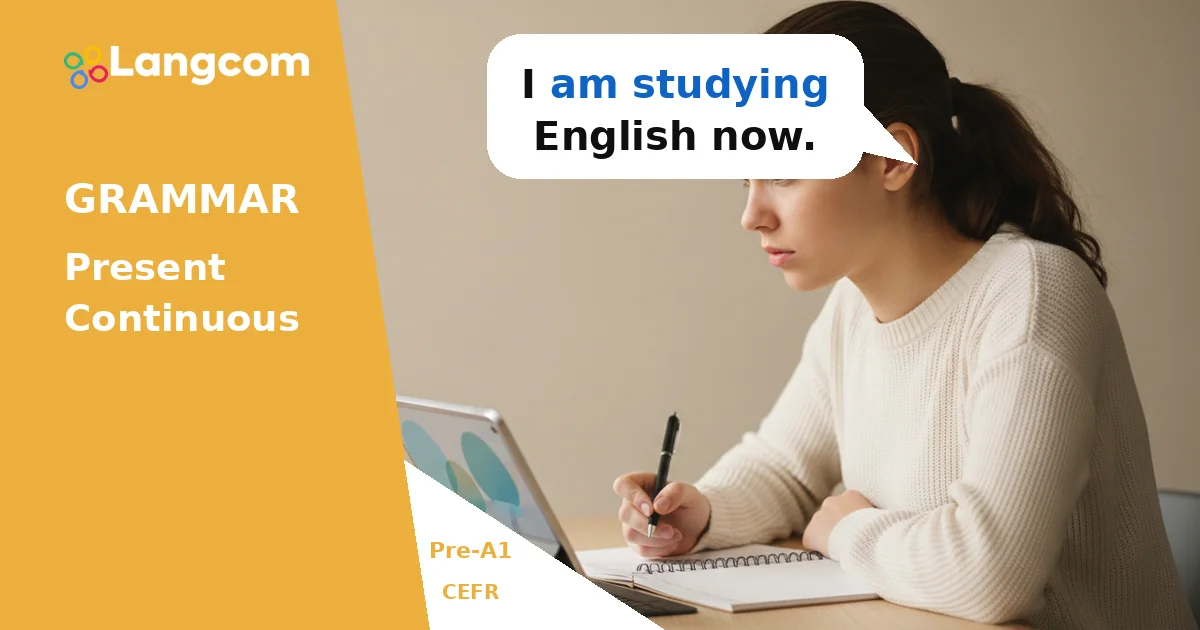

The present continuous helps us talk about actions that are happening at this exact moment, right now. It is very useful for describing what you see or what people are doing in a picture, or what you are doing as you speak. To form it, you need a form of the verb to be (am, is, ou are) and the -ing form of the main verb. For example, I am reading means you are reading at this moment. To make it negative, you simply add not after am, is, ou are, como She is not sleeping. This grammar point is fundamental for describing ongoing activities in English.
What is the Present Continuous?
We use the present continuous to talk about actions that are happening now, at this moment, ou today.
- It describes something in progress.
- It is not for habits or general truths.
🎓 Aprenda inglês com o método misto
Grupos pequenos · Tutor de IA 24 horas por dia, 7 dias por semana · Preparação para os exames de Cambridge
Planos de $39 $79 por mês
How Do We Form the Present Continuous (Affirmative)?
To make a present continuous sentence, we use two parts:
- O verbo to be (am, is, ou are).
- The main verb with -ing at the end.
The pattern is: Subject + am/is/are + verb-ing.
Making Sentences Negative with the Present Continuous
To say that an action is NOT happening now, we add not after am, is, ou are.
- The pattern is: Subject + am/is/are + not + verb-ing.
- You can use contractions: isn't (is not) and aren't (are not).
- Para I am not, we usually say I'm not.
Spelling Rules for -ing Verbs
Most verbs just add -ing. But some verbs have special spelling rules:
- Verbs ending in -e: Remove the -e, then add -ing.
Exemplo: make → making, write → writing - Verbs ending in consonant + vowel + consonant: Double the last consonant, then add -ing. This is common for short verbs.
Exemplo: run → running, sit → sitting
| Subject | Affirmative Form | Negative Form |
|---|---|---|
| I | am + verb-ing | am not + verb-ing |
| He / She / It | is + verb-ing | is not (isn't) + verb-ing |
| You / We / They | are + verb-ing | are not (aren't) + verb-ing |
Exemplos
- I am studying English now.
- She is watching TV at the moment.
- They are playing football outside.
- He is not sleeping.
- We are not eating dinner yet.
- The dog isn't barking.
Prática
💬 Precisa de orientação personalizada?
Como Centro Autorizado de Preparação para os Exames de Cambridge, podemos orientá-lo na escolha do curso e da certificação mais adequados. Entre em contato com nossos orientadores hoje mesmo.
Converse com um consultor pelo WhatsAppErros comuns entre falantes de espanhol
Os falantes de espanhol às vezes cometem estes erros:
- Forgetting 'to be': In Spanish, you might say 'Yo comiendo' (I eating). In English, you MUST use am, is, ou are.
Incorreto: She reading a book.
Correto: She is reading a book. - Using Simple Present for 'now' actions: In Spanish, 'como ahora' (I eat now) is common. In English, use the present continuous for actions happening at this moment.
Incorreto: I eat breakfast now.
Correto: I am eating breakfast now.
Perguntas frequentes
What does 'continuous' mean?
In grammar, 'continuous' means an action is ongoing or in progress. It is not finished.
Can I use the present continuous for future plans?
At Pre-A1 level, focus on using the present continuous only for actions happening now. Later, you will learn it can also be used for future plans.
Why do some verbs double their last letter before -ing?
This happens with short verbs that end in a consonant-vowel-consonant pattern (like run, sit). We double the last consonant to keep the short vowel sound clear when adding -ing.



0 Comentários