

What are ‘Some’ and ‘Any’?
Some e any are quantifiers. They tell us about an unknown or unspecified amount or number of something.
We use them with both countable nouns (things we can count, like books) and uncountable nouns (things we cannot count, like sugar).
✍️ Não sabe em que nível você está?
Faça nosso teste de nivelamento gratuito e receba um feedback personalizado de examinadores certificados pela Cambridge.
Faça nosso teste de nivelamento GRATUITOWhen Do We Use 'Some'?
Utilizamos some mainly in affirmative (positive) sentences.
- With countable nouns: I have some friends.
- With uncountable nouns: She needs some water.
Também utilizamos some in questions when we are offering something or making a request.
- For offers: Would you like some tea? (We expect the answer 'yes'.)
- For requests: Can I have some help? (We expect help.)
When Do We Use 'Any'?
Utilizamos any mainly in negative sentences and most questions.
- In negative sentences (with not): I don't have any brothers.
- In questions: Do you have any questions?
Sometimes, any can also be used in affirmative sentences when it means 'it doesn't matter which'.
- You can choose any book you like.
| <span data-no-translation>Some</span> | <span data-no-translation>Any</span> | |
|---|---|---|
| Affirmative Sentences | Yes (I have some ideas.) | No (unless it means 'it doesn't matter which') |
| Negative Sentences | No | Yes (I don't have any ideas.) |
| Questions (General) | No | Yes (Do you have any ideas?) |
| Questions (Offers/Requests) | Yes (Would you like some coffee?) | No |
Exemplos
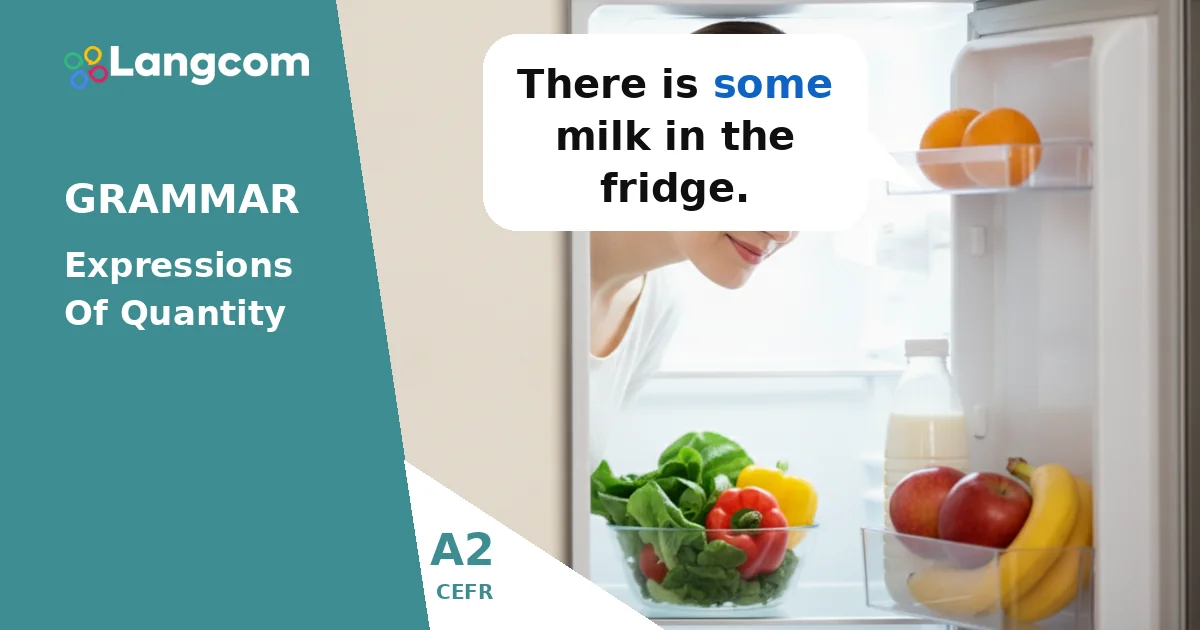
- There is some milk in the fridge.
- I bought some new clothes yesterday.
- Would you like some cake?
- Can I borrow some money?
- I don't have any pets.
- She didn't eat any food.
- Is there any sugar left?
- Do you have any plans for the weekend?
Prática
Pronto para receber seu certificado?
O curso Langcom prepara os alunos para os exames de Cambridge, IELTS, TOEFL, DELE, SIELE e Michigan.
Comece a usar o LangcomErros comuns entre falantes de espanhol
Os falantes de espanhol às vezes cometem erros com some e any because of differences in sentence structure.
- Usando some in negative sentences:
Incorrect: I don't have some money.
Correct: I don't have any money. - Usando any in affirmative sentences (unless it means 'it doesn't matter which'):
Incorrect: I have any friends.
Correct: I have some friends. - Double negatives: In Spanish, double negatives are common. In English, we usually avoid them.
Incorrect: I don't have no money.
Correct: I don't have any money. (Or I have no money.)
Perguntas frequentes
Can I use 'some' with countable nouns?
Sim, você pode usar some with both countable nouns (e.g., some apples) and uncountable nouns (e.g., some water) in affirmative sentences.
When do I use 'some' in a question?
You use some in questions when you are offering something (Would you like some coffee?) or making a request (Can I have some bread?). You expect a positive answer.
Is 'any' always used in questions?
Mostly, yes. Any is used in general questions where you don't know the answer (Do you have any siblings?). Remember the exceptions for offers and requests with some.
How important are 'some' and 'any' for the A2 Key exam?
Understanding some e any is very important for the A2 Key exam. You will need to use them correctly in writing tasks and speaking parts to show your ability to talk about quantities clearly.

0 Comentários