

What is the Passive Voice?
In most sentences, the subject performs the action. This is called the active voice. For example, John writes letters. Here, ‘John’ is the subject and he performs the action ‘writes’.
In the passive voice, the subject receives the action. The focus moves from the person doing the action to the action itself or the object that is affected. For example, Letters are written by John. Now, ‘Letters’ is the subject, and they receive the action ‘are written’.
🎓 Aprenda inglês com o método misto
Grupos pequenos · Tutor de IA 24 horas por dia, 7 dias por semana · Preparação para os exames de Cambridge
Planos de $39 $79 por mês
How Do We Form the Passive Voice?
The general rule for forming the passive voice is always the same:
- The verb 'to be' + the past participle
The form of the verb 'to be' changes depending on the tense (present simple, past simple, etc.) and the subject (singular or plural).
- For Present Simple Passive: Utilizamos am, is, ou are.
- For Past Simple Passive: Utilizamos was ou were.
The past participle is the third form of a verb (e.g., written, broken, made). For regular verbs, it ends in -ed (e.g., cleaned, painted).
When Do We Use the Passive Voice?
We choose the passive voice for several reasons:
- When the agent (the person or thing doing the action) is unknown or unimportant. Por exemplo, My wallet was stolen. (We don't know who stole it.)
- When we want to focus on the action or the object, not the agent. Por exemplo, The new bridge was opened yesterday. (The opening is more important than who opened it.)
- In formal writing, news reports, or scientific descriptions. It makes the text sound more objective. For example, Research is conducted annually.
- When the agent is obvious. Por exemplo, The criminal was arrested. (It's obvious the police arrested him.)
If we need to mention the agent, we use the preposition by. Por exemplo, The book was written by a famous author.
Passive Voice in Present Simple
We use the present simple passive for actions that happen regularly, generally, or are facts.
- Structure: subject + am/is/are + past participle
Look at these examples:
- English is spoken in many countries. (Fact)
- These cars are made in Japan. (General truth)
- The mail is delivered every morning. (Regular action)
To make negative sentences, we add not after am/is/are:
- Coffee isn't grown in England.
To make questions, we put am/is/are before the subject:
- Is dinner served at 7 PM?
Passive Voice in Past Simple
We use the past simple passive for actions that happened at a specific time in the past.
- Structure: subject + was/were + past participle
Consider these examples:
- The Mona Lisa was painted by Leonardo da Vinci. (Specific past event)
- My phone was stolen last night. (Specific past event)
- The new stadium was built in 2020. (Specific past event)
To make negative sentences, we add not after was/were:
- The documents weren't signed yesterday.
To make questions, we put was/were before the subject:
- Was the package delivered?
| Tense | Structure | Exemplo |
|---|---|---|
| Present Simple Passive | subject + am/is/are + past participle | The letters are delivered daily. |
| Past Simple Passive | subject + was/were + past participle | The letter was delivered yesterday. |
Exemplos
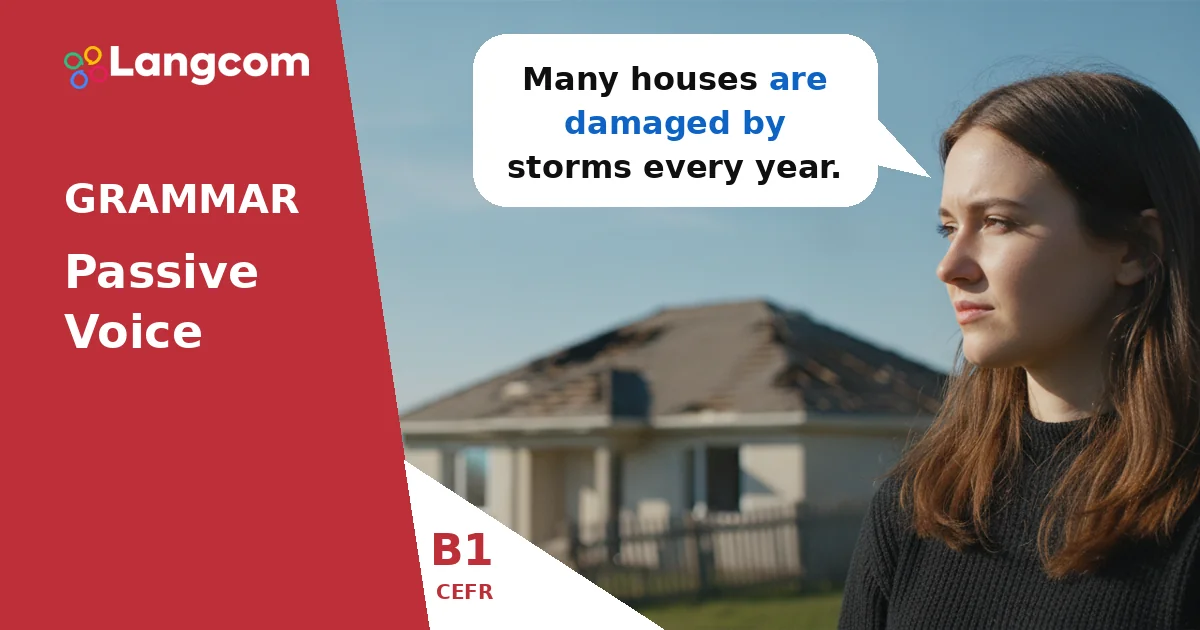
- Many houses are damaged by storms every year.
- The new hospital was opened by the mayor.
- These shoes are made of recycled materials.
- The email was sent an hour ago.
- Is this song played on the radio often?
- The decision wasn't made by me.
- Thousands of trees are planted annually.
- The ancient city was discovered by archaeologists.
Prática
✍️ Não sabe em que nível você está?
Faça nosso teste de nivelamento gratuito e receba um feedback personalizado de examinadores certificados pela Cambridge.
Faça nosso teste de nivelamento GRATUITOErros comuns entre falantes de espanhol
Spanish speakers sometimes make specific errors when using the passive voice:
- Using 'ser' directly instead of 'be': In Spanish, you might say 'es hecho'. In English, you must use the verb to be in the correct tense. For example, don't say The car is repaired (meaning 'it is in a state of being repaired'), but rather The car is repaired (meaning 'it receives the action of being repaired'). The key is the be verb.
- Incorrect past participle: Always remember to use the third form of the verb. For example, not The letter was write, but The letter was written.
- Overusing 'by': Only use by when it's important to say who or what did the action. If it's unknown or obvious, leave it out. For example, My car was stolen is better than My car was stolen by someone.
- Confusion with 'get' passive: While get can sometimes be used for passive actions (e.g., I got paid), it's more informal. For B1, focus on be + past participle for standard passive voice.
Perguntas frequentes
What is the main difference between active and passive voice?
In the active voice, the subject performs the action (e.g., The dog chased the cat.). In the passive voice, the subject receives the action (e.g., The cat was chased by the dog.).
When should I use 'by' in the passive voice?
You should use by when it is important to mention the person or thing that performs the action (the agent). For example, This song was written by a famous musician. If the agent is unknown, unimportant, or obvious, you can omit by.
Is the passive voice more formal?
Yes, the passive voice is often used in more formal contexts, such as academic writing, news reports, and official documents. It can make writing sound more objective and less personal.
Can I use the passive voice for questions?
Yes, you can form questions in the passive voice. You simply put the correct form of be (e.g., is, was) before the subject. For example, Is the report finished? ou Were the keys found?
How does the passive voice help me in exams?
Understanding the passive voice is crucial for B1 exams. It allows you to understand complex sentences in reading tasks and to write more varied and sophisticated sentences in writing tasks, especially when describing processes or events where the agent is not the main focus.



0 Comentários