

What are Possessive Adjectives and Possessive Pronouns?
Possessive adjectives and possessive pronouns both show who owns something. They are similar but work in different ways.
- Possessive Adjectives always come before a noun. They describe the noun.
Examples:
- This is my car.
- Is that your phone?
- She lives with her parents.
- Possessive Pronouns stand alone. They replace a possessive adjective + a noun. This helps us avoid repeating words.
Examples:
- This car is mine. (Instead of ‘my car’)
- Is that phone yours? (Instead of ‘your phone’)
- That house is theirs. (Instead of ‘their house’)
Remember, the possessive adjective its does not have a possessive pronoun form.
🎓 Aprenda inglês com o método misto
Grupos pequenos · Tutor de IA 24 horas por dia, 7 dias por semana · Preparação para os exames de Cambridge
Planos de $39 $79 por mês
How Do We Use the Possessive 's?
We use the apostrophe 's to show that a person or animal owns something. It is very common in English.
- For singular nouns and names: Add 's to the end of the word.
Examples:
- This is Maria's book. (The book belongs to Maria.)
- That is the dog's toy. (The toy belongs to the dog.)
- For plural nouns ending in -s: Just add an apostrophe ' after the -s.
Examples:
- These are the students' desks. (The desks belong to the students.)
- My parents' car is new. (The car belongs to my parents.)
Be careful! 's can also be a short form for is ou has. The meaning depends on the sentence.
- He's a doctor. (He is a doctor.)
- She's got a new phone. (She has got a new phone.)
How Do We Ask About Possession?
To ask who something belongs to, we use the word Whose.
- You can use Whose before a noun.
Examples:
- Whose jacket is this?
- Whose keys are those?
- Você também pode usar Whose alone, after the verb.
Examples:
- Whose is this jacket?
- Whose are those keys?
| Subject | Possessive Adjective | Possessive Pronoun |
|---|---|---|
| I | my | mine |
| You | your | yours |
| He | his | his |
| She | her | hers |
| It | its | - |
| We | our | ours |
| They | their | theirs |
Exemplos
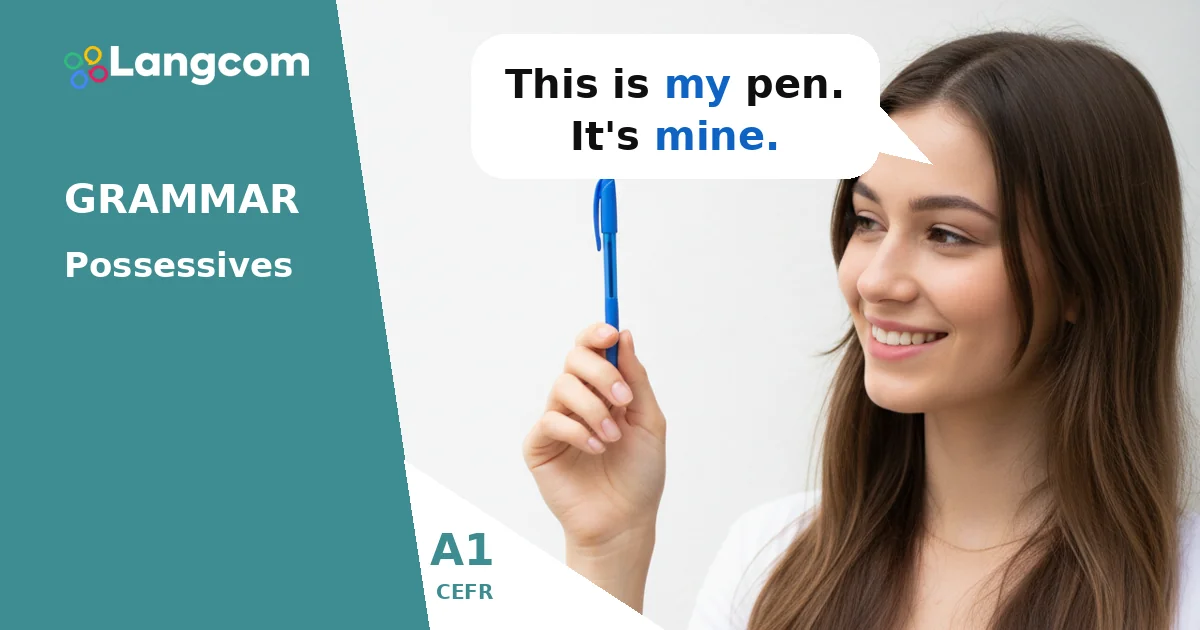
- This is my pen. It's mine.
- That is your bag. Is it yours?
- He has a new phone. It's his.
- She loves her cat. The cat is hers.
- We live in our house. The house is ours.
- They found their dog. The dog is theirs.
- This is my brother's room.
- The children's toys are everywhere.
- Whose car is parked outside?
Prática
💬 Precisa de orientação personalizada?
Como Centro Autorizado de Preparação para os Exames de Cambridge, podemos orientá-lo na escolha do curso e da certificação mais adequados. Entre em contato com nossos orientadores hoje mesmo.
Converse com um consultor pelo WhatsAppErros comuns entre falantes de espanhol
Many Spanish speakers sometimes make these mistakes:
- Using a possessive adjective without a noun: In Spanish, you can often use a possessive word alone (e.g., 'es mío'). In English, possessive adjectives always need a noun after them. You must use a possessive pronoun instead.
- Errado: This book is my.
- Correto: This book is mine.
- Errado: That is your.
- Correto: That is yours.
- Confuso it's e its:
- It's means it is ou it has. Example: It's a beautiful day.
- Its is a possessive adjective. Example: The dog wagged its tail.
Perguntas frequentes
What is the difference between 'my' and 'mine'?
My is a possessive adjective. It always comes before a noun, like in my book. Mine is a possessive pronoun. It replaces 'my + noun', so it stands alone, like in This book is mine.
When do I use 's and when do I use ' for possession?
You use 's for singular nouns and names (e.g., John's car, the cat's toy). You use just ' (the apostrophe after the -s) for plural nouns that already end in -s (e.g., the students' books, my parents' house).
Does 'its' have a possessive pronoun form?
No, its is only a possessive adjective (e.g., The tree lost its leaves.). There is no possessive pronoun form for it.
Can I use 'whose' to ask about people and things?
Sim, você pode usar Whose to ask about possession for both people and things. For example, Whose jacket is this? (for a person) or Whose car is that? (for a thing).



0 Comentários