

What Are Adjectives?
Adjectives are special words. They give us more information about nouns.
Nouns are words for people, places, or things. Adjectives tell us how these nouns look, feel, or are.
How Do We Use Adjectives in English?
In English, adjectives usually go before the noun they describe. This is a very important rule.
- We say “a big house,” 違う “a house big.”
- We say “a beautiful flat,” 違う “a flat beautiful.”
Common Adjectives for Describing Places
Here are some useful adjectives to describe homes, cities, and other places:
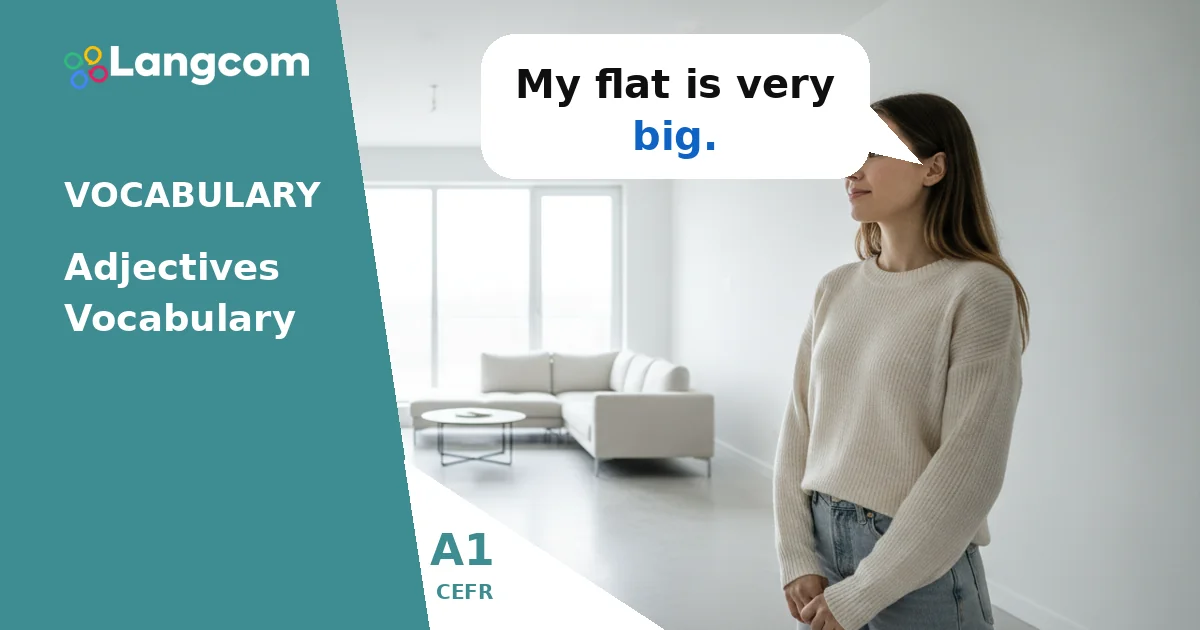
- Big: This means large in size. My flat is big.
- Small: This means not large in size. It is the opposite of big. His house is small.
- New: This means recently made or bought. It is not old. It's a new building.
- Old: This means not new; it has existed for a long time. It is the opposite of new. This is an old town.
- Beautiful: This means very pleasing to the senses or mind. What a beautiful park!
- Nice: This means pleasant, agreeable, or good. It's a nice day today.
Can I Use More Than One Adjective?
Yes, you can use more than one adjective to describe a noun. You often put a comma between them.
If you use and, it usually comes before the last adjective in a list.
| 形容詞 | 意味 | 例 |
|---|---|---|
| Big | Large in size | It's a big city. |
| Small | Not large in size | I live in a small flat. |
| New | Recently made or bought | This is a new building. |
| Old | Not new; existed for a long time | My house is old. |
| Beautiful | Very pleasing to look at | What a beautiful view! |
| Nice | Pleasant or good | We have a nice garden. |
例
- My flat is very big.
- It's a small house.
- Her home is a new flat.
- This is an old village.
- It's a beautiful city.
- They live in a nice area.
- My flat is big, old, and beautiful.
練習
💬 個別のアドバイスが必要ですか?
当校はケンブリッジ試験の公認準備センターとして、皆様に最適なコースや資格取得への道をご案内いたします。ぜひ今すぐアドバイザーにご相談ください。.
WhatsAppでアドバイザーとチャットスペイン語話者がよく犯す間違い
Adjective Placement
A common mistake for Spanish speakers is putting the adjective after the noun. Remember, in English, the adjective comes 以前 the noun.
- 誤り: a house small
- 正しい: a small house
- 誤り: a flat beautiful
- 正しい: a beautiful flat
Adjective Agreement
In Spanish, adjectives change to match the noun's gender and number. In English, adjectives never change.
- 誤り: bigs houses (for plural) or bige house (for gender)
- 正しい: big houses
- 正しい: a big house
よくある質問
What is the main job of an adjective?
The main job of an adjective is to describe a noun. It tells us more about the noun, like its size, age, or how it looks. For example, big describes a house.
Where do adjectives usually go in an English sentence?
In English, adjectives usually come before the noun they describe. For instance, we say “a new car” 違う “a car new.”
Can I use more than one adjective for one noun?
Yes, you can use several adjectives to describe one noun. For example, you can say “a big, old, and beautiful house.” You often use commas between them.


コメント 0 件