

How Do We Make Negative Sentences in Present Simple?
To make a sentence negative in the Present Simple, we add a special word before the main verb. This word is don’t または doesn’t.
These are short forms:
- don’t is short for do not.
- doesn’t is short for does not.
The main verb in the sentence always stays in its base form. This means it does not change, even for he, she, it.
When Do We Use 'Don't'?
当社では don't when the subject of the sentence is:
- I
- You
- We
- They
- Or a plural noun (e.g., my friends, the students).
The structure is: Subject + don't + base form of the verb.
When Do We Use 'Doesn't'?
当社では doesn't when the subject of the sentence is:
- He
- She
- It
- Or a singular noun (e.g., my dad, the dog).
The structure is: Subject + doesn't + base form of the verb. Remember, the verb does not end in '-s' after doesn't.
| Subject | Negative Form | Main Verb |
|---|---|---|
| I | don't | work |
| You | don't | work |
| We | don't | work |
| They | don't | work |
| He | doesn't | work |
| She | doesn't | work |
| It | doesn't | work |
例
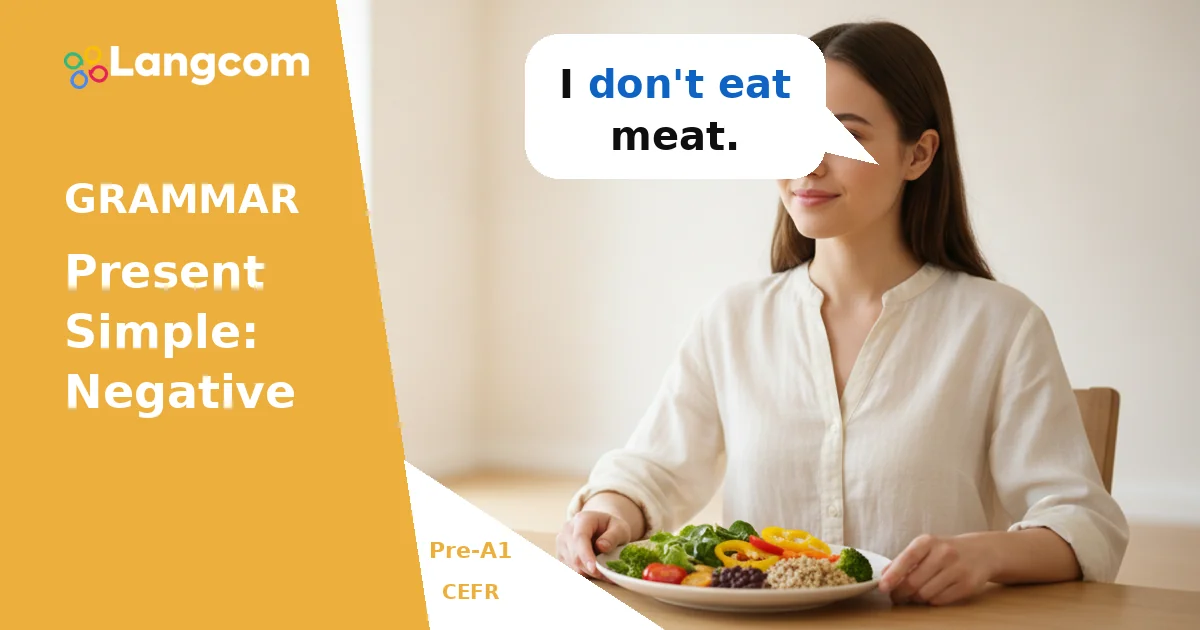
- I don't eat meat.
- You don't live in a big city.
- We don't watch TV in the morning.
- They don't play football on Tuesdays.
- He doesn't like pizza.
- She doesn't work on weekends.
- It doesn't rain much in summer here.
練習
💬 個別のアドバイスが必要ですか?
当校はケンブリッジ試験の公認準備センターとして、皆様に最適なコースや資格取得への道をご案内いたします。ぜひ今すぐアドバイザーにご相談ください。.
WhatsAppでアドバイザーとチャットスペイン語話者がよく犯す間違い
Spanish speakers often say I no like coffee. This is incorrect in English. You must use don't または doesn't. The correct way is I don't like coffee.
Another common mistake is adding '-s' to the verb after doesn't. 例えば、, She doesn't likes pizza is wrong. The correct form is She doesn't like pizza. The verb always stays in its base form after don't または doesn't.
よくある質問
What is the short form of do not and does not?
The short form of do not は don't. The short form of does not は doesn't.
Does the verb change after don't or doesn't?
No, the main verb always stays in its base form after don't または doesn't. 例えば、, He doesn't eat, ではなく He doesn't eats.
Can I use don't or doesn't for all verbs?
あなたは don't または doesn't for most action verbs in the Present Simple. For the verb to be (am, is, are), you make it negative differently (e.g., I am not, He is not).



コメント 0 件