
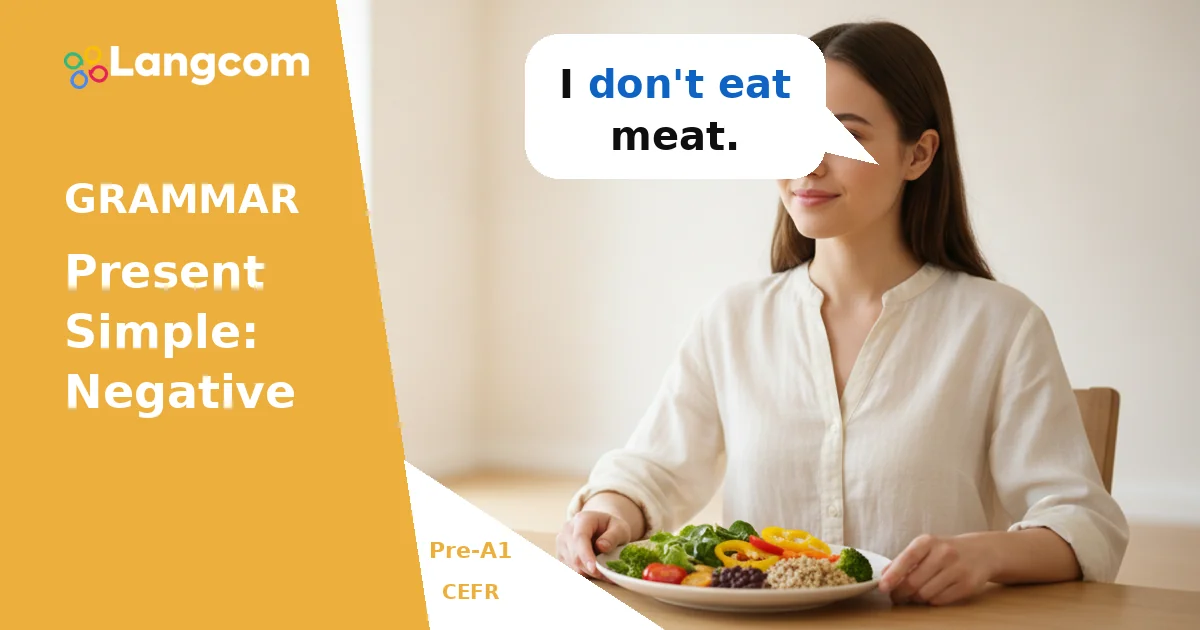

How Do We Make Negative Sentences in Present Simple?
To make a sentence negative in the Present Simple, we add a special word before the main verb. This word is don’t 或 doesn’t.
These are short forms:
- don’t is short for do not.
- doesn’t is short for does not.
The main verb in the sentence always stays in its base form. This means it does not change, even for he, she, it.
When Do We Use 'Don't'?
我们使用 don't when the subject of the sentence is:
- I
- You
- We
- They
- Or a plural noun (e.g., my friends, the students).
其结构如下: Subject + don't + base form of the verb.
When Do We Use 'Doesn't'?
我们使用 doesn't when the subject of the sentence is:
- He
- She
- It
- Or a singular noun (e.g., my dad, the dog).
其结构如下: Subject + doesn't + base form of the verb. Remember, the verb does not end in '-s' after doesn't.
| 主题 | 否定形式 | Main Verb |
|---|---|---|
| I | don't | work |
| You | don't | work |
| We | don't | work |
| They | don't | work |
| He | doesn't | work |
| She | doesn't | work |
| It | doesn't | work |
示例
- I don't eat meat.
- You don't live in a big city.
- We don't watch TV in the morning.
- They don't play football on Tuesdays.
- He doesn't like pizza.
- She doesn't work on weekends.
- It doesn't rain much in summer here.
练习
西班牙语母语者常犯的错误
Spanish speakers often say I no like coffee. This is incorrect in English. You must use don't 或 doesn't. The correct way is I don't like coffee.
Another common mistake is adding '-s' to the verb after doesn't. 例如,, She doesn't likes pizza is wrong. The correct form is She doesn't like pizza. The verb always stays in its base form after don't 或 doesn't.
常见问题
What is the short form of do not and does not?
The short form of do not 是 don't. The short form of does not 是 doesn't.
Does the verb change after don't or doesn't?
No, the main verb always stays in its base form after don't 或 doesn't. 例如,, He doesn't eat, 而不是 He doesn't eats.
Can I use don't or doesn't for all verbs?
You use don't 或 doesn't for most action verbs in the Present Simple. For the verb to be (am, is, are), you make it negative differently (e.g., I am not, He is not).


0 条评论