
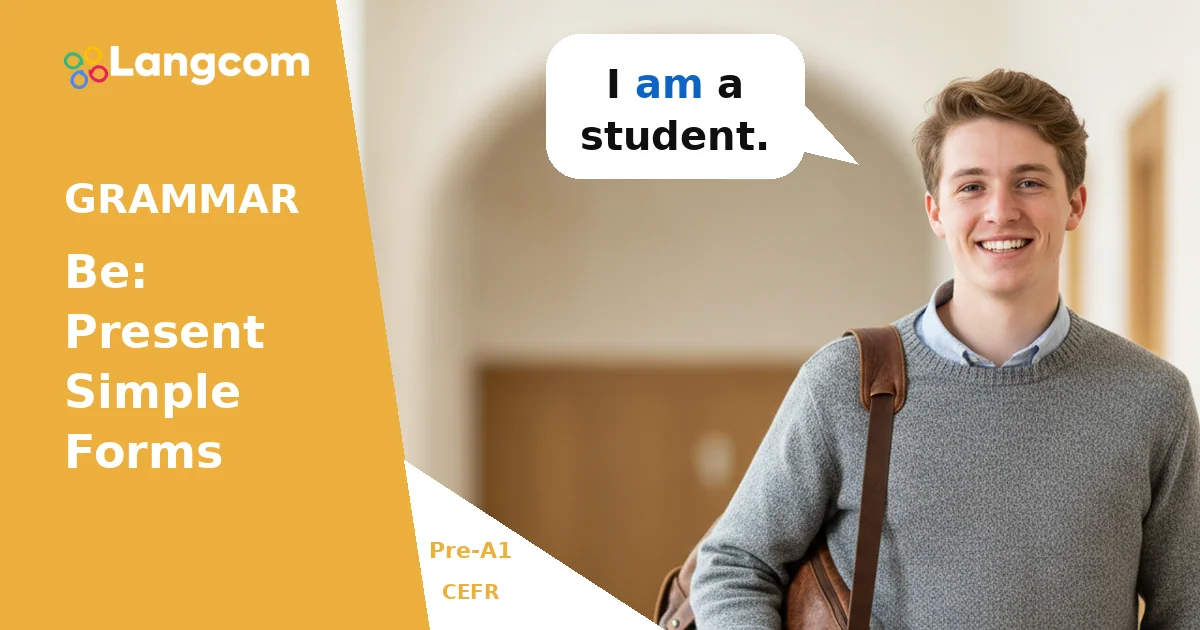

What is the Verb Be?
Il verbo be is very common in English. It helps you describe things and people. It also tells you where things are.
Pensate a be like “ser” and “estar” in Spanish. English uses only one verb for both ideas.
🎓 Impara l'inglese con il metodo misto
Piccoli gruppi · Tutor IA disponibile 24 ore su 24, 7 giorni su 7 · Preparazione agli esami di Cambridge
Piani da $39 $79 al mese
How Do We Use Be in Positive Sentences?
Il verbo be changes its form depending on the subject. There are three forms for the present simple:
- Utilizziamo am con I.
- Esempio: I am happy.
- Utilizziamo is con he, she, it, and singular nouns (one person, one thing).
- Esempio: He is a student.
- Esempio: It is cold.
- Utilizziamo are con you, we, they, and plural nouns (more than one person, more than one thing).
- Esempio: You are kind.
- Esempio: They are friends.
How Do We Use Be in Negative Sentences?
To make a sentence negative, we add not after the verb be.
- With I: am not
- Esempio: I am not sad.
- With he, she, it: is not
- Esempio: She is not from Spain.
- With you, we, they: are not
- Esempio: We are not tired.
What Are Contractions with Be?
In spoken English and informal writing, we often use contractions. Contractions are shorter forms of words.
- For positive sentences:
- I am becomes I'm (ad esempio, I'm a student.)
- He is becomes He's (ad esempio, He's tall.)
- She is becomes She's (ad esempio, She's my sister.)
- It is becomes It's (ad esempio, It's sunny.)
- You are becomes You're (ad esempio, You're welcome.)
- We are becomes We're (ad esempio, We're friends.)
- They are becomes They're (ad esempio, They're at home.)
- For negative sentences:
- I am not becomes I'm not (ad esempio, I'm not hungry.)
- He is not becomes He isn't oppure He's not (ad esempio, He isn't here. oppure He's not here.)
- She is not becomes She isn't oppure She's not
- It is not becomes It isn't oppure It's not
- You are not becomes You aren't oppure You're not (ad esempio, You aren't right. oppure You're not right.)
- We are not becomes We aren't oppure We're not
- They are not becomes They aren't oppure They're not
When Do We Use the Verb Be?
Utilizziamo be for many things. Here are some common uses:
- To talk about identity or names:
- I am Maria.
- He is a doctor.
- To talk about age:
- She is ten years old.
- They are 25.
- To talk about feelings or descriptions:
- We are happy.
- It is a big house.
- To talk about location:
- You are at home.
- The book is on the table.
| Oggetto | Positive Form | Negative Form | Positive Contraction | Negative Contraction |
|---|---|---|---|---|
| I | am | am not | I'm | I'm not |
| He / She / It | is | is not | He's / She's / It's | isn't / He's not / She's not / It's not |
| You / We / They | are | are not | You're / We're / They're | aren't / You're not / We're not / They're not |
Esempi
- I am a student.
- He is my brother.
- She is happy.
- It is a cat.
- You are tall.
- We are friends.
- They are in the park.
- I am not tired.
- He isn't here.
- They aren't sad.
Esercitazione
💬 Hai bisogno di una consulenza personalizzata?
In qualità di Centro autorizzato di preparazione agli esami Cambridge, possiamo aiutarti a scegliere il corso e la certificazione più adatti alle tue esigenze. Contatta oggi stesso i nostri consulenti.
Chatta con un consulente su WhatsAppErrori comuni per chi parla spagnolo
Spanish speakers sometimes make these mistakes with be:
- Utilizzo di have for age: In Spanish, you say "Tengo X años". In English, we use be.
- Sbagliato: I have 10 years.
- A destra: I am 10 years old.
- Forgetting the subject pronoun: In Spanish, you can often omit the subject (e.g., "Es feliz"). In English, you always need a subject.
- Sbagliato: Is happy.
- A destra: He is happy. oppure She is happy.
- Confuso ser e estar: Remember, English uses only be for both.
- Spanish: "Soy alto" (ser) and "Estoy cansado" (estar).
- English: I am tall. e I am tired.
Domande frequenti
What are the three present forms of be?
The three present forms are am, is, e are.
How do I make I am negative?
You add not: I am not oppure I'm not.
Can I use isn't and is not?
Yes, isn't is a contraction for is not. Both are correct, but isn't is more common in speaking.
When do I use is?
Si utilizza is with singular subjects like he, she, it, or one person/thing (e.g., The dog is big.).



0 Commenti