
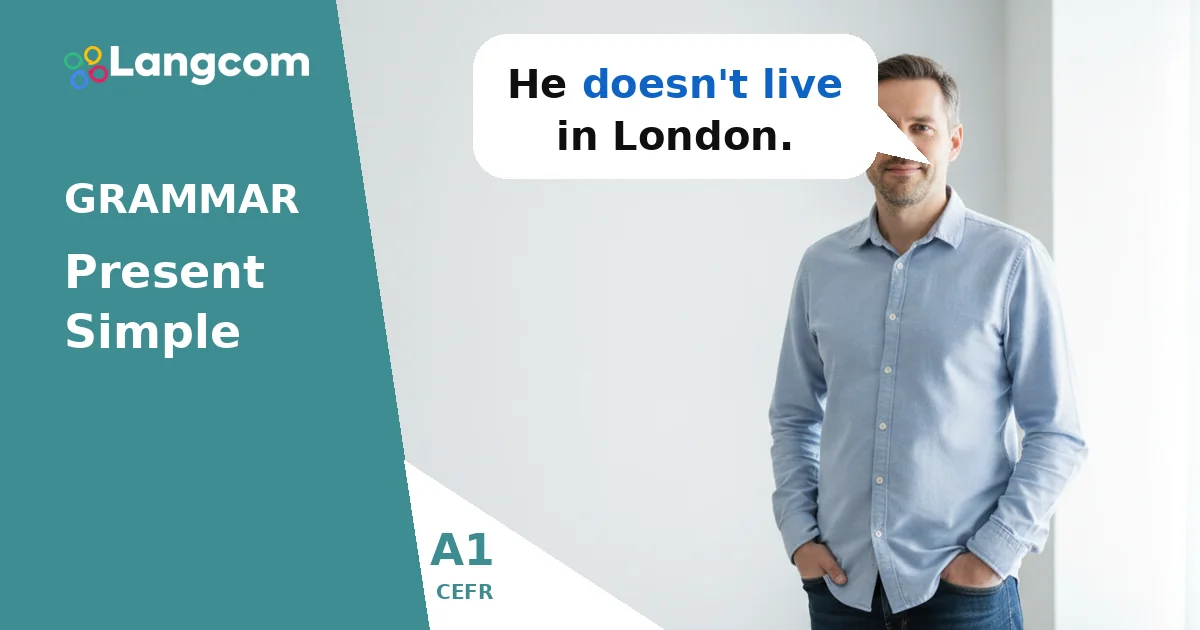

To make negative sentences in the Present Simple for ‘he’, ‘she’, and ‘it’, you always use doesn’t followed by the base form of the verb. This means you do not add ‘-s’ to the main verb. For example, you say He doesn’t work here, not He doesn’t works here. The word doesn’t è l'abbreviazione di does not. It helps us show that the action is not happening or is not true for a singular third-person subject. Remember this simple structure to speak and write correctly about what ‘he’, ‘she’, or ‘it’ does not do.
What is the Present Simple Negative for He, She, It?
The Present Simple is for actions that happen regularly or for facts. When we want to say that something is NOT true or NOT happening for ‘he’, ‘she’, or ‘it’, we use the negative form.
- Utilizziamo doesn’t to make the verb negative.
- Doesn’t is the short form of does not.
- Dopo doesn’t, the main verb always stays in its base form (the infinitive without ‘to’).
🎓 Impara l'inglese con il metodo misto
Piccoli gruppi · Tutor IA disponibile 24 ore su 24, 7 giorni su 7 · Preparazione agli esami di Cambridge
Piani da $39 $79 al mese
How Do We Form Negative Sentences?
The structure for negative sentences with 'he', 'she', and 'it' is very simple:
- Subject + doesn't + Base Form of the Verb
For example, if you want to say that a person does not like coffee, you would say:
- She doesn't like coffee.
It is important to remember that doesn't is only for 'he', 'she', and 'it'. For 'I', 'you', 'we', and 'they', we use don't.
Remember: No '-s' on the Main Verb!
This is a very common mistake for learners. When you use doesn't, the main verb does NOT get an '-s' at the end.
La parola does already shows that the subject is 'he', 'she', or 'it'. So, you do not need to add '-s' to the next verb.
- Corretto: He doesn't play football.
- Errato: He doesn't plays football.
Esempi
- He doesn't live in London.
- She doesn't speak French.
- It doesn't rain much in summer here.
- My brother doesn't work on Sundays.
- The cat doesn't eat fish.
- He doesn't like fast food.
Esercitazione
💬 Hai bisogno di una consulenza personalizzata?
In qualità di Centro autorizzato di preparazione agli esami Cambridge, possiamo aiutarti a scegliere il corso e la certificazione più adatti alle tue esigenze. Contatta oggi stesso i nostri consulenti.
Chatta con un consulente su WhatsAppErrori comuni per chi parla spagnolo
Many Spanish speakers make two common mistakes when forming negative sentences with 'he', 'she', 'it' in the Present Simple:
- Using 'no' directly before the verb: In Spanish, you might say Él no trabaja. But in English, you cannot say He no works. You must use doesn't. The correct form is He doesn't work.
- Adding '-s' to the main verb after 'doesn't': This is a very common error. You might think, 'It's 'he', so the verb needs an '-s'.' But does already has the '-s' form. So, you should say She doesn't like, not She doesn't likes.
Domande frequenti
What is the short form of 'does not'?
The short form of does not è doesn't. Both mean the same thing, but doesn't is more common in everyday speaking.
Why don't we add '-s' to the verb after 'doesn't'?
We do not add -s to the main verb after doesn't because the -s ending is already in the word does. The auxiliary verb does carries the third-person singular marker, so the main verb stays in its base form.
Can I use 'does not' instead of 'doesn't'?
Yes, you can use does not anziché doesn't. Does not is typically used for more formal writing or when you want to emphasize the negative, for example: He does NOT want to go.
Is this grammar point important for English exams?
Yes, understanding how to form negative sentences in the Present Simple for 'he', 'she', and 'it' is fundamental for A1 level English. It is essential for basic communication and will appear in many speaking and writing tasks on exams.


0 Commenti