
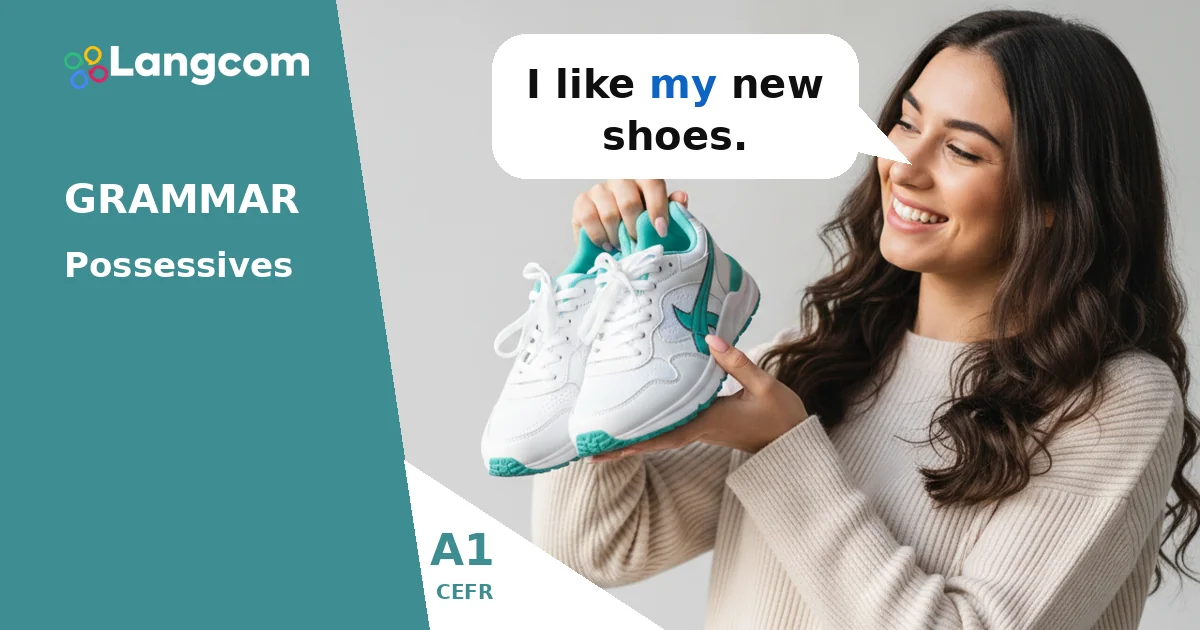

What Are Possessive Adjectives?
Possessive adjectives are small words. They tell us about ownership or connection. They answer the question: Whose?
- They always come before a noun.
- They do not change their form, no matter if the noun is singular or plural.
🎓 Impara l'inglese con il metodo misto
Piccoli gruppi · Tutor IA disponibile 24 ore su 24, 7 giorni su 7 · Preparazione agli esami di Cambridge
Piani da $39 $79 al mese
How Do We Use Possessive Adjectives?
We use possessive adjectives to show that something belongs to someone or something. They describe the noun that follows.
- For example, This is my car. (The car belongs to me.)
- Another example: She likes her new bag. (The bag belongs to her.)
Possessive Adjectives and Subject Pronouns
Each possessive adjective matches a subject pronoun. Look at the table to see the pairs.
When to Use Each Possessive Adjective?
- Utilizzo my per I: This is my phone.
- Utilizzo your per you: Is this your book?
- Utilizzo his per he: That is his brother.
- Utilizzo her per she: Her name is Maria.
- Utilizzo its per it (things or animals): The dog likes its toy.
- Utilizzo our per we: This is our house.
- Utilizzo their per they: They live with their parents.
| Subject Pronoun | Possessive Adjective |
|---|---|
| I | my |
| You | your |
| He | his |
| She | her |
| It | its |
| We | our |
| They | their |
Esempi
- I like my new shoes.
- What is your favorite color?
- He plays with his dog every day.
- She loves her family very much.
- The cat is sleeping in its bed.
- We are proud of our team.
- They are visiting their grandparents.
Esercitazione
💬 Hai bisogno di una consulenza personalizzata?
In qualità di Centro autorizzato di preparazione agli esami Cambridge, possiamo aiutarti a scegliere il corso e la certificazione più adatti alle tue esigenze. Contatta oggi stesso i nostri consulenti.
Chatta con un consulente su WhatsAppErrori comuni per chi parla spagnolo
Spanish speakers often make these mistakes:
- Using subject pronouns instead of possessive adjectives: In Spanish, you might say "Yo libro" (incorrect) or "mi libro." In English, always use the possessive adjective: I have my book. (NON I have I book.)
- Confuso his, her, its, e their with "su": In Spanish, "su" can mean his, her, its, oppure their. In English, you must choose the correct one based on who owns the item. For example, He has his car. (NON He has her car. if it's his car).
- Confuso its e it's: Its is a possessive adjective. It shows possession (e.g., The dog wagged its tail.). It's is a contraction of it is oppure it has (ad esempio, It's a beautiful day.).
Domande frequenti
What is the difference between 'my' and 'mine'?
My is a possessive adjective. It comes before a noun (e.g., my book). Mine is a possessive pronoun. It replaces the noun (e.g., That book is mine.).
Do possessive adjectives change for plural nouns?
No, possessive adjectives do not change. For example, you say my car (singular) and my cars (plural). The word my rimane invariato.
Can I use a possessive adjective without a noun?
No, you cannot. Possessive adjectives always need a noun after them. For example, you must say This is my bag. You cannot say This is my.


0 Commenti