

What are Expressions of Quantity?
Expressions of quantity tell us how much or how many of something there is. They are essential for describing the world around us.
- Some expressions are general, like “some” oppure “a lot of.”
- Others are specific, like “a slice of” oppure “a bar of.”
- These specific expressions are often used with uncountable nouns to give them a measurable form.
✍️ Non sai a quale livello ti trovi?
Fai il nostro test di livello gratuito e ricevi un feedback personalizzato da esaminatori certificati Cambridge.
Fai il nostro test di livello GRATUITOWhy are Specific Expressions Important for B2 English?
As you reach B2 level, your English should become more precise and natural. Using specific expressions of quantity helps you achieve this.
- Precision: They give exact details. For example, "a glass of water" is more precise than "some water."
- Naturalness: Native speakers use these specific terms frequently. Learning them makes your English sound more authentic.
- Exam Success: Exams like the B2 First (FCE) often test your ability to use a wide range of vocabulary, including these specific expressions.
Common Specific Expressions of Quantity
Many uncountable nouns have specific words that describe a part or an amount of them. Here are some common ones:
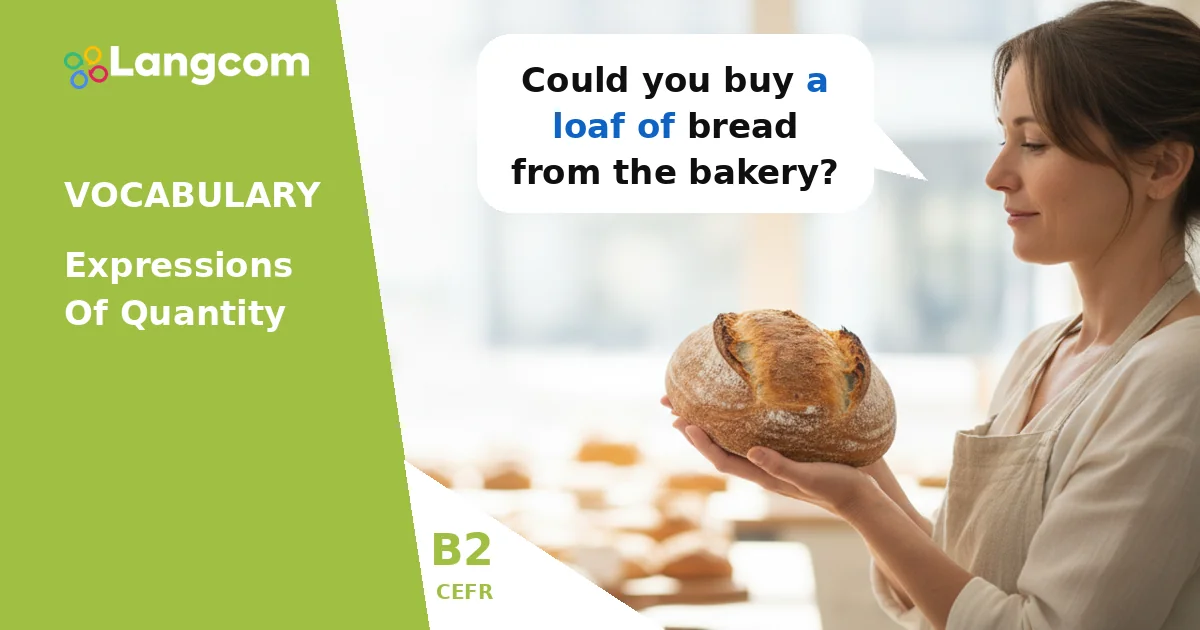
- a loaf of bread: This refers to the whole baked unit of bread.
- a slice of bread/cake: This is a thin, flat piece cut from a larger item.
- a bar of chocolate/soap: This describes a rectangular block.
- a glass of water/juice: This is a container used for drinking liquids.
- a shower of rain: This refers to a short period of rain.
- a flash of lightning: This is a sudden, bright light in the sky.
- a clap of thunder: This is a sudden, loud noise after lightning.
- a pane of glass: This is a single sheet of glass, usually in a window.
- an item of clothing/luggage: This is a single piece from a collection.
- a piece of advice/information: These are common ways to quantify abstract uncountable nouns.
- a ball of string/wool: This describes something wound into a round shape.
- a crowd of people: Mentre "people" is countable, "crowd" is a collective noun often used with this type of expression.
How to Use Them Correctly
The key to using these expressions correctly is to learn which specific quantifier pairs with which uncountable noun.
- Think about the typical form or container of the noun. For example, chocolate often comes in "bars."
- Pay attention to context. In a shop, you might ask for "a loaf of bread," but at home, you take "a slice of bread."
- Practice by reading and listening to how native speakers use them.
| Expression | Uncountable Noun Example |
|---|---|
| a loaf of | bread |
| a slice of | cake, bread, meat |
| a bar of | chocolate, soap |
| a glass of | water, milk, juice |
| a shower of | rain |
| a flash of | lightning |
| a clap of | thunder |
| a pane of | glass |
| an item of | clothing, luggage |
| a piece of | advice, information, furniture |
| a ball of | string, wool |
| a crowd of | people |
Esempi
- Could you buy a loaf of bread from the bakery?
- I'd love a slice of cake with my coffee.
- She gave me a very useful piece of advice.
- We saw a huge flash of lightning during the storm.
- He packed two items of clothing for his short trip.
- Please hand me that ball of string.
- The concert attracted a large crowd of people.
Esercitazione
Sei pronto a ottenere il tuo certificato?
Il corso Langcom prepara gli studenti agli esami Cambridge, IELTS, TOEFL, DELE, SIELE e Michigan.
Inizia a utilizzare LangcomErrori comuni per chi parla spagnolo
Using general quantifiers instead of specific ones
Chi parla spagnolo a volte usa "a piece of" too broadly, similar to "un trozo de" oppure "una pieza de." Mentre "a piece of" is correct for some nouns (like "a piece of advice"), it's often not the most natural choice.
- Errato: I want a piece of chocolate.
- Corretto: I want a bar of chocolate. (oppure a square of chocolate)
Another common mistake is not knowing the specific word for a particular item.
- Errato: The window needs new glass. (if referring to a single sheet)
- Corretto: The window needs a new pane of glass.
Domande frequenti
What is an uncountable noun?
An uncountable noun refers to something that cannot be counted individually, like "water," "information," oppure "advice." We cannot say "two waters" oppure "three informations."
Why can't I just use 'some' for uncountable nouns?
Mentre "some" is correct for uncountable nouns (e.g., "some water"), specific expressions like "a glass of water" provide more detail and sound more natural at a B2 level. They show you understand the common ways to quantify these items.
Are these expressions tested in the B2 First (FCE) exam?
Yes, vocabulary related to specific expressions of quantity can appear in various parts of the B2 First (FCE) exam, especially in the Use of English paper, where you might need to choose the correct word to complete a sentence or transform a word.
Can I use 'a piece of' for everything?
No, "a piece of" is not suitable for all uncountable nouns. While it works for "a piece of advice" oppure "a piece of furniture," it sounds unnatural for things like "bread" (use "a slice of" oppure "a loaf of") or "rain" (use "a shower of").


0 Commenti