

What is Reported Speech?
When we want to share what someone else said, we have two main options: direct speech or reported speech.
-
Direct Speech: We use the exact words the person said. We put these words inside quotation marks.
“I love learning English,” she said.
-
Reported Speech (Indirect Speech): We report the meaning of what was said, but not necessarily the exact words. We do not use quotation marks. Often, we use a reporting verb like say oppure tell, followed by that (which is often optional).
She said (that) she loved learning English.
Remember the difference between say e tell:
-
Utilizziamo say without an object (the person you are speaking to).
He said he was tired.
-
Utilizziamo tell with an object (the person you are speaking to).
He told me he was tired.
✍️ Non sai a quale livello ti trovi?
Fai il nostro test di livello gratuito e ricevi un feedback personalizzato da esaminatori certificati Cambridge.
Fai il nostro test di livello GRATUITOHow Does Backshift Work?
The most common change in reported speech is called 'backshift'. This means that the verb tense usually moves one step back in time.
-
If the original speech was in the present, it changes to the past.
"I am studying." → He said he was studying.
-
If the original speech was in the past, it changes to the past perfect.
"I finished my homework." → She said she had finished her homework.
Modal verbs also change:
-
Can usually changes to could.
"I can help you." → He said he could help me.
-
Will usually changes to would.
"I will call you." → She promised she would call me.
-
May usually changes to might.
"It may rain." → He said it might rain.
-
Must usually changes to had to.
"I must leave." → She said she had to leave.
-
Could, would, should, might, ought to do not change.
"I should study." → He said he should study.
When Does the Tense NOT Change?
Sometimes, backshift is not necessary or even incorrect. Here are the main situations:
-
General Truths or Facts: If the reported statement is a universal truth or a general fact, the tense usually stays the same.
"The Earth is round," the teacher explained. → The teacher explained that the Earth is round.
-
Statements Still True: If the reported statement is still true at the time of reporting, the tense may not change. This is common when reporting recent news or ongoing situations.
"I live in Madrid," she said yesterday. (If she still lives there) → She said she lives in Madrid.
-
Hypothetical Conditionals (Type 2 and 3): The tenses in these conditional sentences do not change in reported speech.
"If I won the lottery, I would travel the world," he said. → He said that if he won the lottery, he would travel the world.
-
Reporting Verb in Present Tense: If the reporting verb (e.g., says, tells) is in the present tense, the tense of the reported speech does not change.
She says, "I am busy." → She says she is busy.
Essential Reporting Verbs and Structures
Beyond say e tell, English has many other reporting verbs that convey different meanings and require specific grammatical structures. Here are some common B2-level examples:
-
Accuse + of + -ing
Mary accused Nick of deliberately forgetting to tell her.
-
Admit + to (optional) + -ing oppure Admit + that (optional)
The company admitted to selling banned products.
I admit that I was to blame.
-
Apologise + for + -ing
James apologised for being late.
-
Argue + for + -ing oppure Argue + that (optional)
The department argued convincingly for having extra staff.
Sally argued that it was unnecessary to delay the expedition.
-
Claim + that (optional)
Newspapers are claiming that the new policy will fail.
| Direct Speech Tense | Reported Speech Tense |
|---|---|
| Present Simple | Past Simple |
| Present Continuous | Past Continuous |
| Present Perfect | Past Perfect |
| Past Simple | Past Perfect |
| Past Continuous | Past Perfect Continuous |
| Will | Would |
| Can | Could |
| May | Might |
| Must | Had to |
Esempi
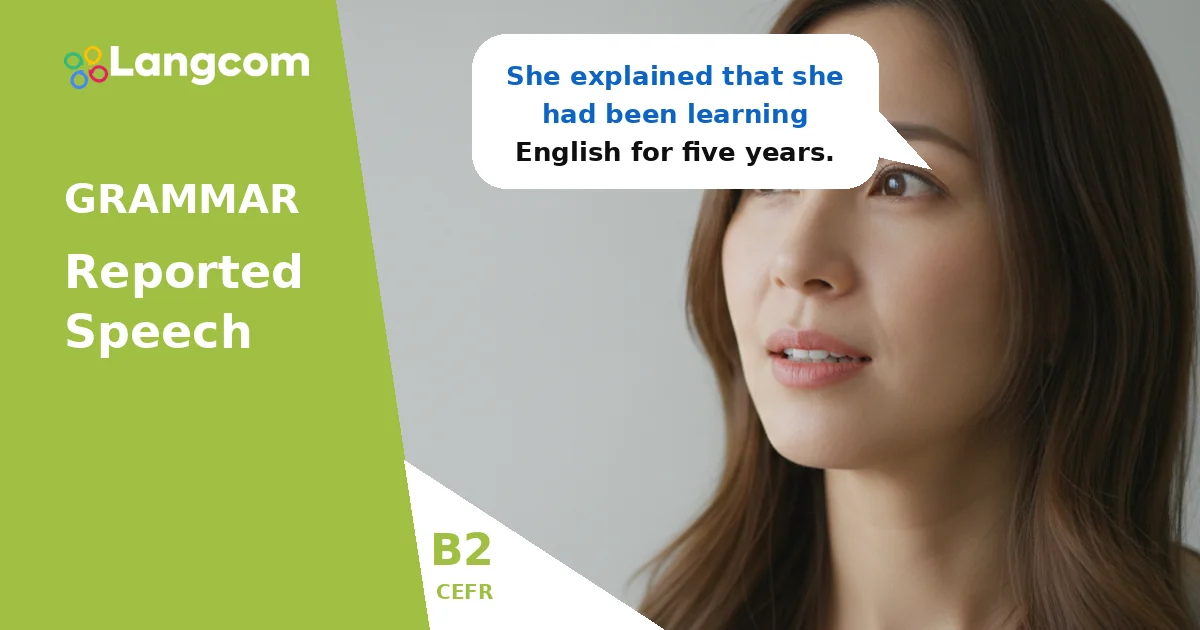
- She explained that she had been learning English for five years.
- My friend asked if I wanted to go to the cinema that night.
- The manager announced that the meeting would be postponed until the following week.
- He denied having taken the money from the drawer.
- They suggested visiting the museum on Saturday.
- The scientist stated that water boils at 100 degrees Celsius.
Esercitazione
Sei pronto a ottenere il tuo certificato?
Il corso Langcom prepara gli studenti agli esami Cambridge, IELTS, TOEFL, DELE, SIELE e Michigan.
Inizia a utilizzare LangcomErrori comuni per chi parla spagnolo
Spanish speakers often make specific mistakes with reported speech due to differences between English and Spanish grammar:
-
Not using backshift: A common error is to keep the original tense, especially when it should change to the past perfect.
-
Errato: She said she went to the party.
-
Corretto: She said she had gone to the party.
-
-
Confuso say e tell: Remember that tell needs an object, while say does not (unless followed by to).
-
Errato: He said me that he was busy.
-
Corretto: He told me that he was busy. oppure He said that he was busy.
-
-
Incorrect prepositions with reporting verbs: Many reporting verbs have specific prepositions or structures that must be followed.
-
Errato: She apologised for be late.
-
Corretto: She apologised for being late.
-
Domande frequenti
What is the main difference between direct and reported speech?
Direct speech uses the speaker's exact words, enclosed in quotation marks, like "I'm tired." Reported speech conveys the message without quotation marks, often changing tenses and pronouns, as in She said she was tired.
Why do tenses change in reported speech?
Tenses change in reported speech, a process called 'backshift,' because the original words were spoken in the past. Moving the tense back reflects that the action or statement happened before the reporting moment. For example, present simple becomes past simple.
Are there any situations where tenses don't change?
Yes, tenses often do not change if the reported statement is a general truth (He said water freezes at 0°C.), if the statement is still true (She said she lives in Paris.), or if the reporting verb is in the present tense (He says he is happy.).
How is reported speech tested in the B2 First exam?
In the B2 First (FCE) Use of English paper, Reported Speech is often tested in Part 3 (Word Formation) where you might need to change a verb form, or Part 4 (Key Word Transformation) where you rewrite a sentence using a given word, often requiring a change from direct to reported speech or vice versa, including backshift and appropriate reporting verbs.
Can I always omit 'that' in reported speech?
Mentre that is often optional, especially in informal spoken English, it is generally safer to include it in formal writing or when omitting it might cause confusion. For example, He said that he was coming is clearer than He said he was coming in some contexts.


0 Commenti