

What is ‘must’ for?
Utilizziamo must to talk about things that are very important. It shows a strong obligation or a rule.
- Obligation or Necessity: When something is necessary to do. For example, Students must wear a uniform.
- Strong Advice: When you think something is a very good idea. For example, You must visit the museum; it’s amazing!
🎓 Impara l'inglese con il metodo misto
Piccoli gruppi · Tutor IA disponibile 24 ore su 24, 7 giorni su 7 · Preparazione agli esami di Cambridge
Piani da $39 $79 al mese
What is 'mustn't' for?
Utilizziamo mustn't (oppure must not) to talk about things that are not allowed. It shows a prohibition.
- Prohibition: When something is forbidden or against the rules. For example, You mustn't take photos in the museum.
- Danger: When something is dangerous to do. For example, Children mustn't play with knives.
How do we form sentences with 'must' and 'mustn't'?
Must e mustn't are easy to use! They are modal verbs, so they follow simple rules.
- Always use the base form of the verb: Dopo must oppure mustn't, the next verb is always in its basic form (e.g., go, eat, study).
- No 'to': We do not use to dopo must oppure mustn't.
- No '-s' for 'he/she/it': Must never changes its form, even for he, she, oppure it.
| Oggetto | Positive Form | Negative Form |
|---|---|---|
| I / You / We / They | must go | mustn't go |
| He / She / It | must go | mustn't go |
Esempi
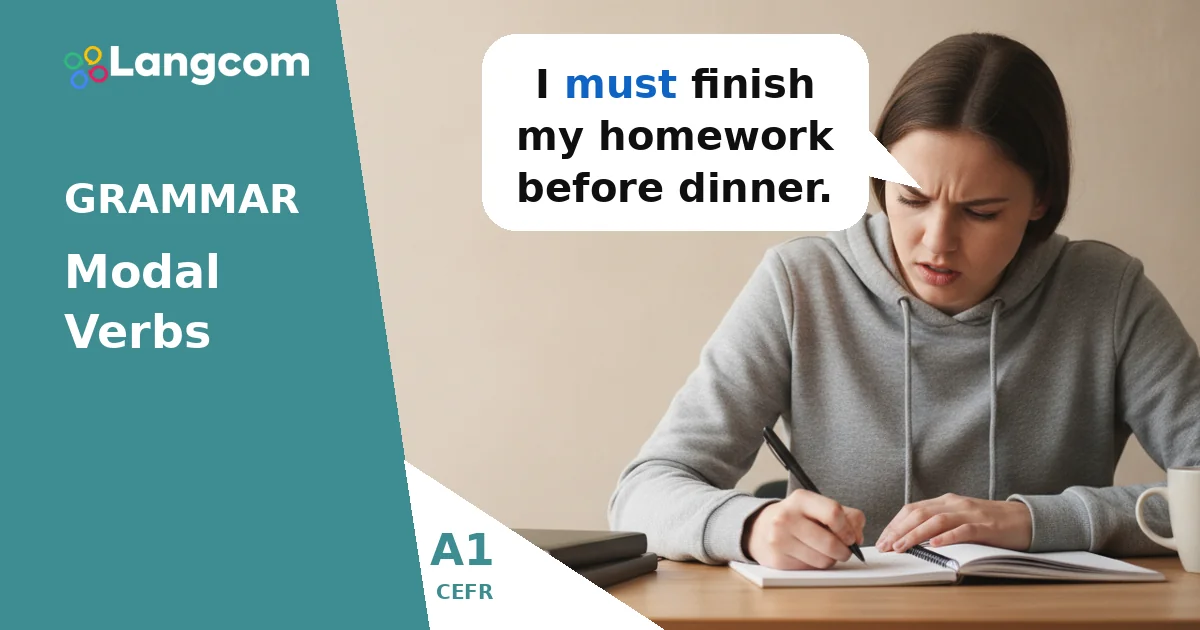
- I must finish my homework before dinner.
- You must be quiet in the library.
- He must wear a helmet when he rides his bike.
- We mustn't talk during the exam.
- She mustn't forget her passport for the trip.
- They must arrive on time for the meeting.
Esercitazione
💬 Hai bisogno di una consulenza personalizzata?
In qualità di Centro autorizzato di preparazione agli esami Cambridge, possiamo aiutarti a scegliere il corso e la certificazione più adatti alle tue esigenze. Contatta oggi stesso i nostri consulenti.
Chatta con un consulente su WhatsAppErrori comuni per chi parla spagnolo
Many Spanish speakers make small mistakes with must e mustn't. Here are the most common ones to avoid:
- Using 'to' after must oppure mustn't:
- ❌ You must to study.
- ✅ You must study.
- Adding '-s' to must for 'he', 'she', 'it':
- ❌ He musts go.
- ✅ He must go.
Domande frequenti
What is the main use of 'must'?
Must is for strong rules, obligations, or things that are very important to do. For example, You must listen to your parents.
What is the main use of 'mustn't'?
Mustn't is for things that are not allowed or forbidden. For example, You mustn't run in the corridors.
Can I say 'must not' instead of 'mustn't'?
Sì, must not è la forma completa, e mustn't is the short, common form. They mean the same thing.
Does 'must' change for 'he/she/it'?
No, must never changes its form. It is always must for all subjects (I, you, he, she, it, we, they).


0 Commenti