

What Are Contractions in English?
Contractions are a way to make two words into one shorter word. We use an apostrophe (‘) to show where letters are missing.
English speakers use contractions all the time. They make conversations faster and more natural.
- You will hear them a lot when people speak.
- You will see them in informal writing, like emails to friends or text messages.
✍️ Non sai a quale livello ti trovi?
Fai il nostro test di livello gratuito e ricevi un feedback personalizzato da esaminatori certificati Cambridge.
Fai il nostro test di livello GRATUITOCommon Contractions with 'to be' (am, is, are)
Many contractions use forms of the verb to be.
- I am becomes I'm.
Esempio: I'm happy to be here. - You are becomes You're.
Esempio: You're a good student. - He is becomes He's.
Esempio: He's my brother. - She is becomes She's.
Esempio: She's going to the shop. - It is becomes It's.
Esempio: It's a beautiful day. - We are becomes We're.
Esempio: We're ready for the test. - They are becomes They're.
Esempio: They're coming later.
Common Contractions with 'have' and 'has'
We also make contractions with have e has, especially in the present perfect tense.
- I have becomes I've.
Esempio: I've finished my homework. - You have becomes You've.
Esempio: You've seen this movie before. - We have becomes We've.
Esempio: We've been waiting for an hour. - They have becomes They've.
Esempio: They've already eaten. - He has becomes He's.
Esempio: He's got a new car. - She has becomes She's.
Esempio: She's never visited London. - It has becomes It's.
Esempio: It's been a long day.
Important: He's, She's, e It's can mean is oppure has. Look at the next word to know the meaning. If the next word is a past participle (like been, finished), it means has. If it's an adjective (like happy) or going, it means is.
Common Contractions with 'will'
We use contractions with will to talk about the future.
- I will becomes I'll.
Esempio: I'll call you later. - You will becomes You'll.
Esempio: You'll be fine. - He will becomes He'll.
Esempio: He'll arrive soon. - She will becomes She'll.
Esempio: She'll help us. - It will becomes It'll.
Esempio: It'll rain tomorrow. - We will becomes We'll.
Esempio: We'll see you there. - They will becomes They'll.
Esempio: They'll probably win.
Contractions with 'would' and 'had'
The contraction 'd can mean would oppure had. Again, look at the next word.
- I would becomes I'd.
Esempio: I'd like a coffee, please. (followed by a verb in base form) - I had becomes I'd.
Esempio: I'd already eaten when they arrived. (followed by a past participle) - You would becomes You'd.
Esempio: You'd better hurry. - He had becomes He'd.
Esempio: He'd never seen snow before.
Negative Contractions (not)
We often contract verbs with not. The o in not changes to an apostrophe (') and joins the verb with n't.
- do not becomes don't.
Esempio: I don't understand. - does not becomes doesn't.
Esempio: She doesn't like pizza. - did not becomes didn't.
Esempio: We didn't go out last night. - is not becomes isn't.
Esempio: It isn't raining now. - are not becomes aren't.
Esempio: They aren't here yet. - was not becomes wasn't.
Esempio: He wasn't at home. - were not becomes weren't.
Esempio: You weren't listening. - cannot becomes can't.
Esempio: I can't swim. - will not becomes won't.
Esempio: She won't be late. - could not becomes couldn't.
Esempio: I couldn't find my keys. - should not becomes shouldn't.
Esempio: You shouldn't worry. - would not becomes wouldn't.
Esempio: They wouldn't agree.
When NOT to Use Contractions
While contractions are common, there are times when it's better to use the full forms.
- Formal Writing: Avoid contractions in academic essays, official reports, or formal letters.
- Emphasis: If you want to emphasize a word, use the full form.
Esempio: I AM going! (non I'm going!) - Short Answers: Do not use contractions at the end of a short answer.
Corretto: Yes, I am. (NON Yes, I'm.)
Corretto: No, she isn't. (NON No, she's not.)
| Full Form | Contracted Form |
|---|---|
| I am | I'm |
| You are | You're |
| He is / He has | He's |
| She is / She has | She's |
| It is / It has | It's |
| We are | We're |
| They are | They're |
| I will | I'll |
| You will | You'll |
| I would / I had | I'd |
| Do not | Don't |
| Does not | Doesn't |
| Did not | Didn't |
| Is not | Isn't |
| Are not | Aren't |
| Was not | Wasn't |
| Were not | Weren't |
| Cannot | Can't |
| Will not | Won't |
Esempi
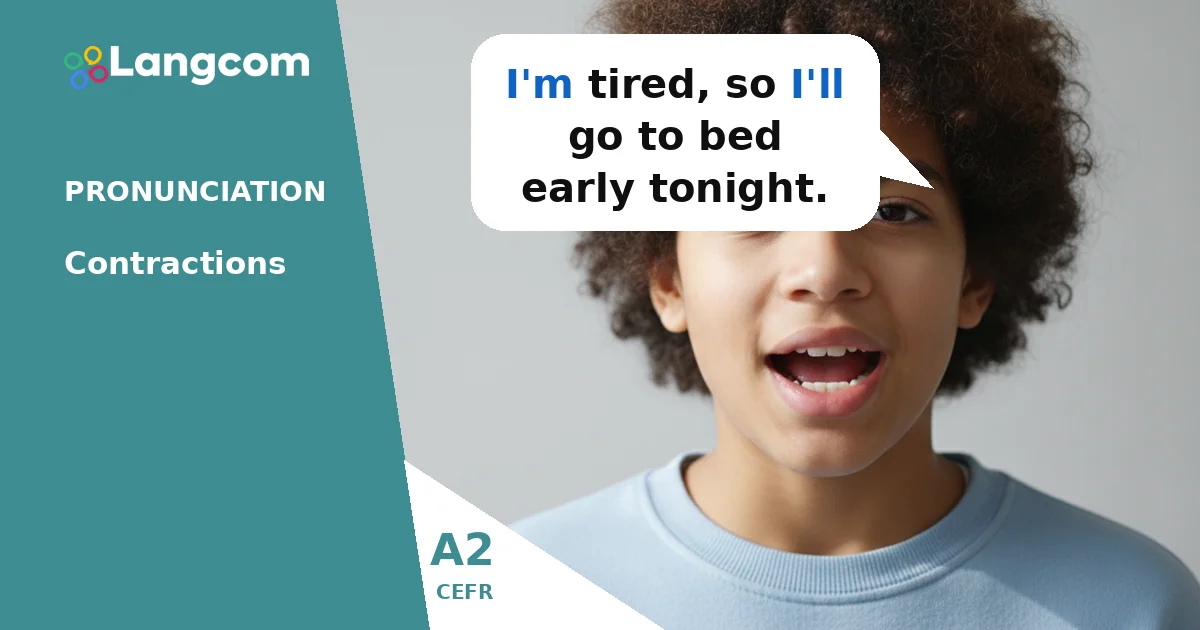
- I'm tired, so I'll go to bed early tonight.
- They're not ready for the party yet.
- He's been waiting for you for an hour.
- It's a secret, so you mustn't tell anyone.
- We'd love to visit Spain again soon.
- She doesn't like coffee, but I do.
Esercitazione
Sei pronto a ottenere il tuo certificato?
Il corso Langcom prepara gli studenti agli esami Cambridge, IELTS, TOEFL, DELE, SIELE e Michigan.
Inizia a utilizzare LangcomErrori comuni per chi parla spagnolo
Spanish speakers sometimes prefer to use the full forms of words, as contractions are not as common in Spanish grammar. However, in English, using contractions is natural and expected in most informal situations.
- Confusing similar-sounding words: Be careful with words that sound the same but have different meanings and spellings.
- It's (it is/it has) vs. Its (possessive, like su in Spanish).
Sbagliato: The dog wagged it's tail.
A destra: The dog wagged its tail. - You're (you are) vs. Your (possessive, like tu/su in Spanish).
Sbagliato: Your a great friend.
A destra: You're a great friend. - They're (they are) vs. Their (possessive) vs. There (place).
Sbagliato: Their going to the park.
A destra: They're going to the park.
- It's (it is/it has) vs. Its (possessive, like su in Spanish).
- Using contractions in formal writing: Remember to use full forms in academic essays or formal emails.
- Not using contractions in speech: While grammatically correct, always using full forms can make your English sound less natural to native speakers. Try to practice using contractions when you speak.
Domande frequenti
What is a contraction in English?
A contraction is a shortened form of two words, usually a pronoun and a verb, or a verb and not. An apostrophe (') replaces the missing letters. For example, I am becomes I'm.
Why do English speakers use contractions?
English speakers use contractions to make their speech faster, more fluent, and more natural. They are a common part of everyday conversation and informal writing.
Are contractions informal?
Yes, contractions are generally considered informal. They are perfect for speaking and casual writing (like emails to friends or text messages), but you should avoid them in formal academic writing or official documents.
How do I know if 'he's' means 'he is' or 'he has'?
You need to look at the word that comes after he's. If it's followed by a verb in the '-ing' form or an adjective, it means he is (ad esempio, He's running, He's happy). If it's followed by a past participle (e.g., been, finished), it means he has (ad esempio, He's been there, He's finished his work).
Can I use contractions in the A2 Key (KET) exam?
Yes, you can use contractions in the A2 Key (KET) exam, especially in informal writing tasks like an email to a friend. However, if you are asked to write something more formal, like a short story or an article, it's safer to use full forms.

0 Commenti