
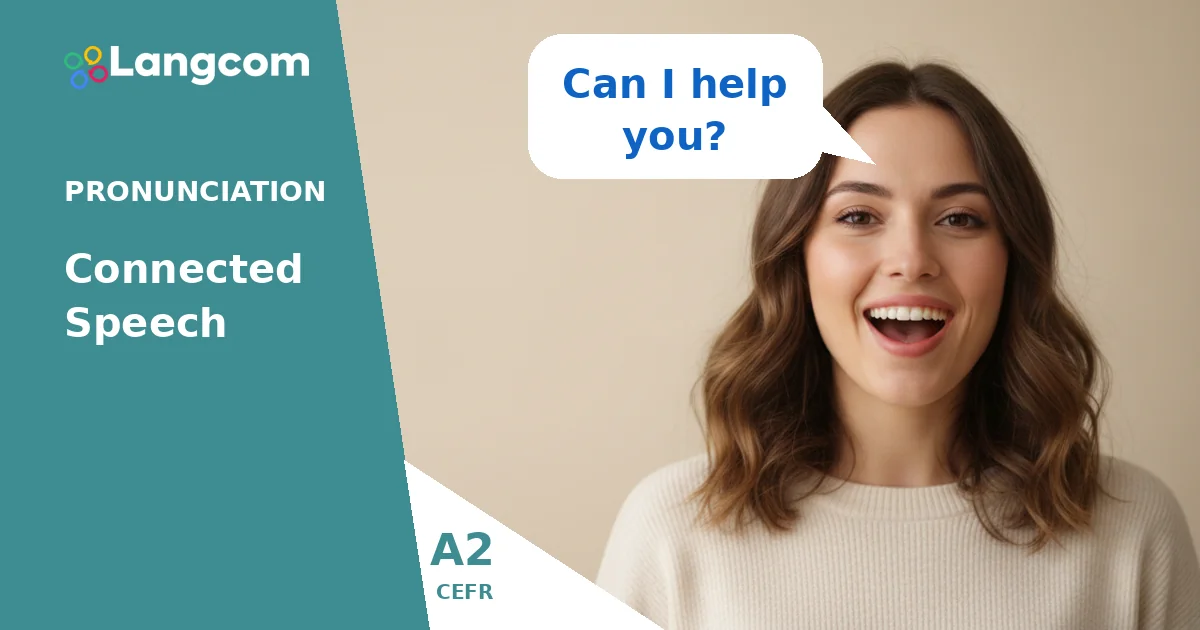

What is Connected Speech?
Connected speech is how we speak naturally in English. Words are not always separate. Instead, they often link together. This creates a smooth flow of sound.
Think about how you speak your native language. Do you pause after every single word? Probably not! English is the same.
🎓 Impara l'inglese con il metodo misto
Piccoli gruppi · Tutor IA disponibile 24 ore su 24, 7 giorni su 7 · Preparazione agli esami di Cambridge
Piani da $39 $79 al mese
How Do We Join Words in English?
The most common way to join words is when a word ends with a consonant sound and the next word starts with a vowel sound.
- The final consonant sound moves to the beginning of the next word.
- It's like the two words become one.
- Remember, it's about the sound, not just the letter. For example, the letter 'h' in “hour” is silent, so “an hour” connects.
Here are some examples:
- “an apple” sounds like /ənˈæpl/ (a-napple)
- “get up” sounds like /ɡɛtˈʌp/ (ge-tup)
- “take it” sounds like /teɪkˈɪt/ (ta-kit)
Why is Joining Words Important?
Understanding connected speech is very important for two main reasons:
- Better Listening: Native English speakers join words all the time. If you expect to hear every word separately, you might get lost. Knowing about connected speech helps you recognize words in fast conversation.
- More Natural Speaking: When you join words correctly, your English will sound more natural and fluent. You will sound more like a native speaker. It also helps you speak more quickly and smoothly.
Esempi
- Can I help you?
- What is it?
- Get out of here!
- I need an umbrella.
- He's a good actor.
Esercitazione
💬 Hai bisogno di una consulenza personalizzata?
In qualità di Centro autorizzato di preparazione agli esami Cambridge, possiamo aiutarti a scegliere il corso e la certificazione più adatti alle tue esigenze. Contatta oggi stesso i nostri consulenti.
Chatta con un consulente su WhatsAppErrori comuni per chi parla spagnolo
Many Spanish speakers pause between every word in English. This is because Spanish often has clearer word boundaries. In English, this can sound unnatural or choppy.
- Incorrect (with pauses): I... need... an... apple.
- Correct (connected): I need an apple. (sembra che... I nee-dan apple.)
Another mistake is not realizing that silent letters or different spellings can still lead to a vowel sound at the start of a word. Always listen for the sound!
Domande frequenti
What is connected speech?
Connected speech is when words link together in natural, spoken English, rather than being pronounced separately. It makes speech flow smoothly.
Why do English speakers join words?
Speakers join words to make speech faster, smoother, and more efficient. It's a natural part of how the language is spoken.
Does this happen with all words?
No, not with all words. The most common type of joining happens when a word ends with a consonant sound and the next word begins with a vowel sound. Other types of connected speech exist, but this is the main one for A2.
How can I practice joining words?
Listen carefully to native speakers in movies, songs, and podcasts. Try to imitate them. Read sentences aloud and focus on connecting the consonant and vowel sounds. Record yourself and listen back.


0 Commenti