
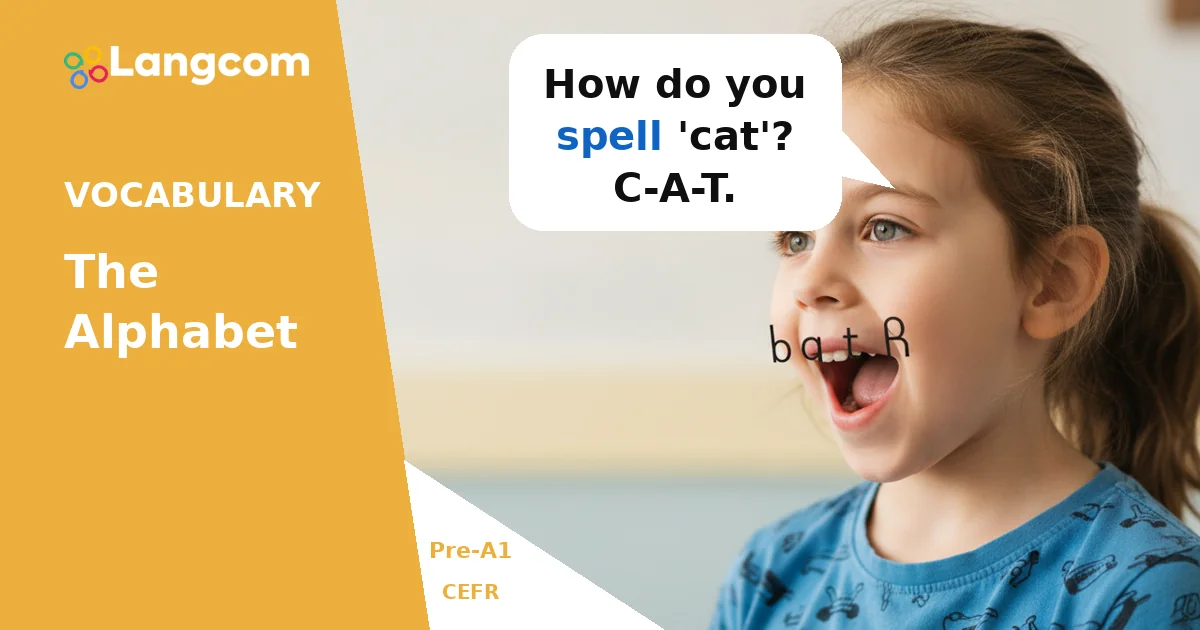

What is the English Alphabet?
The English alphabet is a set of letters. These letters are the building blocks of all English words. There are 26 letters in the English alphabet.
Each letter has two forms:
- A capital letter (also called uppercase), like A, B, C.
- A small letter (also called lowercase), like a, b, c.
You use capital letters at the beginning of sentences and for names. Small letters are used for most other words.
🎓 Impara l'inglese con il metodo misto
Piccoli gruppi · Tutor IA disponibile 24 ore su 24, 7 giorni su 7 · Preparazione agli esami di Cambridge
Piani da $39 $79 al mese
Why is the Alphabet Important?
Learning the alphabet is very important for many reasons:
- Reading: You need to know the letters to read words.
- Writing: You use letters to write words and sentences.
- Spelling: When you spell a word, you say the letters one by one. This is very useful when someone does not understand a word or a name.
- Understanding: When someone spells a word for you, you can understand it better.
How Do I Say the Letters?
Each letter in the English alphabet has a specific name. It is important to learn these names. Listen carefully to how native speakers say them.
Here are the 26 letters of the English alphabet:
- A, B, C, D, E, F, G
- H, I, J, K, L, M, N
- O, P, Q, R, S, T, U
- V, W, X, Y, Z
Remember, the name of the letter is often different from its sound when it is part of a word. For example, the letter A has a name, but it also has different sounds in words like cat oppure car.
How Do I Spell My Name?
To spell your name, you say each letter of your name one by one. This is a common question in English.
For example, if your name is Ana, you spell it: A-N-A.
| Capital Letter | Small Letter |
|---|---|
| A | a |
| B | b |
| C | c |
| D | d |
| E | e |
| F | f |
| G | g |
| H | h |
| I | i |
| J | j |
| K | k |
| L | l |
| M | m |
| N | n |
| O | o |
| P | p |
| Q | q |
| R | r |
| S | s |
| T | t |
| U | u |
| V | v |
| W | w |
| X | x |
| Y | y |
| Z | z |
Examples
- How do you spell ‘cat’? C-A-T.
- My name is ‘John’. J-O-H-N.
- Can you spell ‘book’ for me? B-O-O-K.
- Please spell ‘London’. L-O-N-D-O-N.
Practice
💬 Hai bisogno di una consulenza personalizzata?
In qualità di Centro autorizzato di preparazione agli esami Cambridge, possiamo aiutarti a scegliere il corso e la certificazione più adatti alle tue esigenze. Contatta oggi stesso i nostri consulenti.
Chatta con un consulente su WhatsAppCommon mistakes for Spanish speakers
Many Spanish speakers make common mistakes with the English alphabet:
- Confusing Letter Names with Sounds: In Spanish, letter names often sound like their common sound. In English, this is not always true. For example, the letter A is pronounced /eɪ/, but its sound in cat is /æ/.
- Mixing Up Similar Sounds: Letters like E (/iː/) and I (/aɪ/) can sound similar to Spanish speakers. Practice saying them clearly.
- Forgetting the H: The letter H is often silent in Spanish, but in English, it has a sound, like in hello.
Practice helps you learn these differences.
Domande frequenti
How many letters are in the English alphabet?
Ci sono 26 letters in the English alphabet.
What are capital and small letters?
Capital letters (like A) are used at the beginning of sentences and for names. Small letters (like a) are used for most other words.
Why is spelling important in English?
Spelling is important to clearly communicate words, especially names or words that might be difficult to understand when spoken. It helps you read, write, and understand others.


0 Commenti