
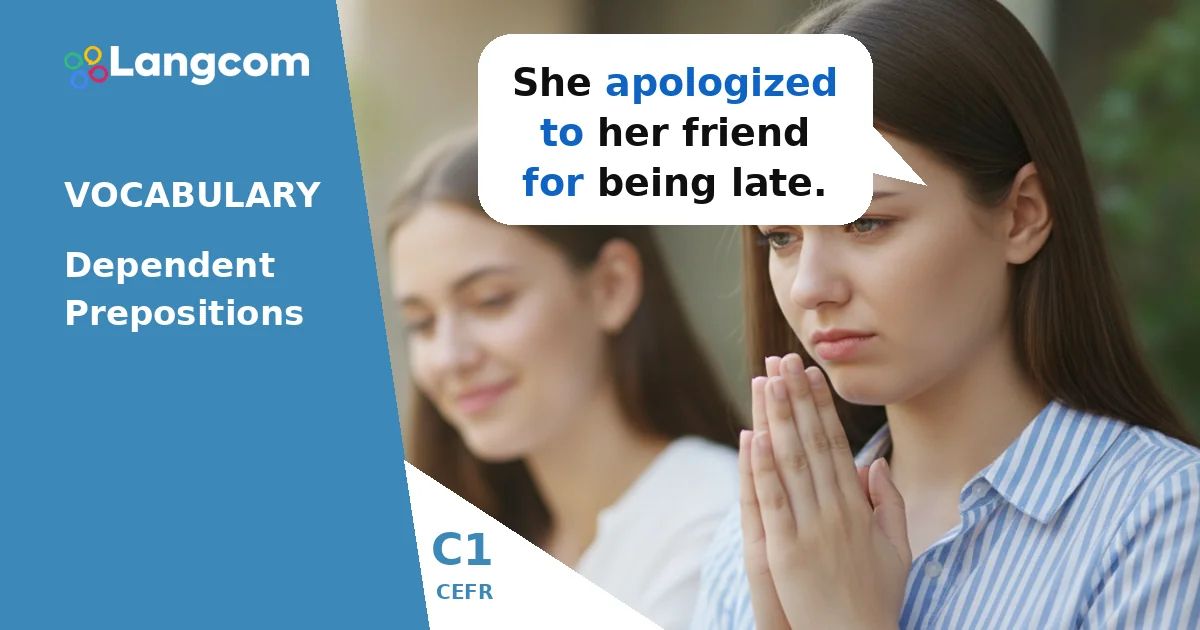

What Are Dependent Prepositions?
Dependent prepositions are small words like on, of, for, oppure with that are fixed to certain other words. They form a phrase with a verb, a noun, or an adjective.
These combinations are not logical; you cannot guess them. For example, we say afraid of, not afraid from. The preposition depends entirely on the word before it.
- Verb + Preposition: I believe in hard work.
- Noun + Preposition: Her interest in art grew.
- Adjective + Preposition: He is responsible for the project.
✍️ Non sai a quale livello ti trovi?
Fai il nostro test di livello gratuito e ricevi un feedback personalizzato da esaminatori certificati Cambridge.
Fai il nostro test di livello GRATUITOWhy Are Dependent Prepositions Important for C1 English?
At the C1 level, using correct dependent prepositions is crucial for several reasons. It shows a high level of accuracy and makes your English sound much more natural and fluent.
- Suono naturale: Native speakers use these combinations automatically. Using the wrong preposition can make your speech or writing sound unnatural or even confusing.
- Improve Accuracy: Correct usage demonstrates precision in your language, which is a key characteristic of advanced learners.
- Succeed in Exams: For the C1 Advanced (CAE) exam, dependent prepositions are frequently tested. You will find them in tasks such as Reading and Use of English Part 1 (Multiple-choice cloze), Part 3 (Word formation), and Part 4 (Key word transformations).
How Can I Learn Dependent Prepositions Effectively?
Learning dependent prepositions requires a different approach than learning grammar rules. Since there are no clear rules, memorization and exposure are key.
- Learn in Context: Always learn the preposition with the word it accompanies. Do not learn prepositions in isolation. For example, learn accuse someone of something, not just of.
- Use a Dictionary: A good dictionary will show you which prepositions go with which words and provide example sentences. Pay attention to these examples.
- Keep a Notebook: Create a dedicated section in your vocabulary notebook. Group words by preposition or by word type (verb, noun, adjective).
- Read and Listen Actively: When you read books, articles, or listen to podcasts and videos, pay attention to these combinations. Highlight or note down any new ones you encounter.
- Practice Regularly: The more you use them correctly in your own speaking and writing, the more they will become natural to you.
| Word Type | Word + Preposition | Example Sentence |
|---|---|---|
| Verb | account for | How do you account for the missing money? |
| Verb | accuse sb of sth | They accused him of cheating on the exam. |
| Verb | agree with sb about sth | I agree with you about the new policy. |
| Verb | approve of | My parents don't approve of my career choice. |
| Verb | cope with | It's hard to cope with so much pressure. |
| Verb | invest in | Many people invest in the stock market. |
| Verb | object to | I object to the way you're speaking to me. |
| Verb | rely on | You can always rely on her support. |
| Adjective | afraid of | She's afraid of flying in small planes. |
| Adjective | capable of | Are you capable of finishing this by Friday? |
| Adjective | keen on | He's very keen on playing football. |
| Adjective | responsible for | Who is responsible for this mess? |
Esempi
- She apologized to her friend for being late.
- Many students struggle with complex grammar.
- His success depends on his hard work and dedication.
- I am very interested in learning new languages.
- The manager is responsible for the entire team.
- There was a strong demand for the new product.
- They decided to invest in renewable energy.
- He was accused of stealing company secrets.
Esercitazione
Sei pronto a ottenere il tuo certificato?
Il corso Langcom prepara gli studenti agli esami Cambridge, IELTS, TOEFL, DELE, SIELE e Michigan.
Inizia a utilizzare LangcomErrori comuni per chi parla spagnolo
Spanish speakers often make mistakes with dependent prepositions due to direct translation from Spanish or using a common but incorrect preposition.
- Errato: I depend of my parents.
Corretto: I depend on my parents. (Spanish 'depender de' often leads to 'depend of') - Errato: She is interested on art.
Corretto: She is interested in art. (Spanish 'interesado en' can sometimes be confused with 'on') - Errato: He dreamed with flying.
Corretto: He dreamed of flying. (Spanish 'soñar con' often translates to 'dream with') - Errato: I agree with that. (when agreeing with a statement)
Corretto: I agree with that statement. oppure I agree. (When agreeing with a person, use agree with. When agreeing with an idea or plan, use agree to. When talking about a topic, use agree about/on.)
Domande frequenti
What is the difference between 'depend on' and 'rely on'?
Entrambi depend on e rely on mean to need someone or something for support or help. They are often interchangeable. For example, You can depend on me e You can rely on me both mean you can trust me for help. However, depend on can also refer to something being determined by another factor, like Success depends on effort.
Are dependent prepositions tested in the C1 Advanced (CAE) exam?
Yes, absolutely! Dependent prepositions are frequently tested in the C1 Advanced (CAE) exam, especially in the Reading and Use of English paper. You might find them in Part 1 (Multiple-choice cloze), where you choose the correct word to complete a gap, or in Part 4 (Key word transformations), where you need to rephrase a sentence using a given word, often involving a specific verb-preposition combination.
Can a word have more than one dependent preposition?
Yes, some words can combine with different prepositions, and the meaning changes. For example, agree with (a person), agree to (a plan or suggestion), and agree on/about (a topic). Another example is care for (look after) versus care about (feel concern for).
Is there a list of common dependent prepositions for C1?
Yes, there are many lists available. It's helpful to categorize them by word type (verb, noun, adjective). Some common C1 examples include account for, accuse of, adapt to, approve of, blame for, concentrate on, cope with, discourage from, invest in, object to, rely on, suffer from, aware of, capable of, keen on, e responsible for.



0 Commenti