
di Raúl | Lug 18, 2026 | Inglese per bambini - Livello pre-A1 (principianti)
Learning the names of rooms in English is very important for describing your home and daily activities. Every house has different spaces, and each space has a special name and purpose. Knowing these words helps you talk about where you live, what you do, and where...
di Raúl | Lug 18, 2026 | Inglese per bambini - Livello pre-A1 (principianti)
We use Is there…? to ask about one thing and Are there…? to ask about more than one thing. These phrases are very important for asking if something exists in a particular place. For example, if you want to know about a single item, like a television, you...
di Raúl | Lug 18, 2026 | Inglese per bambini - Livello pre-A1 (principianti)
To describe what exists in a place, use There is for one thing (singular) and There are for many things (plural). This grammar point helps you talk about objects, people, or places around you. For example, if you see one book, you say There is a book on the table. If...
di Raúl | Lug 18, 2026 | A2 Key (KET)
Learning English family vocabulary helps you talk about the people closest to you and is important for the A2 Key exam. You will learn words like mother, father, sister, and brother for your immediate family. For your extended family, you will learn grandparents,...
di Raúl | Lug 18, 2026 | A2 Key (KET)
Adverbs of frequency tell us how often something happens. They are important words like always, usually, often, sometimes, hardly ever, and never. These adverbs help you describe your habits and routines in English. Knowing where to put them in a sentence is key for...
di Raúl | Lug 18, 2026 | A2 Key (KET)
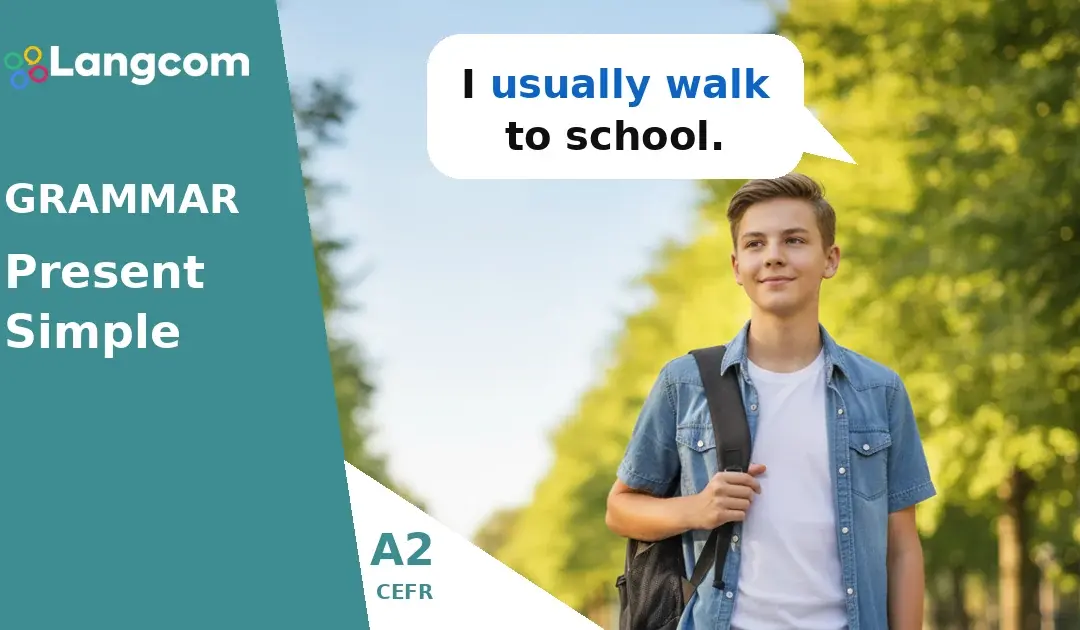
The Present Simple tense helps us talk about things that happen regularly, general facts, and daily routines. It is one of the first and most important tenses you learn in English, essential for everyday communication. We use it to describe habits, repeated actions,...
