

What Are Action Verbs?
Action verbs are words that show an action. They tell you what a person, animal, or thing does.
These verbs are very important for talking about daily life. They help you describe activities and express your feelings.
🎓 Impara l'inglese con il metodo misto
Piccoli gruppi · Tutor IA disponibile 24 ore su 24, 7 giorni su 7 · Preparazione agli esami di Cambridge
Piani da $39 $79 al mese
Meet Your New English Verbs
Here are some common action verbs. You can use them to talk about many things:
-
Eat: This verb means to put food in your mouth and swallow it. It is how you get energy.
-
Live: This verb means to have your home in a place. It also means to be alive.
-
Work: This verb means to do a job or an activity that needs effort. People often work to earn money.
-
Like: This verb means you think something is good or pleasant. You enjoy it.
-
Love: This verb means you like something very, very much. It is a strong feeling of affection.
-
Cook: This verb means to prepare food by heating it. You cook to make meals.
How to Use These Verbs in Simple Sentences
To make a simple sentence, you need a subject (who or what does the action) and a verb (the action).
For example, you can say I eat pizza. Here, I is the subject, and eat is the action verb.
-
Subject + Verb + Object/Complement
These verbs are used in the simple present tense for daily routines or general facts.
| Verb | Meaning |
|---|---|
| eat | To put food in your mouth and swallow it. |
| live | To have your home in a place; to be alive. |
| work | To do a job or an activity that needs effort. |
| like | To find something pleasant or enjoyable. |
| love | To like something very, very much; a strong feeling of affection. |
| cook | To prepare food by heating it. |
Examples
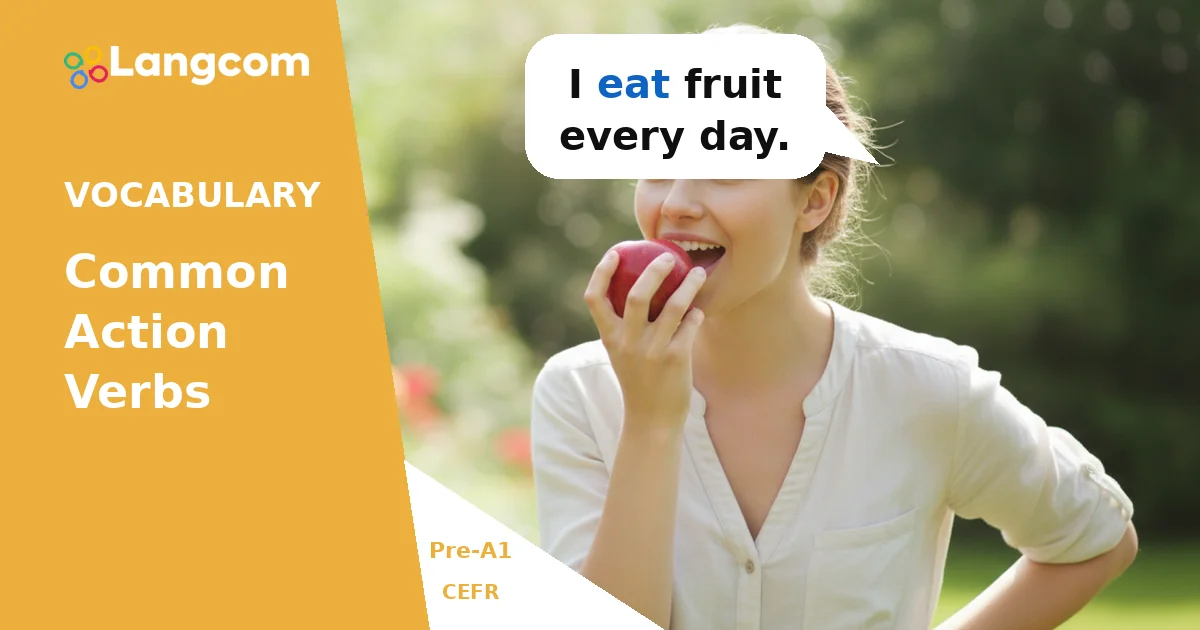
- I eat fruit every day.
- My family lives in a big house.
- She works in an office.
- We like to play football.
- They love their dog.
- He cooks pasta on Sundays.
- I like pizza.
- You live in Arequipa.
- We eat lunch together.
Practice
💬 Hai bisogno di una consulenza personalizzata?
In qualità di Centro autorizzato di preparazione agli esami Cambridge, possiamo aiutarti a scegliere il corso e la certificazione più adatti alle tue esigenze. Contatta oggi stesso i nostri consulenti.
Chatta con un consulente su WhatsAppCommon mistakes for Spanish speakers
Missing the Subject
In Spanish, you can often leave out the subject pronoun (like ‘yo’, ‘tú’, ‘él’). But in English, you almost always need a subject.
-
Wrong: Eat pizza. (Meaning ‘I eat pizza’)
-
Right: I eat pizza.
Using ‘to be’ with Action Verbs
Beginners sometimes add ‘am’, ‘is’, or ‘are’ before an action verb when it’s not needed for simple present actions.
-
Wrong: I am eat fruit.
-
Right: I eat fruit.
Confusing ‘Like’ and ‘Love’
Both verbs express positive feelings, but love is a much stronger feeling than like.
-
Like: I like coffee. (I enjoy it.)
-
Love: I love my family. (Very strong affection.)
Domande frequenti
What is an action verb?
An action verb is a word that describes something a person, animal, or thing does. For example, eat, run, oppure sleep are action verbs.
Do I need ‘to be’ (am/is/are) with these action verbs?
No, for simple present actions, you do not use ‘to be’ with these verbs. You say I eat, not I am eat. You use ‘to be’ for descriptions (like I am happy) or continuous actions (like I am eating now), which is a different grammar point.
Why are these verbs important for beginners?
These verbs are important because they help you talk about your daily life, your preferences, and what you do. They are building blocks for making simple sentences and starting conversations in English.
Can I use these verbs to talk about the past or future?
Yes, but the verb form will change. For example, for the past, eat becomes ate. For the future, you can add will oppure going to. At the Pre-A1 level, focus on the simple present forms for now.



0 Commenti