

What are important words for relationships?
When we talk about people in our lives, we use specific words to describe our connections. These words help us explain how we feel about others and what kind of bond we share.
-
Friendship: This is a close connection between friends. It is a noun that describes the state of being friends.
-
Relationship: This word describes the way two people or groups feel and behave towards each other. It can be romantic, professional, or familial.
-
Relatives: These are members of your family. They are people connected to you by blood or marriage.
-
Strangers: These are people you do not know. You have never met them before.
🎓 Impara l'inglese con il metodo misto
Piccoli gruppi · Tutor IA disponibile 24 ore su 24, 7 giorni su 7 · Preparazione agli esami di Cambridge
Piani da $39 $79 al mese
How do we describe connections with people?
English uses many phrasal verbs and expressions to describe how we interact with others. These phrases are very common in daily conversation.
-
Get on (with): To have a good relationship with someone. You can say I get on well with my sister.
-
Get to know: To learn about someone or something. This process takes time, as in It takes time to get to know new colleagues.
-
Keep in touch: To communicate regularly with someone, usually by phone, email, or social media. For example, We keep in touch even though we live far apart.
-
Have in common: To share interests, qualities, or opinions with someone. If you both like the same music, you have music in common.
How do we talk about shared experiences and feelings?
Beyond direct connections, we also describe shared aspects of our lives and personalities. These terms help explain why we connect with certain people.
-
Background: This refers to a person's education, experience, and family history. People from a similar background often understand each other well.
-
Interests: These are hobbies or activities you enjoy. Sharing interests is a common way to form friendships.
-
Sense of humour: This is the ability to understand and enjoy funny things. People often look for friends with a similar sense of humour.
-
Support: This means help, encouragement, or approval. Friends often offer emotional support during difficult times.
| Word / Phrase | Significato |
|---|---|
| Friendship | A close connection between friends. |
| Relationship | The way two people feel and behave towards each other. |
| Relatives | Members of your family (e.g., aunts, cousins, grandparents). |
| Strangers | People you do not know. |
| Get on (with) | To have a good relationship with someone. |
| Get to know | To learn about someone or something over time. |
| Keep in touch | To communicate regularly with someone. |
| Have in common | To share interests, qualities, or opinions. |
| Background | A person's education, experience, and family history. |
| Interests | Hobbies or activities you enjoy. |
| Sense of humour | The ability to understand and enjoy funny things. |
| Support | Help, encouragement, or approval. |
Esempi
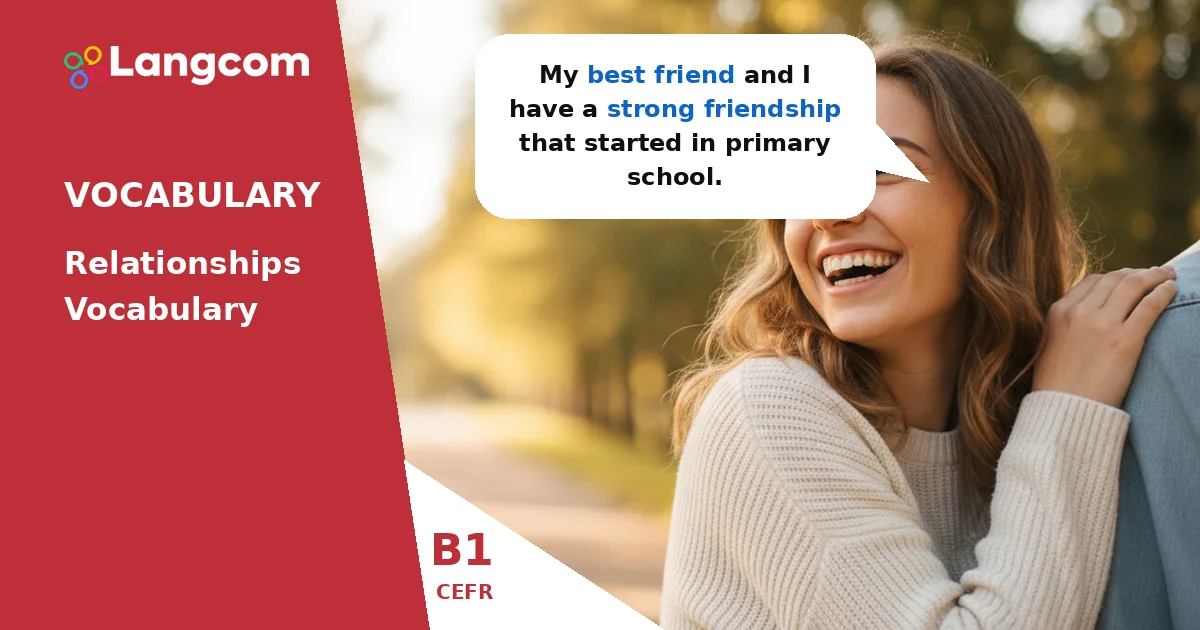
- My best friend and I have a strong friendship that started in primary school.
- I don't usually talk to strangers on the street.
- She has a good relationship with all her relatives.
- It's easy to get on with people who have a similar sense of humour.
- We don't have much in common, but we still enjoy spending time together.
- I want to get to know my new neighbours better.
- Even after moving, we try to keep in touch through video calls.
- He always offers great support when I have problems.
- Many of my friends come from a similar cultural background.
- Sharing interests like hiking and reading helps us bond.
Esercitazione
✍️ Non sai a quale livello ti trovi?
Fai il nostro test di livello gratuito e ricevi un feedback personalizzato da esaminatori certificati Cambridge.
Fai il nostro test di livello GRATUITOErrori comuni per chi parla spagnolo
Spanish speakers sometimes make specific mistakes with these words:
-
Relationship vs. Friendship: While both describe connections, relationship (relación) is broader and can be romantic, professional, or family-based. Friendship (amistad) specifically refers to the bond between friends. Do not say I have a good friendship with my boyfriend; say I have a good relationship with my boyfriend.
-
Relatives vs. 'Relations': Relatives (familiares) are family members. 'Relations' is a more formal or less common word for family, and can also mean connections between countries or groups. Always use relatives when talking about your family members.
-
Get to know vs. 'Know': Get to know (conocer, in the sense of 'become acquainted with') describes the process of learning about someone. 'Know' (conocer, in the sense of 'be familiar with') means you already have that knowledge. For example, I want to get to know my new boss (I'm learning about them), not I know my new boss (I already know them well).
-
Prepositions with phrasal verbs: Remember to use the correct prepositions. For example, get on with someone e keep in touch with someone. Non dire I get on well my friends; say I get on well with my friends.
Domande frequenti
What is the difference between 'relationship' and 'friendship'?
Relationship is a general term for how two people are connected, including family, work, or romantic ties. Friendship specifically describes the close bond and connection between friends.
Can 'get on with' be used for family members?
Yes, absolutely. You can say I get on well with my brother oppure My parents don't always get on with each other. It means to have a good (or not so good) relationship.
Is 'stranger' a negative word?
Not necessarily. Stranger simply means a person you don't know. It can sometimes imply caution (e.g., Don't talk to strangers), but it's not inherently negative. It's a neutral term for an unknown person.
Why is 'sense of humour' important in relationships?
A shared sense of humour often helps people connect, relax, and enjoy time together. It can make conversations more fun and help people understand each other better, strengthening their bond.
What does 'have in common' mean?
A have in common means to share similar interests, ideas, or characteristics with another person. For example, We both love reading, so we have that in common.

0 Commenti