
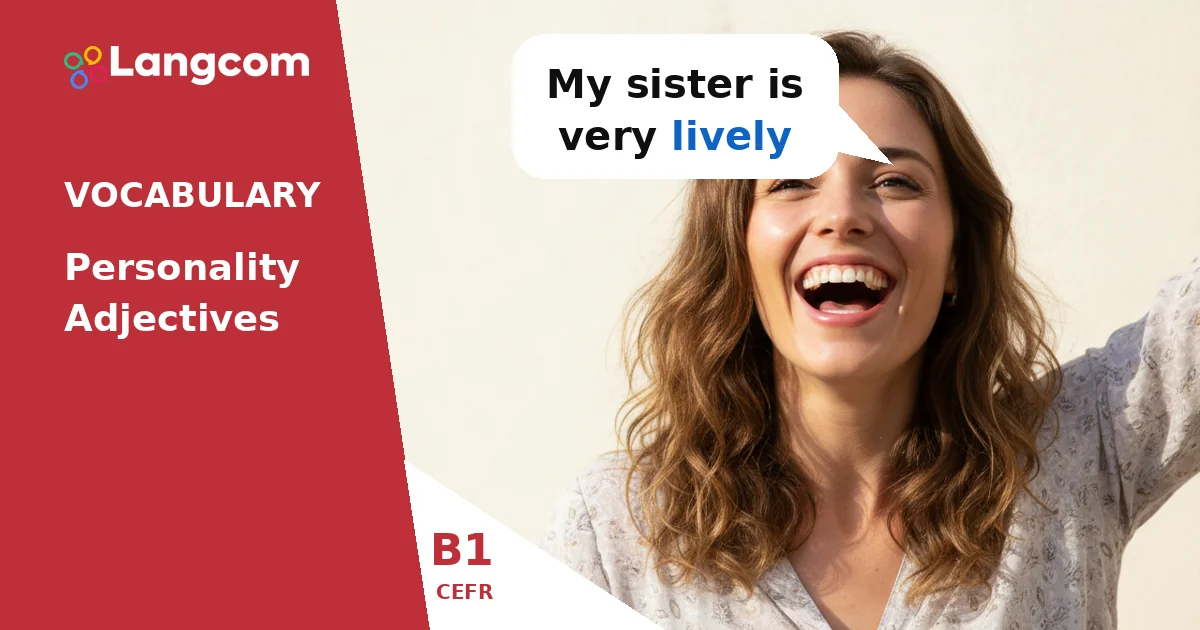

What Are Personality Adjectives?
Personality adjectives are words that describe a person’s character, feelings, and behavior. They tell us what someone is like on the inside.
Using these adjectives helps you give more detail when you talk or write about people. They make your descriptions richer and more interesting.
🎓 Impara l'inglese con il metodo misto
Piccoli gruppi · Tutor IA disponibile 24 ore su 24, 7 giorni su 7 · Preparazione agli esami di Cambridge
Piani da $39 $79 al mese
Common B1 Personality Adjectives
Here are some important B1 personality adjectives. You can use them to describe yourself, your friends, or people you read about.
-
Sociable: Someone who likes spending time with other people. They enjoy company and social activities.
-
Shy: Someone who is not confident, especially when meeting new people. They might feel uncomfortable talking a lot.
-
Lively: Someone who is full of energy and enthusiasm. They are often cheerful and active.
-
Active: Someone who does a lot of things or moves around a lot. They are often involved in sports or many activities.
-
Talkative: Someone who talks a lot. They enjoy conversations and expressing their thoughts verbally.
-
Sensitive: Someone who is easily upset or feels emotions deeply. They can also be very understanding of others' feelings.
How to Use Personality Adjectives in Sentences
You can use personality adjectives in two main ways:
-
Prima di un sostantivo: The adjective comes before the person it describes.
Ad esempio: She is a sociable person.
-
After a 'be' verb (is, am, are, was, were): The adjective comes after the verb.
Ad esempio: My brother is shy.
Describing Introverts and Extroverts
Personality adjectives are very useful for talking about different personality types, like introverts and extroverts.
-
Extroverts often enjoy being with people. They might be described as sociable, talkative, active, oppure lively.
-
Introverts often prefer quiet time or small groups. They might be described as shy oppure sensitive. This doesn't mean they are not interesting, just that they express themselves differently.
| Aggettivo | Significato | Example Sentence |
|---|---|---|
| Sociable | Likes spending time with other people. | She's very sociable and loves parties. |
| Shy | Not confident, especially with new people. | He's a bit shy, but very kind once you know him. |
| Lively | Full of energy and enthusiasm. | The children were very lively at the birthday party. |
| Active | Does a lot of things or moves around a lot. | My grandfather is still very active; he walks every day. |
| Talkative | Talks a lot. | My aunt is very talkative; she can chat for hours. |
| Sensitive | Easily upset or feels emotions deeply. | He is a sensitive person, so be careful with your words. |
Esempi
- My sister is very lively; she always has new ideas.
- He is a talkative student and always participates in class.
- Don't be too loud, my mother is very sensitive to noise.
- Even though he's shy, he's a very good listener.
- They are a very active family; they love hiking and cycling.
- She's so sociable that she knows everyone in the neighborhood.
Esercitazione
✍️ Non sai a quale livello ti trovi?
Fai il nostro test di livello gratuito e ricevi un feedback personalizzato da esaminatori certificati Cambridge.
Fai il nostro test di livello GRATUITOErrori comuni per chi parla spagnolo
Common Mistakes with Personality Adjectives
-
Confuso sensitive e sensible: In Spanish, 'sensible' often means sensitive. Tuttavia, in inglese, sensible means practical and reasonable, while sensitive means easily upset or very aware of others' feelings.
-
Errato: My friend is very sensible and cries easily.
-
Corretto: My friend is very sensitive and cries easily.
-
-
Direct translation of 'simpático': Many Spanish speakers translate 'simpático' directly to sympathetic. Tuttavia, sympathetic means you feel pity or understanding for someone's problems. For 'simpático', use friendly, nice, oppure pleasant.
-
Errato: My new colleague is very sympathetic. (Unless you mean they feel sorry for people.)
-
Corretto: My new colleague is very friendly.
-
-
Incorrect word order: Remember that adjectives usually come before the noun they describe.
-
Errato: He is a person shy.
-
Corretto: He is a shy person.
-
Domande frequenti
Qual è la differenza tra active e lively?
Active means someone does a lot of physical things or is busy. Lively means someone is full of energy, enthusiasm, and often cheerful. A person can be active without being lively (e.g., a serious athlete), and lively without being extremely active (e.g., a person with a bright personality).
Can I use personality adjectives for things, not just people?
Generally, no. Personality adjectives describe human characteristics. For things, you would use different adjectives. For example, you wouldn't say a shy book, but you might say an interesting book.
How can I remember new personality adjectives?
Try to connect new adjectives to people you know. For example, think: My friend Ana is very sociable. You can also use flashcards, draw pictures, or write sentences about fictional characters.
How are personality adjectives used in B1 English exams?
In B1 English exams, you might use personality adjectives in speaking tasks to describe friends, family, or people in pictures. In writing, you could use them in emails, short stories, or opinion essays to give more detail about individuals and make your descriptions more vivid.

0 Commenti