
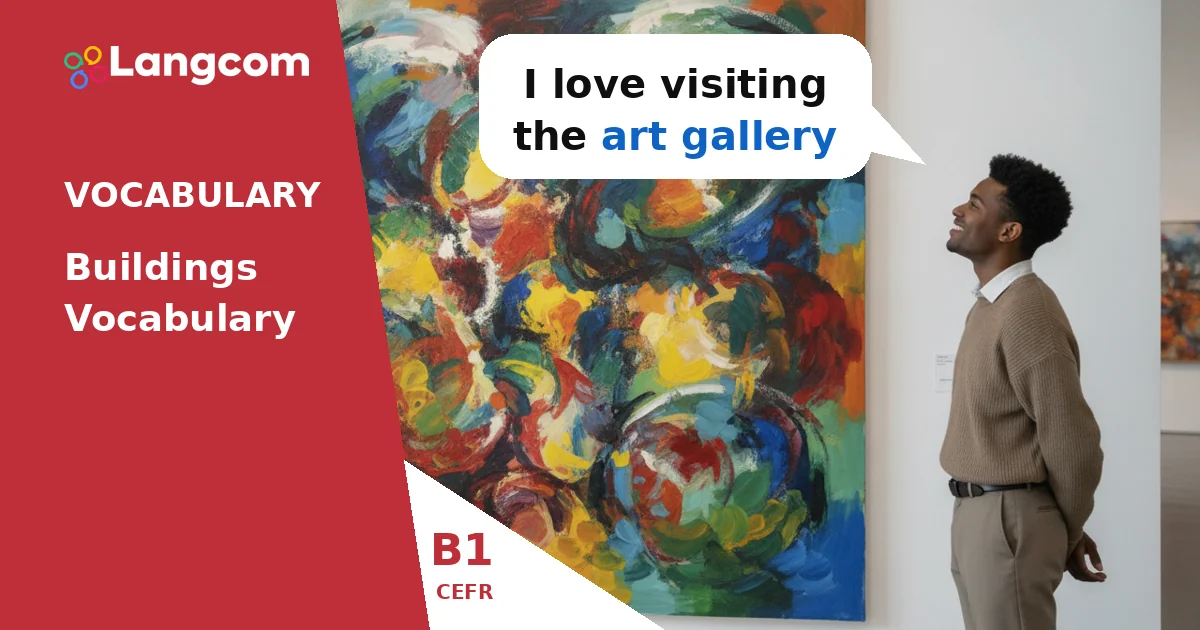

Why Learn About Buildings and Places?
Learning vocabulary for buildings and places helps you communicate clearly in many situations.
- You can describe your hometown to new friends.
- You can ask for or give directions when traveling.
- You can understand news or stories about local events.
- This vocabulary is often tested in the B1 Preliminary exam, for example, when you describe a picture or talk about your daily life.
✍️ Non sai a quale livello ti trovi?
Fai il nostro test di livello gratuito e ricevi un feedback personalizzato da esaminatori certificati Cambridge.
Fai il nostro test di livello GRATUITOWhat Kinds of Buildings and Places Are There?
Cities and towns have many different structures, each with a specific purpose. Let's look at some common ones:
Places for Shopping:
- A book shop is a store where you can buy books.
- A department store is a large shop that sells many different types of products, like clothes, electronics, and home goods, often on several floors.
- A shopping centre (or mall) is a large building or complex with many different shops, restaurants, and sometimes cinemas.
Places for Culture and Learning:
- Un art gallery is a place where paintings, sculptures, and other art are displayed for people to see.
- A library is a building where you can borrow books, magazines, and other media for free.
- A monument is a statue or structure built to remember a person or an important event.
Public and Community Spaces:
- A bridge is a structure built over a river, road, or railway to allow people or vehicles to cross.
- A fountain is a structure that sends water into the air, often found in parks or public squares.
- A town hall is the main building of a local government, where official meetings are held and local services are provided.
- A youth club is a place where young people can meet, socialize, and take part in activities.
- A sports centre is a building or complex with facilities for various sports, such as swimming pools, gyms, and courts.
Industrial Places:
- A factory is a large building where machines are used to make goods in large quantities.
| Parola inglese | What It Is / Its Purpose |
|---|---|
| Art gallery | A place to see paintings and other art. |
| Book shop | A store where you buy books. |
| Bridge | A structure for crossing over water or roads. |
| Shopping centre | A large building with many different shops and restaurants. |
| Department store | A large shop selling many types of goods on different floors. |
| Library | A place where you can borrow books for free. |
| Factory | A building where products are made using machines. |
| Fountain | A structure that sends water into the air, often decorative. |
| Monument | A structure built to remember a person or event. |
| Town hall | The main building for local government. |
| Youth club | A place for young people to meet and do activities. |
| Sports centre | A building with facilities for various sports. |
Esempi
- I love visiting the art gallery to see new exhibitions.
- She bought a novel at the book shop yesterday.
- The old bridge offers a beautiful view of the river.
- We spent the afternoon at the shopping centre looking for new clothes.
- My mother always buys her clothes at the same department store.
- You can borrow books from the library for three weeks.
- Many cars are produced in that factory on the edge of town.
- Children often play near the fountain in the main square.
- The city built a new monument to honor the local heroes.
- The mayor works in the town hall.
- Teenagers can meet friends at the youth club after school.
- I go to the sports centre twice a week to swim.
Esercitazione
Sei pronto a ottenere il tuo certificato?
Il corso Langcom prepara gli studenti agli esami Cambridge, IELTS, TOEFL, DELE, SIELE e Michigan.
Inizia a utilizzare LangcomErrori comuni per chi parla spagnolo
Spanish speakers sometimes confuse certain words because of similar concepts or direct translations:
- Library vs. Book shop: In Spanish, 'librería' can mean both. Remember: a library is for borrowing books (like 'biblioteca'), and a book shop is for buying books. For example, you say "I went to the library to return a book" (correct) not "I went to the book shop to return a book" (incorrect).
- Shopping centre vs. Department store: A shopping centre (or mall) is a collection of many different stores. A department store is one very large store that sells many types of goods under one roof. Think of a shopping centre as 'centro comercial' and a department store as 'grandes almacenes'.
Domande frequenti
What is the difference between a library and a book shop?
A library is a place where you can borrow books for free, and then you return them. A book shop is a store where you buy books to keep.
Why is this vocabulary important for the B1 Preliminary exam?
This vocabulary is important for the B1 Preliminary exam because you might need to describe your town, a place you visited, or where an event happened in the speaking or writing parts. For example, you could be asked to describe a picture of a city or talk about your favourite shopping centre.
Can I use these words in daily conversation?
Yes, absolutely! These words are very common and useful for daily conversations. You will use them to talk about where you go, what you do, and describe places to other people.
What is a youth club?
A youth club is a place specifically for young people, usually teenagers, to meet, socialize, and participate in various activities like sports, games, or arts and crafts in a safe environment.

0 Commenti