

What are the main uses of ‘would’ in English?
Would is a powerful modal verb with many functions. It often helps us talk about things that are not real, not certain, or that happened in the past.
- It can describe actions that happened repeatedly in the past, like a habit.
- We use it to make requests or offers sound more polite.
- Would is key for talking about imaginary or conditional situations.
- It also plays a role in reporting what someone said or thought.
✍️ Non sai a quale livello ti trovi?
Fai il nostro test di livello gratuito e ricevi un feedback personalizzato da esaminatori certificati Cambridge.
Fai il nostro test di livello GRATUITOHow do we use 'would' for past habits?
Utilizziamo would to talk about actions that happened regularly or repeatedly in the past. This is similar to used to, but would is generally for actions, not states.
- It describes typical behavior from a past period.
When I was a child, my grandmother would always bake cookies on Sundays. - We often use it in storytelling to set a scene or describe routines.
Every summer, we would go to the beach and spend hours playing in the sand.
Remember, we don't usually use would for past states (e.g., I would live in Madrid is incorrect; use I used to live in Madrid).
When do we use 'would' for polite requests and offers?
Would makes requests and offers sound much more polite and less direct. It's a common feature of formal and informal polite English.
- For polite requests, we often use Would you...? oppure Would you mind...?
Would you mind closing the window, please?
Would you be able to help me with this box? - For polite offers, we can use Would you like...?
Would you like some more coffee?
I would be happy to assist you.
How does 'would' work in conditionals and hypothetical situations?
Would is fundamental in second and third conditional sentences, which describe unreal or imaginary situations.
- In second conditionals, would describes the hypothetical result of an unlikely or imaginary present/future condition.
If I won the lottery, I would travel the world. (I probably won't win) - In third conditionals, would have + past participle describes the hypothetical result of an unreal past condition.
If you had studied harder, you would have passed the exam. (You didn't study, so you didn't pass) - Utilizziamo inoltre would to talk about wishes or preferences that are contrary to fact.
I wish he would listen to my advice.
What about 'would' in reported speech?
Would is the past form of will when we report what someone said or thought. This is part of backshifting in reported speech.
- Direct speech: She said, "I will call you tomorrow."
- Reported speech: She said she would call me the next day.
- This also applies to questions.
Direct speech: He asked, "Will you come?"
Reported speech: He asked if I would come.
Can 'would' express willingness or refusal?
Sì, would and especially wouldn't can express willingness or refusal in the past.
- Would can show a past willingness.
He said he would help, and he did. - Wouldn't often means "refused to" or "was unable to" in the past.
The car wouldn't start this morning. (It refused/was unable to start)
I asked him to apologize, but he wouldn't. (He refused to apologize)
How can 'would' express typical behavior or opinions?
Would can describe what is typical or expected in a certain situation, or express an opinion politely.
- To describe typical behavior:
It's just like him that he would forget his keys. (It's typical of him)
Who would have thought she would win? (Expresses surprise about something unexpected but now known) - To express a polite opinion or judgment:
I would say that's a fair assessment.
I wouldn't recommend eating there.
Other advanced uses of 'would'?
At C1 level, you might also encounter would in more specific constructions:
- Would rather: To express preference.
I would rather stay home tonight.
I'd rather you didn't tell anyone. - Would have + past participle (without an 'if' clause): To express a past action that didn't happen but was intended or possible.
I would have called you, but my phone battery died. - It would appear/seem that...: To express a polite or tentative observation.
It would appear that we have a problem.
| Utilizzo | Esempio |
|---|---|
| Past Habit / Repeated Action | Every summer, we would visit my grandparents. |
| Polite Request / Offer | Would you like another slice of cake? |
| Hypothetical / Conditional | If I had more time, I would learn a new language. |
| Reported Speech (Past of 'will') | He said he would call me later. |
| Past Refusal / Inability | The old machine wouldn't work anymore. |
| Polite Opinion / Expectation | I would say that's a reasonable price. |
| Preference ('would rather') | I'd rather go out tonight. |
Esempi
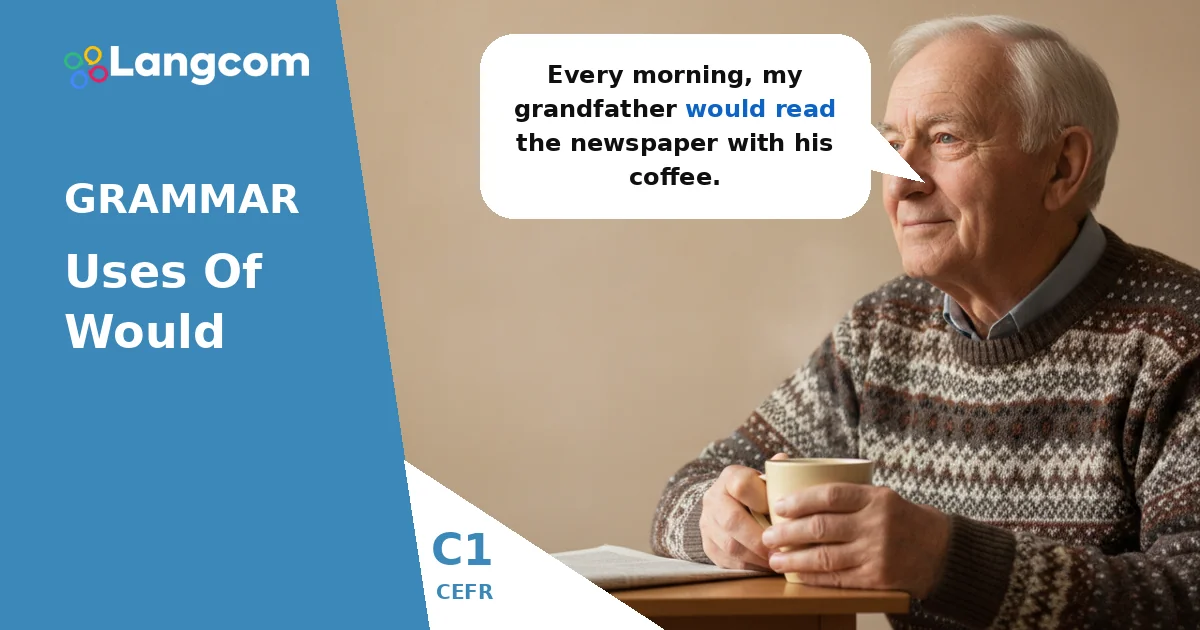
- Every morning, my grandfather would read the newspaper with his coffee.
- Would you mind helping me carry these bags?
- If I were you, I would accept the job offer.
- She promised she would be there by 7 PM.
- The old engine just wouldn't turn over.
- I would imagine it's quite difficult to learn Japanese.
- We would often spend our holidays at the lake.
- He asked if I would like to join them for dinner.
- If they had known, they would have told us immediately.
- I would rather have tea than coffee right now.
Esercitazione
Sei pronto a ottenere il tuo certificato?
Il corso Langcom prepara gli studenti agli esami Cambridge, IELTS, TOEFL, DELE, SIELE e Michigan.
Inizia a utilizzare LangcomErrori comuni per chi parla spagnolo
Spanish speakers often encounter specific challenges when using would due to similarities and differences with the Spanish conditional tense (e.g., -ría).
- Overusing would for past states: In Spanish, you might say "Yo viviría en Madrid" in a conditional sense, but for a past habit of living, you'd use imperfect. In English, would is for repeated actions, not states.
❌ When I was young, I would live in a small town.
✅ When I was young, I used to live in a small town. (For a state)
✅ When I was young, I would play in the park every day. (For a repeated action) - Confuso wouldn't with simple negation: Wouldn't often implies refusal or inability, not just "did not."
❌ I wouldn't go to the party yesterday. (If you simply didn't go)
✅ I didn't go to the party yesterday.
✅ I asked him to come, but he wouldn't. (He refused) - Direct translation of conditional: Mentre would often translates to -ría, its range of use for past habits or typical behavior is broader than the Spanish conditional.
❌ He would be very happy to see you. (If referring to a general state, use simple present or future)
✅ He would be very happy to see you if you came. (Conditional)
✅ He is very happy to see you. (Simple present)
Domande frequenti
Is 'would' always about the past?
No, not always. While would can refer to past habits or be the past of will, it is also used for hypothetical situations in the present or future (e.g., If I had time, I would help you). It often creates a sense of distance from reality or certainty.
What is the difference between 'would' and 'used to' for past habits?
Both express past habits. However, used to can describe both past actions and past states (e.g., I used to live there). Would is typically used only for repeated past actions, not states (e.g., We would play outside every day, but not We would be happy there).
Can I use contractions with 'would'?
Sì, would often contracts to 'd, especially in informal speech and writing. For example, I would like becomes I'd like, e they would have becomes they'd have. The negative form would not contracts to wouldn't.
Is 'would' more formal than 'will' for requests?
Yes, generally would makes requests more polite and less direct than will. Ad esempio, Would you open the door? is politer than Will you open the door?, especially when speaking to someone you don't know well.

0 Commenti