

What Vocabulary Do You Need for Job Applications?
When you look for a job, you will use specific words. These words help you describe the process of finding and getting a new position.
- Apply for (a job): This means to formally ask for a job, often by sending a CV or filling out a form.
I want to apply for the marketing position.
- Candidate: A candidate is a person who is trying to get a job or is being considered for a job.
There were many candidates for the manager role.
- CV (Curriculum Vitae): This is a document that lists your education, work experience, and skills. It is often used when you apply for a job.
Please send your CV to the HR department.
- Grades: These are marks you receive for your schoolwork or exams. Good grades can be important for your CV.
She got excellent grades in her university course.
🎓 Impara l'inglese con il metodo misto
Piccoli gruppi · Tutor IA disponibile 24 ore su 24, 7 giorni su 7 · Preparazione agli esami di Cambridge
Piani da $39 $79 al mese
Who Works in a Company?
Understanding the different roles and relationships in a workplace is important. Here are some key terms:
- Employer: Un employer is a person, company, or organization that hires and pays people to work.
Our employer offers good benefits.
- Employee: Un employee is a person who works for another person or a company for wages or a salary.
All employees must follow the company rules.
- In charge of: If you are in charge of something, you are responsible for it or you control it.
Who is in charge of this project?
- Business contacts: These are people you know through your work who can help you professionally, for example, by offering advice or job opportunities.
Networking helps you build strong business contacts.
How Can You Talk About Your Professional Life?
These words help you discuss your long-term professional journey and what you know.
- Career: Il tuo career is the series of jobs and experiences that a person has in a particular area of work, usually over a long period.
She has a successful career in medicine.
- Knowledge: This refers to information, understanding, or skill that you get through experience or education.
His knowledge of computers is impressive.
| Parola/Frase | Significato | Example Sentence |
|---|---|---|
| Apply for | To formally request a job or position. | She will apply for the manager role. |
| Candidate | A person applying for or being considered for a job. | We interviewed five candidates. |
| Career | The series of jobs and experiences over a person's working life. | He had a long career in finance. |
| Knowledge | Information, understanding, or skill gained through experience or education. | Her knowledge of marketing is excellent. |
| Employee | A person employed for wages or salary, especially at non-executive level. | The company has 100 employees. |
| In charge of | Responsible for something or someone. | I am in charge of the new project. |
| Grades | Marks given for schoolwork or exams. | Good grades can help you get into university. |
| CV | Curriculum Vitae; a summary of your education and experience for job applications. | Update your CV regularly. |
| Business contacts | People you know professionally who can help your career. | Networking helps build business contacts. |
| Employer | A person or organization that employs people. | Our employer provides health insurance. |
Esempi
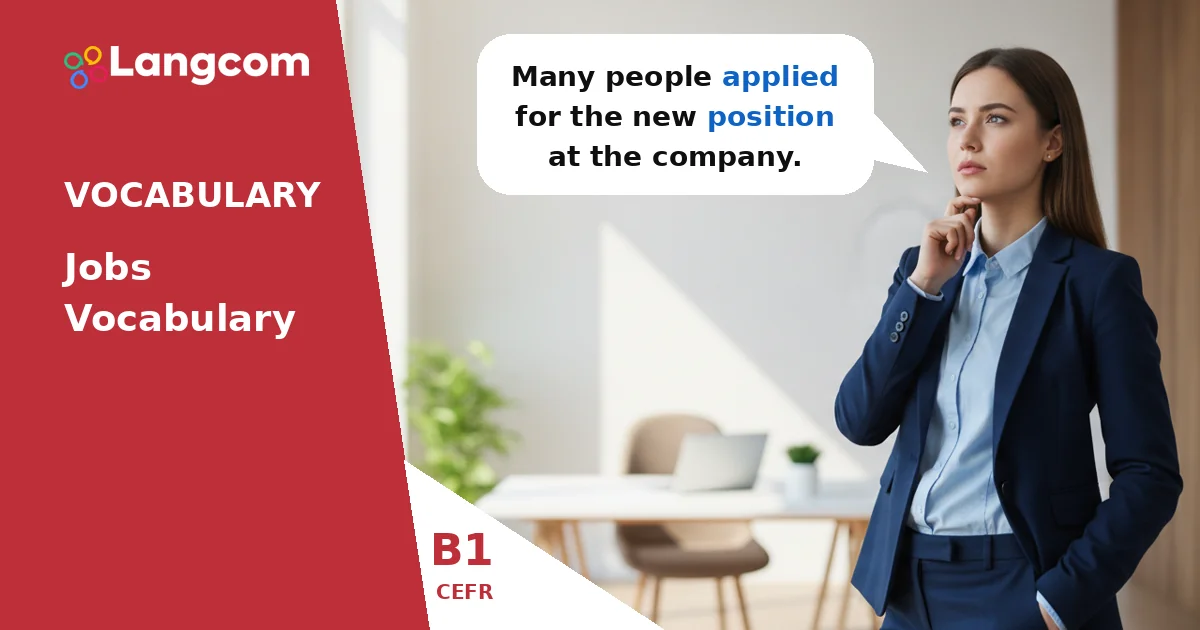
- Many people applied for the new position at the company.
- The best candidate will get the job offer next week.
- Building a strong career takes time and effort.
- She has deep knowledge of ancient history.
- The company has over 500 employees worldwide.
- I am in charge of the sales team this quarter.
- Good grades are important for university applications.
- Remember to update your CV before applying for jobs.
- My business contacts helped me find a new opportunity.
- The employer is looking for someone with experience.
Esercitazione
✍️ Non sai a quale livello ti trovi?
Fai il nostro test di livello gratuito e ricevi un feedback personalizzato da esaminatori certificati Cambridge.
Fai il nostro test di livello GRATUITOErrori comuni per chi parla spagnolo
It is common for Spanish speakers to confuse certain English words related to work. Be careful with these:
- Job vs. Work:
- Job (noun): A specific position of employment. You have a job. (e.g., I have a new job as a teacher.)
- Work (uncountable noun): The activity involved in a job, or the place where you do it. (e.g., I have a lot of work to do. oppure I go to work every day.) - Employer vs. Employee:
- Employer: The person or company that PAYS you. (e.no-translation>g., The employer hired new staff.)
- Employee: The person who IS PAID to work. (e.g., The employee works hard.) - Career vs. Job:
- Job: A single position you hold. (e.g., My first job was at a restaurant.)
- Career: The whole series of jobs and experiences over your professional life. (e.g., She had a long career in law.)
Domande frequenti
What is the main difference between 'job' and 'work'?
The main difference is that job is a countable noun for a specific position (e.g., a job, many jobs). Work is usually an uncountable noun for the activity or effort (e.g., I have a lot of work) or the place (e.g., I go to work).
What does 'CV' stand for and what is it used for?
CV stands for Curriculum Vitae. It is a document that summarizes your education, skills, and work experience. You use it when you apply for a job to show an employer why you are a good candidate.
Can 'grades' refer to anything other than school marks?
Sì, grades can also refer to levels of quality or importance. For example, you might talk about different grades of coffee. However, in the context of jobs and education, it almost always means school marks.
Why are 'business contacts' important for a career?
Business contacts are important because they can help you find new job opportunities, give you advice, or introduce you to other professionals. They are part of building your professional network and can advance your career.



0 Commenti