
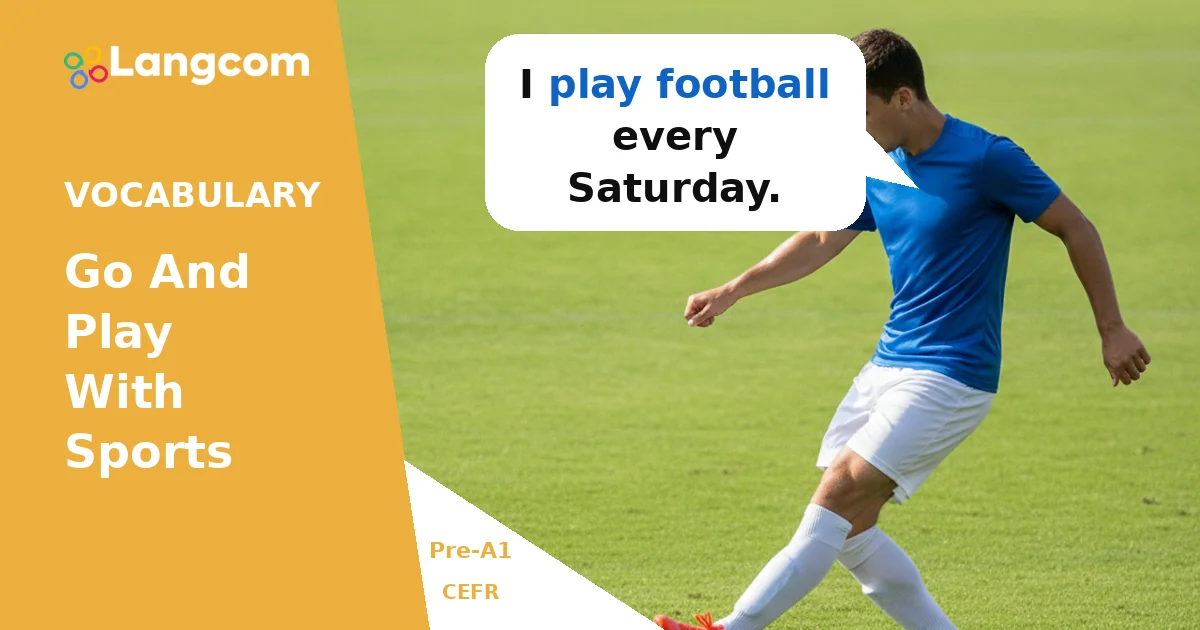

When Do We Use ‘Play’ with Sports?
Nous utilisons le verbe play for sports that involve a ball. We also use play for team sports and competitive games.
Think about sports where you ‘play a game’.
- Utilisation play for football.
- Utilisation play for basketball.
- Utilisation play for tennis.
- Utilisation play for volleyball.
- Utilisation play for golf.
🎓 Apprenez l'anglais grâce à la méthode mixte
Petits groupes · Tuteur IA disponible 24 h/24, 7 j/7 · Préparation aux examens de Cambridge
Plans provenant de $39 $79 par mois
When Do We Use 'Go' with Activities?
Nous utilisons le verbe go for activities that end with -ing. These are often individual activities or activities that involve moving from one place to another.
Think about activities where you 'go somewhere to do something'.
- Utilisation go for swimming.
- Utilisation go for sailing.
- Utilisation go for horse riding.
- Utilisation go for windsurfing.
| Utilisation <span data-no-translation>Play</span> for... | Utilisation <span data-no-translation>Go</span> for... |
|---|---|
| football | swimming |
| basketball | sailing |
| tennis | horse riding |
| golf | windsurfing |
| volleyball |
Exemples
- I play football every Saturday.
- She wants to play tennis.
- They play basketball at school.
- We go swimming in the summer.
- He likes to go sailing.
- Do you go horse riding?
Entraînement
💬 Vous avez besoin de conseils personnalisés ?
En tant que centre de préparation agréé par Cambridge, nous pouvons vous aider à choisir la formation et la certification qui vous conviennent. Discutez-en dès aujourd'hui avec nos conseillers.
Discutez avec un conseiller sur WhatsAppErreurs courantes chez les hispanophones
Many Spanish speakers sometimes use do ou make for activities where English uses go ou play.
For example, you might say hacer natación in Spanish. But in English, we say go swimming.
It is also common to forget the -ing ending after go.
Incorrect : I go swim.
Correct : I go swimming.
Remember, for sports with a ball, always use play.
Incorrect : I go football.
Correct : I play football.
Questions fréquemment posées
Why do we say 'play football'?
Nous utilisons play for football because it is a sport with a ball and it is a team game.
Why do we say 'go swimming'?
Nous utilisons go for swimming because it is an activity that ends in -ing.
Is there a simple rule to remember?
Yes! Use play for sports with a ball or team games. Use go for activities that end with -ing.


0 commentaire