
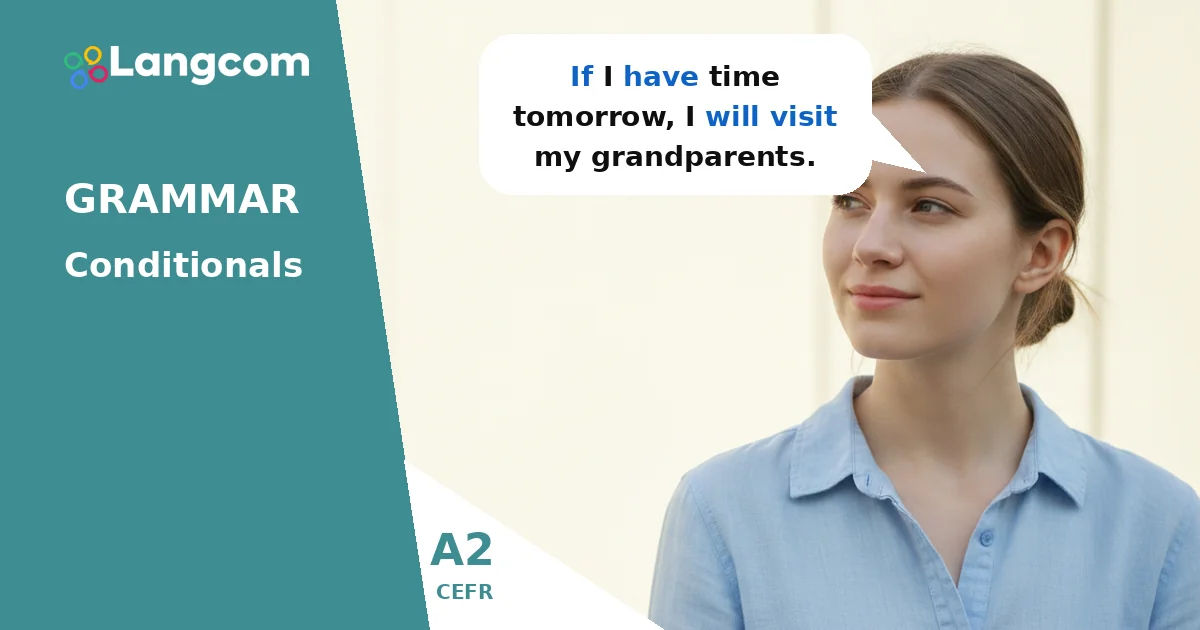

What is the First Conditional used for?
We use the first conditional to talk about future events that are possible or likely to happen. It connects a condition (something that might happen) with a result (what will happen because of that condition).
- Use it for real possibilities in the future.
- It shows a cause and effect relationship.
- The condition is not certain, but it is very possible.
✍️ Vous ne savez pas quel est votre niveau ?
Passez notre test de niveau gratuit et recevez des commentaires personnalisés de la part d'examinateurs certifiés par Cambridge.
Passez notre test de niveau GRATUITHow do we form the First Conditional?
The first conditional has two parts: the 'if' clause and the main clause. We use different verb tenses in each part.
- The 'if' clause uses the present simple tense. This part describes the condition.
- The main clause uses will + the base form of the verb. This part describes the result.
The basic structure is: If + subject + present simple, subject + will + base verb.
You can also use won't (will not) for negative results. For example: If I don't study, I won't pass the exam.
When do we use a comma?
The position of the 'if' clause can change where you put a comma.
- If the if clause comes first, we use a comma before the main clause. For example: If it's sunny, we'll go to the park.
- If the main clause comes first, we usually do not use a comma. For example: We'll go to the park if it's sunny.
| If Clause (Condition) | Main Clause (Result) |
|---|---|
| If + Present Simple | will + Base Verb |
| If it snows... | ...we will build a snowman. |
| If you don't hurry... | ...you will be late. |
Exemples
- If I have time tomorrow, I will visit my grandparents.
- She will be happy if you invite her to the party.
- If it rains, we won't go to the beach.
- They will miss the bus if they don't leave now.
- If you study hard, you will pass the A2 Key exam.
Entraînement
Prêt à obtenir votre certificat ?
Le cours Langcom prépare les étudiants aux examens de Cambridge, IELTS, TOEFL, DELE, SIELE et Michigan.
Commencez avec LangcomErreurs courantes chez les hispanophones
Spanish speakers sometimes make specific mistakes with the first conditional:
- Using 'will' in the 'if' clause: In Spanish, you might use a future tense in both parts. However, in English, the 'if' clause always uses the present simple.
- Incorrect : If I will go to the shop, I will buy some milk.
- Correct : If I go to the shop, I will buy some milk.
- Using a different tense in the 'if' clause: Remember to always use the present simple in the 'if' clause, even if the meaning is about the future.
- Incorrect : If I am going to study, I will pass.
- Correct : If I study, I will pass.
Questions fréquemment posées
What is the main purpose of the first conditional?
The first conditional is used to talk about possible future situations and their likely results. It describes real possibilities.
What is the basic structure of the first conditional?
The basic structure is If + present simple, will + base verb. For example, If I work hard, I will succeed.
Is there a difference between 'if' and 'when' in conditional sentences?
Yes. We use if for something that might happen. We use when for something that is certain to happen. For example, If it rains, I'll stay home (maybe it will rain, maybe not). But When I finish work, I'll go home (I am certain to finish work).
How is the first conditional useful for the A2 Key exam?
The first conditional is a common structure in the A2 Key exam. You might see it in reading texts, use it in writing tasks (like emails or short stories), or hear it in listening exercises. Understanding it helps you express future plans and consequences clearly.

0 commentaire