

What Are Conditional Sentences?
Conditional sentences have two parts: an if clause (the condition) and a main clause (the result). The if clause states something that might happen or might have happened. The main clause describes the consequence.
You can put the if clause first or second. If it comes first, use a comma after it. If it comes second, no comma is needed.
✍️ Vous ne savez pas quel est votre niveau ?
Passez notre test de niveau gratuit et recevez des commentaires personnalisés de la part d'examinateurs certifiés par Cambridge.
Passez notre test de niveau GRATUITZero Conditional: Facts and Habits
We use the Zero Conditional for general truths, scientific facts, or things that always happen under certain conditions. It describes a cause and effect that is always true.
- Form: If + present simple, present simple
You can often use when instead of if in this conditional, because the result is certain.
First Conditional: Real Possibilities
Les First Conditional talks about real or very likely situations in the future. It describes a possible condition and its probable result.
- Form: If + present simple, will + base verb
You can also use other modal verbs like can, may, might, should, ou must in the main clause to express different levels of certainty or advice.
Second Conditional: Imaginary Situations
We use the Second Conditional for hypothetical, unlikely, or impossible situations in the present or future. It describes what we imagine would happen if a condition were true.
- Form: If + past simple, would + base verb
For the verb to be in the if clause, we often use were pour toutes les matières (I, he, she, it) in formal English. Was is common in informal speech.
You can also use could ou might instead of would in the main clause to show possibility.
Third Conditional: Past Regrets
Les Third Conditional talks about hypothetical situations in the past. It describes what would have happened if a past condition had been different. We often use it to express regret or missed opportunities.
- Form: If + past perfect, would have + past participle
Like other conditionals, you can use could have ou might have instead of would have to express different meanings in the main clause.
Understanding Mixed Conditionals
Sometimes, the condition and the result refer to different times. This creates Mixed Conditionals. There are two common types:
- Past condition, present result: Les if clause is in the past perfect (like a Third Conditional), but the main clause est would + base verb (like a Second Conditional). This describes how a past action affects the present.
- Present condition, past result: Les if clause is in the past simple (like a Second Conditional), but the main clause est would have + past participle (like a Third Conditional). This describes how a present, ongoing condition affected a past event.
Using 'Unless' in Conditional Sentences
Unless means if not. It introduces a negative condition. The verb after unless is always positive, but the meaning of the sentence is negative.
- Exemple : Unless you study, you won't pass the exam. (This means: If you don't study, you won't pass the exam.)
You can use unless dans Zero et First Conditional sentences. It is less common in Second et Third Conditionals.
| Conditional Type | Utilisation | Form (If clause, Main clause) |
|---|---|---|
| Zero Conditional | General truths, scientific facts, habits | If + present simple, present simple |
| First Conditional | Real or likely future situations | If + present simple, will + base verb |
| Second Conditional | Imaginary or unlikely present/future situations | If + past simple, would + base verb |
| Third Conditional | Hypothetical past situations (regrets) | If + past perfect, would have + past participle |
Exemples
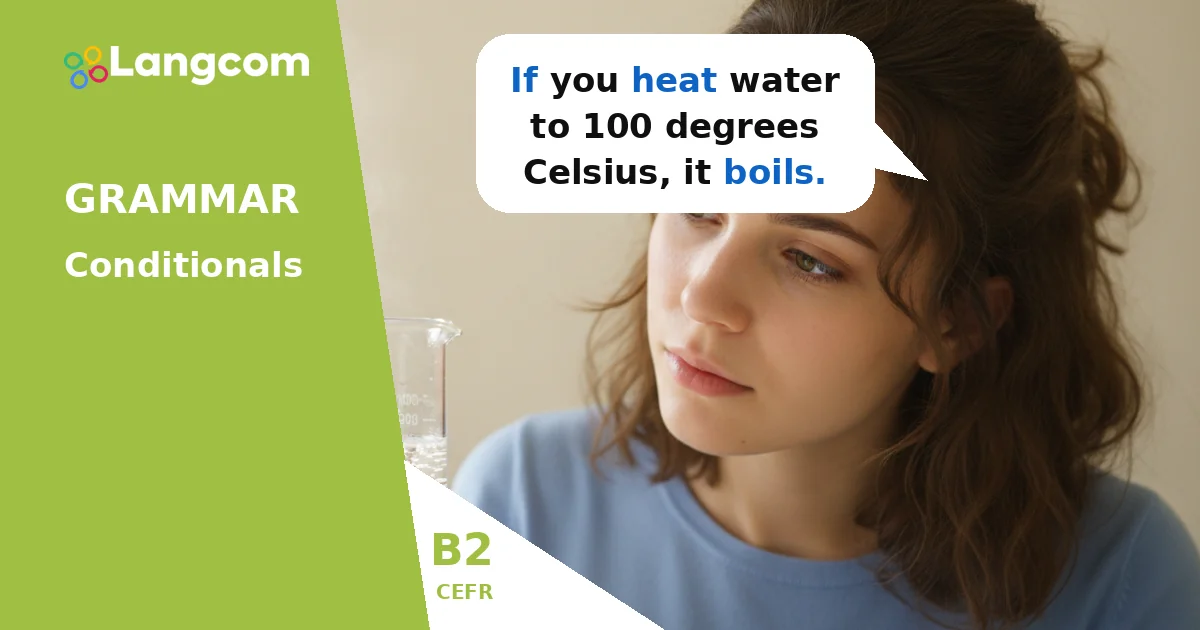
- If you heat water to 100 degrees Celsius, it boils.
- When I eat too much sugar, I feel sick.
- If it rains tomorrow, we will stay at home.
- If she studies hard, she might pass the exam.
- You must tell me if you have any problems.
- If I won the lottery, I would travel the world.
- If I were you, I'd accept the job offer.
- If they had arrived earlier, they could have seen the beginning of the show.
- If I hadn't missed the bus, I wouldn't be late now.
- If I spoke French, I would have understood what they said yesterday.
- You won't get good grades unless you do your homework.
Entraînement
Prêt à obtenir votre certificat ?
Le cours Langcom prépare les étudiants aux examens de Cambridge, IELTS, TOEFL, DELE, SIELE et Michigan.
Commencez avec LangcomErreurs courantes chez les hispanophones
Many Spanish speakers make similar mistakes with English conditionals due to direct translation or confusion with tenses:
- Using 'will' in the 'if' clause (First Conditional): In English, we use the present simple after if for future conditions.
Incorrect : If I will go, I will call you.
Correct : If I go, I will call you. - Confusing Second and Third Conditionals: N'oubliez pas que, Second Conditional is for imaginary present/future, Third Conditional is for imaginary past.
Incorrect : If I had more time, I would have visited you yesterday. (This mixes present condition with past result incorrectly).
Correct : If I had more time, I would visit you. (Second Conditional)
Correct : If I had had more time yesterday, I would have visited you. (Third Conditional) - Incorrect use of 'would' or 'could' in the 'if' clause: These modals belong in the main clause, not the if clause.
Incorrect : If I would know the answer, I would tell you.
Correct : If I knew the answer, I would tell you.
Questions fréquemment posées
What is the main difference between the First and Second Conditional?
Les First Conditional talks about real or very likely future situations. For example, If it rains, we will stay home. Les Second Conditional talks about imaginary, unlikely, or impossible situations in the present or future. For example, If I won the lottery, I would buy a house.
Can I use 'when' instead of 'if' in conditional sentences?
Yes, you can often use when instead of if in the Zero Conditional. This is because the result is always true or happens regularly. For example, When I'm tired, I go to bed early means the same as If I'm tired, I go to bed early. For other conditionals, if is generally used for conditions that may or may not happen.
Is 'if I was' correct?
For the Second Conditional, if I were is traditionally considered more grammatically correct and is preferred in formal English, especially for advice (If I were you...). However, if I was is very common and accepted in informal spoken English.
How are conditionals used in the B2 First exam?
In the B2 First (FCE) exam, you might encounter conditionals in various tasks. For example, in the Reading and Use of English paper, you might need to complete sentences using the correct conditional form (e.g., Part 2: Open Cloze ou Part 4: Key Word Transformation). In the Writing paper, you'll need to use conditionals correctly to express hypothetical situations, give advice, or discuss consequences in essays, reports, or emails.
Can I mix conditional types?
Yes, you can use Mixed Conditionals when the time frame of the condition and the result are different. For example, If I had studied harder (past condition), I would have a better job now (present result). This allows for more complex and nuanced expression of ideas.



0 commentaire