

How Do We Form the Present Perfect Tenses?
Both tenses use the auxiliary verb have ou has, but their main verbs are different.
- For the Present Perfect Simple, we use have/has + the past participle (par exemple, eaten, seen, finished).
- For the Present Perfect Continuous, we use have/has + been + the -ing form of the main verb (e.g., eating, seeing, finishing).
🎓 Apprenez l'anglais grâce à la méthode mixte
Petits groupes · Tuteur IA disponible 24 h/24, 7 j/7 · Préparation aux examens de Cambridge
Plans provenant de $39 $79 par mois
When Do We Use Present Perfect Simple?
Nous utilisons Present Perfect Simple for several situations that connect the past to the present.
- Completed actions with a present result: The action is finished, and we see the effect now. For example, I have lost my keys (so I can't get into my house now).
- Experiences: Things you have done (or not done) in your life, without saying exactly when. For example, She has visited Paris three times.
- States that started in the past and continue now: This is common with state verbs like know, be, have (for possession), live, work. We often use for ou since. For example, They have lived here for ten years.
When Do We Use Present Perfect Continuous?
Nous utilisons Present Perfect Continuous to talk about actions that started in the past and are still ongoing or have just finished.
- Actions continuing up to now: The activity started in the past and is still happening. For example, I have been studying English for two hours. (I am still studying.)
- Actions that have just stopped with a visible result: The activity recently finished, and you can see or feel the evidence. For example, Why are your clothes so dirty? I have been working in the garden.
- Temporary habits or repeated actions that started recently: Par exemple, She has been going to the gym a lot lately.
State Verbs vs. Action Verbs: A Key Difference
The type of verb can often guide your choice between the two tenses.
- State verbs (verbs that describe states, not actions, like know, believe, love, own, be) are almost always used with the Present Perfect Simple, even for ongoing situations. For example, I have known him for years. (Not I have been knowing him.)
- Action verbs (verbs that describe activities, like run, read, work, wait) can use both tenses, depending on the meaning you want to convey.
- Some verbs like live et work can often use either tense with very little difference in meaning, especially when talking about duration. For example, I have lived here for five years et I have been living here for five years are both correct.
Comparing Results: Completed Action vs. Ongoing Activity
Consider the difference in emphasis when talking about results:
- Utilisation Present Perfect Simple when the *completion* of the action is important, and it has a result now. For example, I have painted the kitchen. (The painting is finished, and the kitchen looks new.)
- Utilisation Present Perfect Continuous when the *activity itself* is important, and it has a result now, often showing tiredness or evidence. For example, I have been painting the kitchen. (I am tired, or the kitchen smells of paint, but the painting might not be finished.)
| Fonctionnalité | Present Perfect Simple | Present Perfect Continuous |
|---|---|---|
| Form | have/has + past participle | have/has + been + -ing verb |
| Main Focus | Completed action or state; result of action | Duration of activity; activity itself |
| Key Usage 1 | Life experiences (I have visited...) | Ongoing actions (I have been studying...) |
| Key Usage 2 | Completed actions with present result (I have lost my keys.) | Recent activity with visible result (I'm tired because I have been running.) |
| With State Verbs | Commonly used (I have known him.) | Rarely used (incorrect for most state verbs) |
Exemples
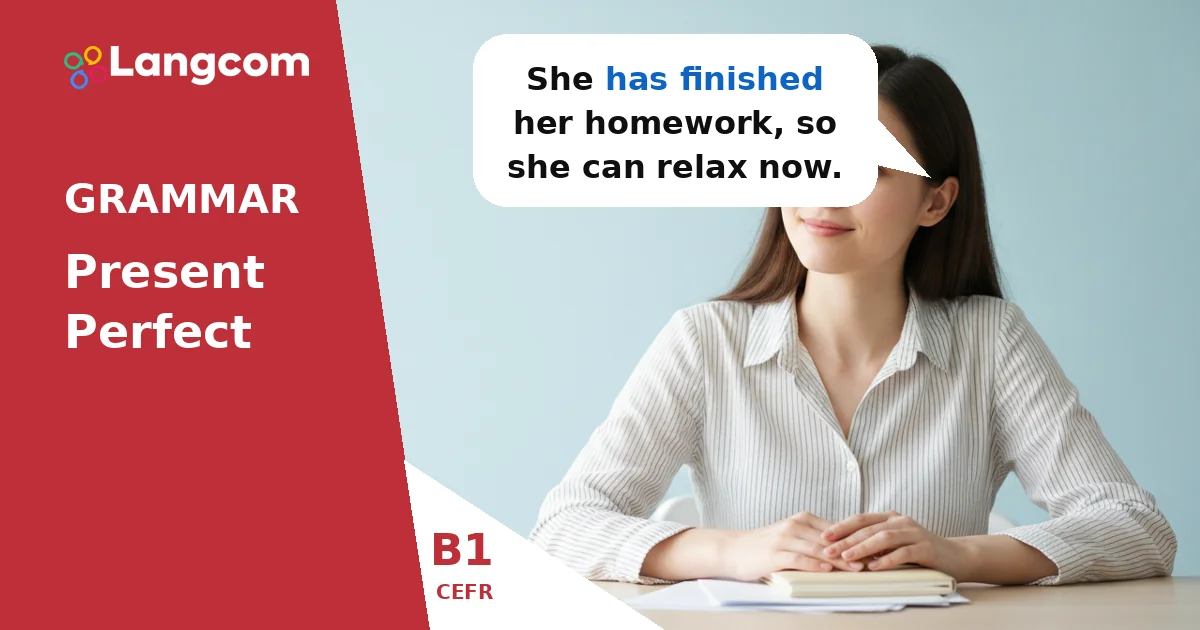
- She has finished her homework, so she can relax now.
- They have been waiting for the bus for twenty minutes.
- I have never seen a movie like that before.
- He has been playing video games all afternoon.
- How long have you known your best friend?
- My eyes are red because I have been crying.
Entraînement
✍️ Vous ne savez pas quel est votre niveau ?
Passez notre test de niveau gratuit et recevez des commentaires personnalisés de la part d'examinateurs certifiés par Cambridge.
Passez notre test de niveau GRATUITErreurs courantes chez les hispanophones
Using Simple Past Instead of Present Perfect
Spanish speakers sometimes use the simple past for actions that connect to the present, where English requires the present perfect.
- Incorrect : I bought a new car. (If you mean 'I own a new car now' and the exact time is not important.)
- Correct : I have bought a new car.
Confusing For et Since
Remember that for is used for a duration of time, and since is used for a starting point in time.
- Incorrect : I have studied English since three years.
- Correct : I have studied English for three years.
- Correct : I have studied English since 2021.
Using Continuous with State Verbs
Avoid using the continuous form with state verbs, even if the situation is ongoing.
- Incorrect : She has been owning that shop for a long time.
- Correct : She has owned that shop for a long time.
Questions fréquemment posées
What is the main difference between Present Perfect Simple and Continuous?
Les Present Perfect Simple focuses on the completion of an action or a state, often with a result now. The Present Perfect Continuous emphasizes the duration or ongoing nature of an activity, or an activity that just finished with a visible result.
Can I use both tenses with verbs like 'live' or 'work'?
Yes, with verbs like live et work, you can often use either the Present Perfect Simple ou Continuous with very little difference in meaning, especially when talking about how long something has been happening. For example, I have lived here for years et I have been living here for years are both correct.
When should I definitely use Present Perfect Simple?
You should use Present Perfect Simple for completed actions with a present result, for life experiences, and with state verbs (e.g., know, believe, own) to describe ongoing states.
When should I definitely use Present Perfect Continuous?
You should use Present Perfect Continuous for actions that are still ongoing up to the present, for activities that have just finished with a visible result (e.g., I'm tired because I've been running), or for temporary recent habits.

0 commentaire