

What is Connected Speech?
Connected speech describes how words sound different when spoken in a sentence compared to when they are said alone. In natural, fast English, words do not always stay separate. They often join together, and their sounds can change.
This is a normal part of every language. For English learners, especially at C1 level, understanding connected speech is essential for advanced listening comprehension. It helps you recognize words even when they are not pronounced clearly and separately.
✍️ Vous ne savez pas quel est votre niveau ?
Passez notre test de niveau gratuit et recevez des commentaires personnalisés de la part d'examinateurs certifiés par Cambridge.
Passez notre test de niveau GRATUITWhy Do Words Change in Connected Speech?
Words change in connected speech for several reasons:
- Efficiency: It is faster and easier to say words when they blend together.
- Rhythm: English has a stress-timed rhythm. Unstressed words often become shorter and weaker to maintain this rhythm.
- Natural Flow: Sounds at the end of one word can influence sounds at the beginning of the next, leading to smoother transitions.
One common type of change is 'reduction' or 'elision,' where sounds are dropped or made much shorter.
Understanding Reductions in Colloquial English
Reductions are a significant part of connected speech, especially in informal or colloquial English. They involve shortening words or phrases by removing sounds or syllables. This makes speech faster and more natural.
Here are some common reductions you will hear:
- kind of → kinda
Exemple : "It's kinda cold today." - because → 'cuz
Exemple : "I can't go 'cuz I'm busy." - want to → wanna
Exemple : "Do you wanna grab a coffee?" - going to → gonna
Exemple : "I'm gonna be late." - have to → hafta
Exemple : "I hafta leave now." - a lot of → lotta
Exemple : "There's a lotta traffic." - would have → woulda
Exemple : "I woulda called you." - should have → shoulda
Exemple : "You shoulda told me." - could have → coulda
Exemple : "I coulda helped." - got to → gotta
Exemple : "I gotta go." - let me → lemme
Exemple : "Lemme see that." - give me → gimme
Exemple : "Gimme a break!" - don't know → dunno
Exemple : "I dunno what to do." - do you → d'ya
Exemple : "D'ya want anything?" - did you → didja
Exemple : "Didja hear that?"
Tips for Listening to Reductions
- Listen Actively: Pay close attention to how words sound when spoken quickly. Try to identify the 'ghost' of the full words.
- Practice with Authentic Materials: Watch movies, TV shows, podcasts, and interviews with native speakers. Focus on informal conversations.
- Don't Try to Write Them: These reductions are for listening and speaking informally. Avoid writing them in formal essays or emails.
- Focus on Context: If you miss a word, the surrounding words and the overall situation can help you understand the meaning.
- Repeat and Imitate: Try to imitate the reduced forms you hear. This helps your brain connect the sound to the full form.
Exemples
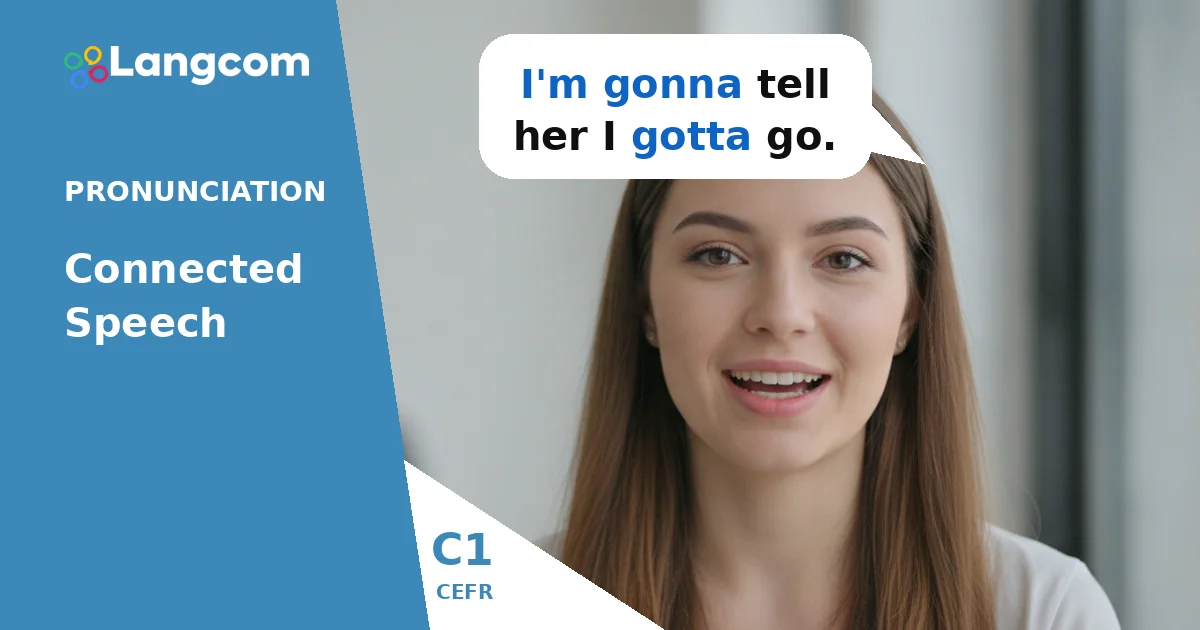
- I'm gonna tell her I gotta go.
- He shoulda known it was kinda late.
- D'ya wanna grab a lotta food?
- I dunno why she woulda said that.
- Lemme know if you hafta work tomorrow.
Entraînement
Prêt à obtenir votre certificat ?
Le cours Langcom prépare les étudiants aux examens de Cambridge, IELTS, TOEFL, DELE, SIELE et Michigan.
Commencez avec LangcomErreurs courantes chez les hispanophones
Spanish speakers often expect English words to be pronounced clearly and distinctly, similar to how words are often pronounced in Spanish. This can make connected speech, especially reductions, very challenging.
- Expecting Full Pronunciation: A common mistake is waiting to hear the full form of words like "going to" ou "kind of." When you hear "gonna" ou "kinda" instead, it can sound like a completely different word, leading to confusion.
- Misinterpreting Sounds: Sometimes, a reduced sound might be confused with another word. For example, "woulda" might sound like "water" if not heard in context.
- Over-using Reductions in Formal Settings: While understanding reductions is good for listening, using them too much in formal speaking or writing can sound inappropriate. Remember, "I wanna go" is informal, while "I want to go" is standard.
Questions fréquemment posées
Are reductions grammatically correct?
Reductions are not grammatically correct in written English, and they are generally considered informal in spoken English. They are natural features of colloquial speech, not formal grammar rules. You should understand them for listening, but use standard forms like "want to" ou "going to" in formal speaking and all writing.
Do all native speakers use these reductions?
Most native speakers use some form of reductions in their everyday, informal conversations. The extent can vary by region, individual speaking style, and the level of formality. You will hear them frequently in movies, TV shows, and casual chats.
How can I improve my listening for connected speech at C1 level?
At C1, focus on active listening to authentic materials. Try to predict what reduced forms you might hear. Practice transcribing short audio clips, paying attention to how words blend. Don't be afraid to rewind and listen multiple times. Understanding the common patterns of reduction, like "wanna" for "want to," will significantly improve your comprehension.
Will I be tested on connected speech in C1 exams?
C1 exams (like CAE or IELTS) often feature listening tasks with authentic, natural speech. While you won't be asked to identify specific reductions, your ability to understand speakers who use connected speech and reductions is crucial for achieving a high score in the listening section. The exercises in this course are designed to help you prepare for such real-world listening challenges.


0 commentaire