
par Raúl | Sep 17, 2026 | B1 Anglais intermédiaire
The passive voice in English helps you focus on the action or the object receiving the action, rather than the person or thing performing it. You form the passive voice using the verb ‘to be’ plus the past participle of the main verb. For example, instead...
par Raúl | Sep 17, 2026 | B1 Anglais intermédiaire
Learning vocabulary for film and TV genres helps you talk about your favorite shows and movies in English. Knowing words like comedy, drama, and documentary allows you to describe what you like to watch and understand what others are talking about. This is useful for...
par Raúl | Sep 17, 2026 | B2 First (FCE)
The passive voice helps you focus on the action or result of an event, rather than who performed it. It is formed using a form of the verb to be followed by the past participle of the main verb. We often use the passive when the person or thing doing the action is...
par Raúl | Sep 17, 2026 | B2 First (FCE)
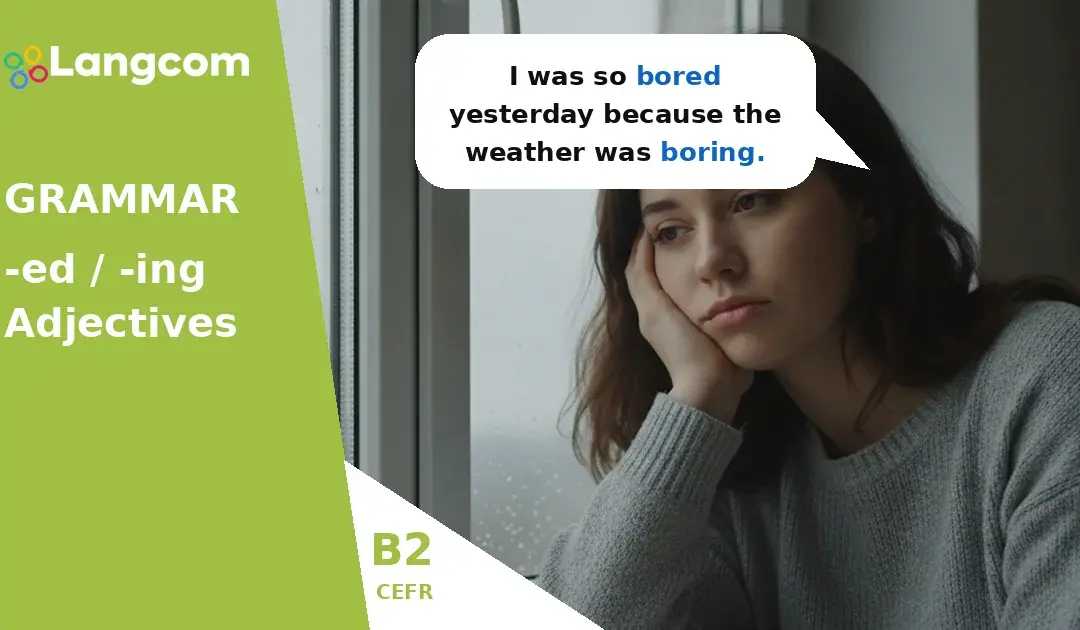
-ed adjectives describe how a person or animal feels, focusing on the effect of something on them, while -ing adjectives describe the person, thing, or situation that causes that feeling or effect. This distinction is a common point of confusion for English learners,...
par Raúl | Sep 17, 2026 | B2 First (FCE)
Adjectives describe nouns or pronouns, while adverbs describe verbs, adjectives, or other adverbs. However, a special group of verbs, known as ‘linking verbs,’ are always followed by an adjective, not an adverb. These include verbs like be, seem, become,...
