

What are common vehicles for personal travel?
This section focuses on vehicles many people own or use for individual trips.
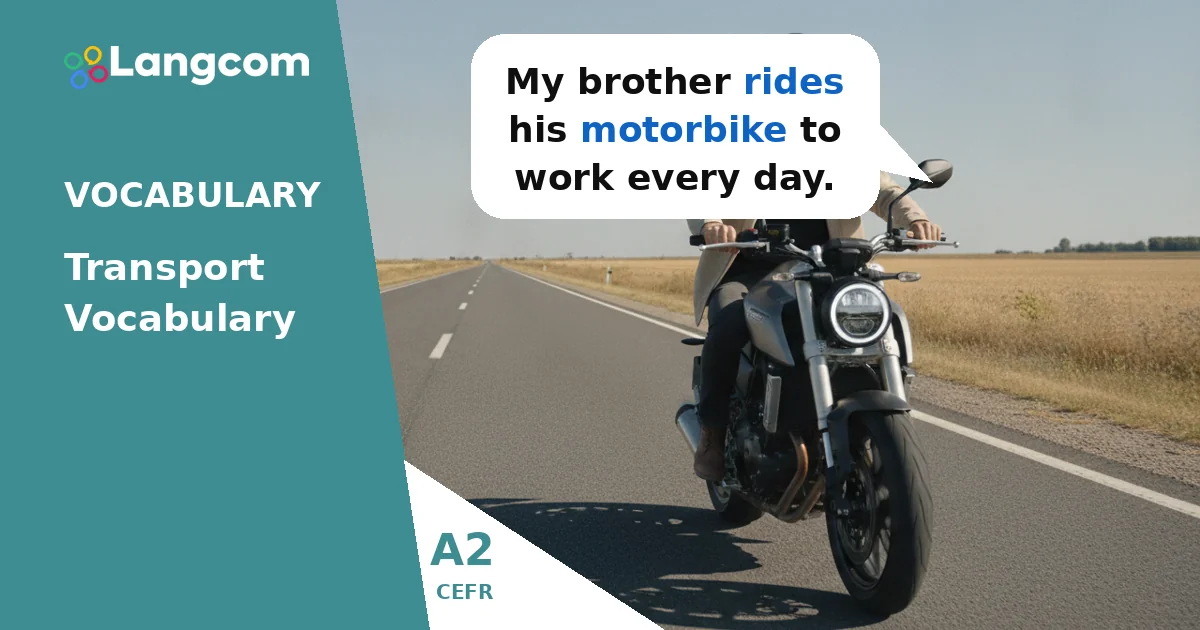
- A motorbike is a two-wheeled vehicle with an engine. It is faster and more powerful than a scooter.
- A scooter is also a two-wheeled vehicle with an engine, but it is usually smaller and easier to ride than a motorbike.
- A taxi is a car with a driver that you pay to take you to a specific place. You can usually find them in cities.
✍️ Vous ne savez pas quel est votre niveau ?
Passez notre test de niveau gratuit et recevez des commentaires personnalisés de la part d'examinateurs certifiés par Cambridge.
Passez notre test de niveau GRATUITWhat vehicles do we use for public transport?
Public transport helps many people travel together.
- A coach is a long, comfortable bus used for long journeys, often between cities or for tourist trips.
- A tram is a vehicle that runs on rails in the street, often in cities. It is like a train but for shorter distances in urban areas.
- Other common public transport vehicles include a bus (for shorter city journeys) and a train (for longer journeys, often between cities).
What about vehicles in the air?
Some vehicles travel high above the ground.
- A helicopter is an aircraft that flies using large blades on top that spin around. It can fly straight up and down and hover in the air.
- A plane (ou aeroplane) is a larger aircraft with wings, used for flying long distances.
How do we talk about different types of transport?
We often use the word "by" to say how we travel.
- Utilisation by car, by bus, by train, by plane, by motorbike, by scooter, by tram, by coach.
- Exemple : I go to work by bus.
- But for walking, we say on foot. Example: I go to school on foot.
- For taxi, we often say take a taxi ou in a taxi. Example: We took a taxi to the airport.
| Vehicle | Common Use |
|---|---|
| Motorbike | Personal travel, faster than a scooter |
| Coach | Long-distance public travel between cities |
| Helicopter | Air travel, can fly vertically |
| Scooter | Personal travel, smaller and easier than a motorbike |
| Taxi | Private car for hire in cities |
| Tram | Public transport on rails in cities |
| Bus | Public transport for short city journeys |
| Train | Public transport for longer journeys on rails |
| Plane | Air travel for long distances |
Exemples
- My brother rides his motorbike to work every day.
- We took a coach from London to Paris.
- The helicopter landed on the roof of the hospital.
- She likes riding her scooter around the city park.
- Can you call a taxi for me, please?
- The tram stops right outside my office.
- I usually travel by train when I visit my family.
- They went on holiday by plane.
Entraînement
Prêt à obtenir votre certificat ?
Le cours Langcom prépare les étudiants aux examens de Cambridge, IELTS, TOEFL, DELE, SIELE et Michigan.
Commencez avec LangcomErreurs courantes chez les hispanophones
- Confusing coach et bus:
- A bus is typically for shorter journeys within a city or town.
- A coach is for longer journeys, often between cities or countries, and is usually more comfortable.
- Correct : I take the bus to school. (Short city trip)
- Correct : We travelled by coach to the coast. (Longer trip)
- Using "in" instead of "by" for general transport:
- We say by car, by bus, by train, etc., when talking about the method of transport.
- Incorrect : I go to work in bus.
- Correct : I go to work by bus.
- However, we say in a car ou in a taxi when we are inside the specific vehicle.
- Correct : I am in a taxi now.
Questions fréquemment posées
Why is learning transport vocabulary important for A2 English learners?
Learning transport words helps you talk about daily activities, travel plans, and give directions. It is essential for communicating in many real-life situations.
What is the difference between a bus et a coach?
A bus usually makes many stops within a city. A coach is for longer journeys, often between different towns or cities, with fewer stops.
How can I use these words for the A2 Key (KET) exam?
You might need to describe how you travel in the Speaking Part 1 or write about a journey in the Writing Part 6. For example, "I travel by tram to college."




0 commentaire