

What Are Reported Questions?
Reported questions, also known as indirect questions, are a way to tell someone what another person asked without using their exact words. We often use them in conversations or when writing reports.
Think of it as summarizing a question. Instead of saying “He said, ‘Where are you going?'”, dis-tu “He asked where I was going.”
- You use a reporting verb, usually asked.
- You change the word order from a question to a statement.
- You usually change the verb tense (this is called ‘backshift’).
- You do not use a question mark at the end.
✍️ Vous ne savez pas quel est votre niveau ?
Passez notre test de niveau gratuit et recevez des commentaires personnalisés de la part d'examinateurs certifiés par Cambridge.
Passez notre test de niveau GRATUITHow to Report 'Wh-' Questions
For questions that start with what, where, when, why, who, which, ou how, you keep the wh- word in the reported question.
La structure est la suivante : reporting verb + wh- word + subject + verb (in past tense).
- Direct: "What is your name?"
- Reported: She asked what my name was.
- Direct: "Where do you live?"
- Reported: He asked where I lived.
- Direct: "When did you arrive?"
- Reported: They asked when I had arrived.
Notice how the question word order (verb + subject) changes to statement word order (subject + verb).
How to Report 'Yes/No' Questions
For questions that can be answered with a simple yes ou no, on utilise if ou whether as the connector.
La structure est la suivante : reporting verb + if/whether + subject + verb (in past tense).
- Direct: "Are you hungry?"
- Reported: She asked if I was hungry.
- Direct: "Did you finish your homework?"
- Reported: He asked whether I had finished my homework.
- Direct: "Will you come to the party?"
- Reported: They asked if I would come to the party.
Whether is slightly more formal than if, and it is often used with or not (par exemple, He asked whether I wanted to go or not.).
Important Changes When Reporting Questions
When you report a question, several things change from the direct speech version:
- Tense Backshift: The verb tense usually moves "back" in time. For example, present simple becomes past simple, et past simple becomes past perfect. (See table below for more details.)
- Pronouns: These often change to reflect the new speaker and listener. For example, I might become he/she, et you might become I/we/they.
- Time and Place Expressions: Des mots comme now, yesterday, here also change. For example, now becomes then, et yesterday becomes the day before.
- No Auxiliary Verbs: You remove do, does, ou did from the reported question.
- No Question Mark: The reported question ends with a full stop (.), not a question mark (?).
| Direct Question Tense | Reported Question Tense |
|---|---|
| Present Simple | Past Simple |
| Present Continuous | Past Continuous |
| Present Perfect | Past Perfect |
| Past Simple | Past Perfect |
| Will | Would |
| Can | Could |
| May | Might |
| Must | Had to |
Exemples
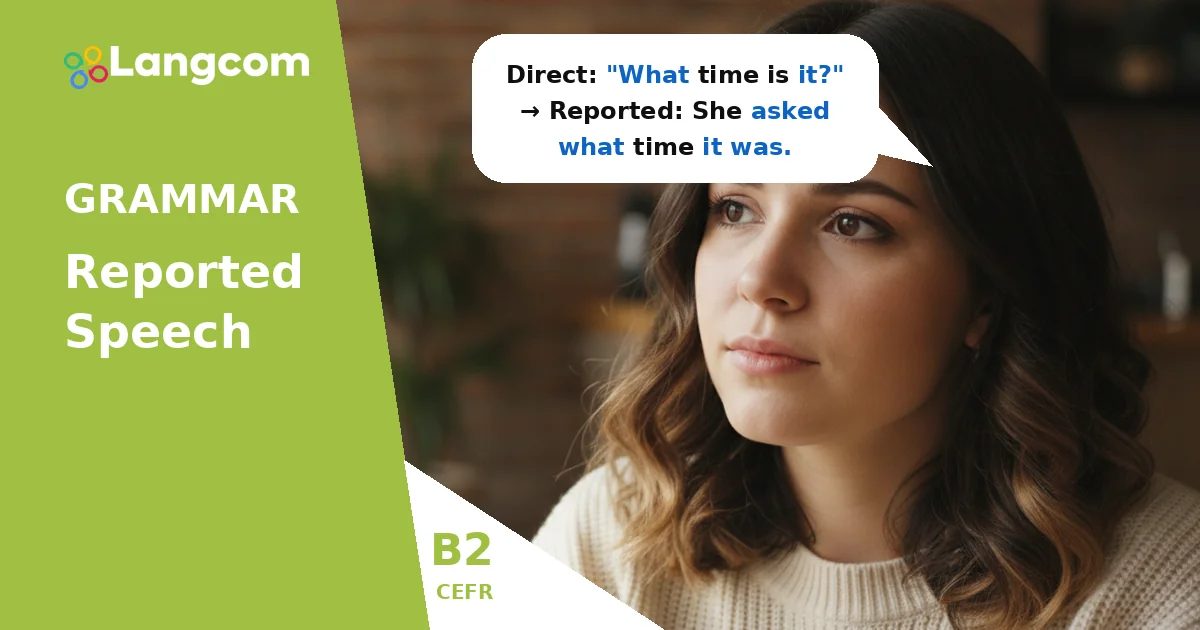
- Direct: "What time is it?" → Reported: She asked what time it was.
- Direct: "Where did you go last night?" → Reported: He asked where I had gone the previous night.
- Direct: "Are you feeling better?" → Reported: My friend asked if I was feeling better.
- Direct: "Have you ever been to London?" → Reported: They asked whether I had ever been to London.
- Direct: "Why are you late?" → Reported: The teacher asked why I was late.
- Direct: "Can you help me?" → Reported: She asked if I could help her.
Entraînement
Prêt à obtenir votre certificat ?
Le cours Langcom prépare les étudiants aux examens de Cambridge, IELTS, TOEFL, DELE, SIELE et Michigan.
Commencez avec LangcomErreurs courantes chez les hispanophones
Spanish speakers often make specific mistakes when forming reported questions due to differences in grammatical structures. Be careful with these common errors:
- Incorrect Word Order: A very common mistake is keeping the question word order (verb before subject) instead of changing to statement order (subject before verb).
- Incorrect: He asked where was I going.
- Correct: He asked where I was going.
- Not Removing Auxiliary Verbs: Forgetting to remove do, does, ou did.
- Incorrect: She asked what did I want.
- Correct: She asked what I wanted.
- Using 'that' for Yes/No Questions: Using that instead of if ou whether.
- Incorrect: He asked that I was ready.
- Correct: He asked if I was ready.
- No Tense Backshift: Not changing the verb tense to a past form.
- Incorrect: They asked what is my name.
- Correct: They asked what my name was.
Questions fréquemment posées
What is the main difference between direct and reported questions?
The main difference is that direct questions use the exact words of the speaker and end with a question mark (e.g., "Where is the station?"). Reported questions tell you what was asked without using the exact words, changing the word order to a statement, shifting tenses, and ending with a full stop (e.g., She asked where the station was.).
Do I always change the tense in reported questions?
Generally, yes, you should shift the tense back (e.no-translation.g., present simple à past simple). However, if the reported question refers to a situation that is still true or a general truth, the tense change is optional. For example, "What is your name?" could be He asked what my name was ou He asked what my name is if your name hasn't changed.
How are reported questions tested in the B2 First exam?
Reported questions are often tested in the Use of English Part 3 (Word Formation) ou Part 4 (Key Word Transformation). In Key Word Transformation, you might be given a direct question and a key word, and you need to rewrite the sentence as a reported question, making sure to change the word order, tense, and pronouns correctly.
Can I use 'if' and 'whether' interchangeably?
Yes, for most reported yes/no questions, if et whether are interchangeable. Whether is slightly more formal. You must use whether when it's followed immediately by or not (par exemple, She asked whether or not I wanted coffee.) or after a preposition (e.g., We discussed whether to go.).



0 commentaire