

What Are English Verb Patterns?
In English, when one verb follows another, the second verb often needs a specific form. This is called a verb pattern.
These patterns tell you whether to use the -ing form (a gerund) or the to + infinitive form after the first verb. Choosing the correct pattern is important for clear communication.
🎓 Apprenez l'anglais grâce à la méthode mixte
Petits groupes · Tuteur IA disponible 24 h/24, 7 j/7 · Préparation aux examens de Cambridge
Plans provenant de $39 $79 par mois
When Do We Use the -ing Form (Gerund)?
Les -ing form of a verb, also known as a gerund, acts like a noun. We use it in several situations:
- After prepositions: If a verb comes after a preposition (like about, of, by, for), it must be in the -ing form. I'm interested in learning English.
- As the subject of a sentence: Les -ing form can be the main topic of your sentence. Reading helps you relax.
- After certain verbs: Many common verbs are always followed by a gerund. Examples include enjoy, mind, keep, admit, recommend, suggest. She enjoys traveling.
- After some expressions: Phrases like it's worth ou it's no good also require the -ing form. It's worth visiting that museum.
To make the gerund negative, we put not before the -ing form. He regrets not studying harder.
When Do We Use To + Infinitive?
Les to + infinitive form is used in different contexts:
- To show purpose: We often use to + infinitive to explain why someone does something. I went to the store to buy milk.
- After certain verbs: Many verbs are followed by to + infinitive. Common examples include want, hope, agree, offer, promise, need, decide. They decided to move.
- After certain adjectives: Adjectives like difficult, good, important, easy often take to + infinitive. It's important to listen.
- After question words: When a question word (like how, what, where) is followed by a verb, it often uses to + infinitive. I don't know how to fix it.
To make the infinitive negative, we put not avant to + infinitive. She promised not to be late.
What About Verbs with Objects?
Some verbs require an object (a person or thing) before the to + infinitive form:
- Verb + Object + to + Infinitive: Verbs like advise, ask, invite, remind, tell, warn follow this pattern. They invited me to join the team.
Other verbs, specifically make (meaning 'force') and let (meaning 'allow'), use an object followed by a bare infinitive (the infinitive without to):
- Make / Let + Object + Bare Infinitive: My parents made me clean my room. She let me borrow her car.
Do Some Verbs Use Both Forms?
Yes, some verbs can be followed by either the -ing form or to + infinitive. For some, the meaning stays the same:
- Same Meaning: Verbs like start, begin, et continue often have the same meaning with both patterns. It started raining. et It started to rain. mean the same thing.
However, for other verbs, the meaning changes significantly:
- Different Meaning: Verbs such as try, forget, et remember change their meaning depending on the pattern.
When Does the Meaning Change?
- Try:
- Try + -ing means to do something as an experiment or to see what happens. I tried calling her, but she didn't answer. (I experimented with calling)
- Try + to + infinitive means to make an effort or attempt to do something difficult. I tried to lift the heavy box, but I couldn't. (I made an effort) - Remember:
- Remember + -ing means to recall a past memory or experience. I remember visiting Paris when I was a child. (It's a memory)
- Remember + to + infinitive means to not forget to do something in the future. Remember to lock the door before you leave. (Don't forget this task) - Forget:
- Forget + -ing means to not recall a past event. I'll never forget seeing that beautiful sunset. (It's a strong memory)
- Forget + to + infinitive means to fail to do something you intended to do. I forgot to send the email. (I didn't do the task)
| Verb + <span data-no-translation>-ing</span> (Gerund) | Verb + <span data-no-translation>To + Infinitive</span> |
|---|---|
| enjoy | want |
| mind | hope |
| suggest | decide |
| avoid | plan |
| finish | agree |
Exemples
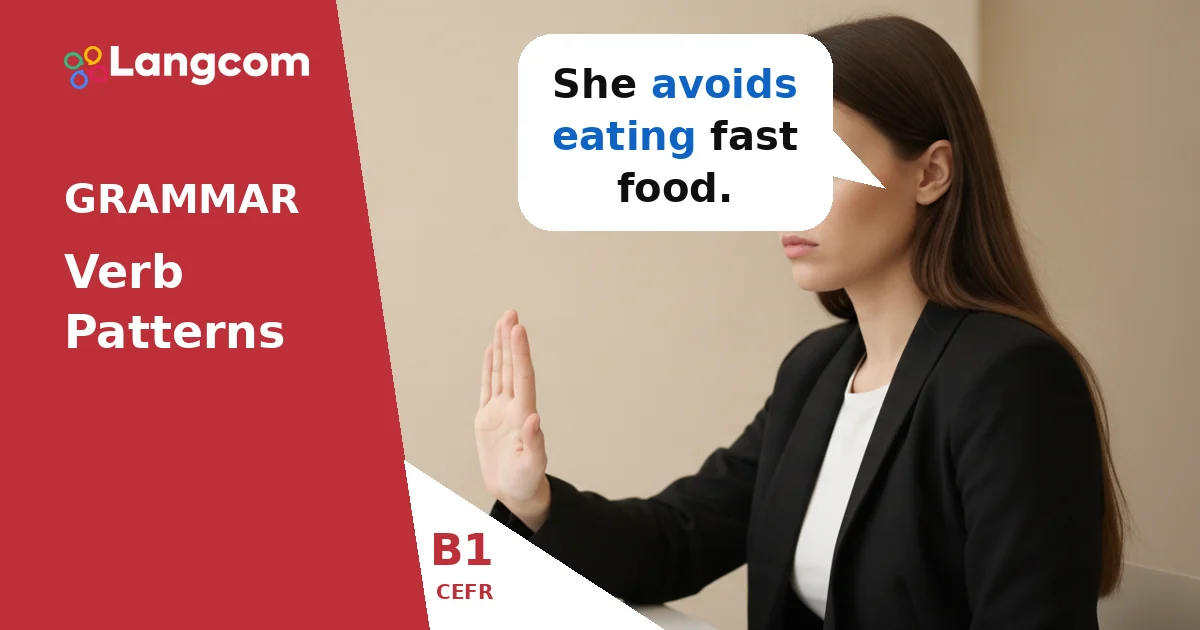
- She avoids eating fast food.
- It's difficult to understand this rule.
- We decided to study together.
- He's good at playing the guitar.
- They warned us not to touch the wires.
- My teacher made me rewrite the essay.
- I tried to open the jar, but it was too tight.
- Do you remember turning off the lights?
Entraînement
✍️ Vous ne savez pas quel est votre niveau ?
Passez notre test de niveau gratuit et recevez des commentaires personnalisés de la part d'examinateurs certifiés par Cambridge.
Passez notre test de niveau GRATUITErreurs courantes chez les hispanophones
Spanish speakers often make mistakes with verb patterns, especially by using the infinitive where a gerund is needed.
- After prepositions: In Spanish, you might use an infinitive after a preposition (e.g., interesado en aprender). In English, it must be a gerund.
- Incorrect : I am interested in to learn English.
- Correct : I am interested in learning English. - After certain verbs: Some verbs that take an infinitive in Spanish might take a gerund in English.
- Incorrect : I enjoy to dance.
- Correct : I enjoy dancing. - Objectif : While to + infinitive shows purpose in English, sometimes Spanish uses other structures. Always remember to + infinitive for 'why'.
- Incorrect : I went to the shop for buy bread.
- Correct : I went to the shop to buy bread.
Questions fréquemment posées
What is a gerund?
A gerund is the -ing form of a verb that functions as a noun. For example, in Swimming is good exercise, swimming is a gerund and the subject of the sentence.
What is an infinitive?
An infinitive is the base form of a verb, usually preceded by to (par exemple, to eat, to sleep). It can also appear as a bare infinitive (without to) after certain verbs like make ou let.
How can I remember which pattern to use?
The best way is to learn verbs with their common patterns. When you learn a new verb, try to learn if it takes -ing ou to + infinitive. Practice and exposure to English will help you remember. You can also group verbs by pattern.
Are verb patterns tested in B1 exams?
Yes, verb patterns are commonly tested in B1 English exams, often in grammar sections or through sentence completion tasks. Correct usage shows a good understanding of English sentence structure.


0 commentaire