
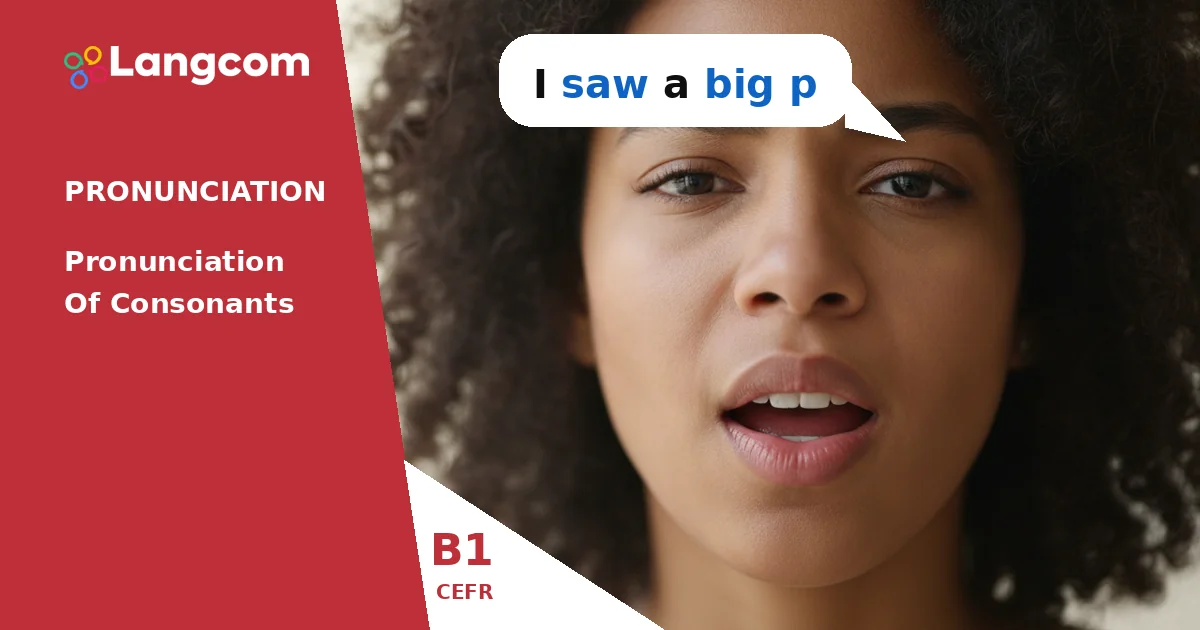

What are Voiced Consonants?
When you make a voiced consonant sound, your vocal cords vibrate. This vibration creates the sound.
You can easily feel this by touching your throat. If you feel a buzz or vibration, the sound is voiced.
- Examples of voiced sounds: /b/ as in ball, /d/ as in dog, /g/ as in go.
- Try saying “zzzzzz” like a bee. Feel the vibration in your throat? That’s a voiced sound (/z/).
🎓 Apprenez l'anglais grâce à la méthode mixte
Petits groupes · Tuteur IA disponible 24 h/24, 7 j/7 · Préparation aux examens de Cambridge
Plans provenant de $39 $79 par mois
What are Unvoiced Consonants?
Unvoiced consonants are made without your vocal cords vibrating. The sound comes from air passing through your mouth or nose.
When you touch your throat for these sounds, you will not feel any vibration.
- Examples of unvoiced sounds: /p/ as in pen, /t/ as in top, /k/ as in cat.
- Try saying "ssssss" like a snake. No vibration in your throat, right? That's an unvoiced sound (/s/).
How Can I Feel the Difference?
This simple trick will help you identify voiced and unvoiced sounds:
- Place two fingers gently on your throat, right on your voice box.
- Say a sound like /b/. You should feel a vibration.
- Now say a sound like /p/. You should feel no vibration.
- Practice with different consonant sounds to get used to the feeling.
Common Voiced and Unvoiced Pairs
Many English consonants come in pairs. One is voiced, and the other is unvoiced. They are made in the same part of the mouth but differ only by vocal cord vibration.
- /p/ (unvoiced) and /b/ (voiced)
- /t/ (unvoiced) and /d/ (voiced)
- /k/ (unvoiced) and /g/ (voiced)
- /f/ (unvoiced) and /v/ (voiced)
- /s/ (unvoiced) and /z/ (voiced)
- /θ/ (unvoiced 'th' as in think) and /ð/ (voiced 'th' as in this)
- /tʃ/ (unvoiced 'ch' as in chair) and /dʒ/ (voiced 'j' as in jump)
| Unvoiced Sound | Voiced Sound | Example Words |
|---|---|---|
| /p/ | /b/ | pat / bat |
| /t/ | /d/ | tin / din |
| /k/ | /g/ | cut / gut |
| /f/ | /v/ | fan / van |
| /s/ | /z/ | sip / zip |
| /θ/ (th) | /ð/ (th) | think / this |
| /tʃ/ (ch) | /dʒ/ (j) | chair / jail |
Exemples
- I saw a big pen. (Unvoiced /p/)
- The boy played with a ball. (Voiced /b/)
- She likes tea. (Unvoiced /t/)
- The dog is very dark. (Voiced /d/)
- He has a cat. (Unvoiced /k/)
- Let's go to the garden. (Voiced /g/)
- I need to find my friend. (Unvoiced /f/)
- They visit their village often. (Voiced /v/)
Entraînement
✍️ Vous ne savez pas quel est votre niveau ?
Passez notre test de niveau gratuit et recevez des commentaires personnalisés de la part d'examinateurs certifiés par Cambridge.
Passez notre test de niveau GRATUITErreurs courantes chez les hispanophones
Spanish speakers sometimes confuse voiced and unvoiced sounds, especially with certain pairs:
- /p/, /t/, /k/ aspiration: In English, these unvoiced sounds often have a puff of air (aspiration) at the beginning of words, like in pen ou top. Spanish p, t, k are usually not aspirated. Make sure to release that air in English!
- /v/ vs. /b/: The English /v/ (voiced) is made by touching your upper teeth to your lower lip (e.g., very). In Spanish, v et b often sound similar. Be careful not to pronounce very like berry.
- 'Th' sounds: The two 'th' sounds (/θ/ unvoiced, /ð/ voiced) do not exist in Spanish. Many learners replace them with /t/ ou /d/. Practice placing your tongue between your teeth for these sounds. For example, think (unvoiced /θ/) should not sound like tink.
Questions fréquemment posées
Why is it important to know about voiced and unvoiced consonants?
Understanding these sounds helps you pronounce English words more clearly and naturally. It also improves your listening skills, as you can better distinguish between similar-sounding words like pat et bat.
Do all consonants have a voiced and unvoiced pair?
No, not all consonants have a direct voiced/unvoiced pair. For example, /h/ as in house is unvoiced, but it doesn't have a voiced counterpart made in the same way. However, many common consonants do form these pairs.
How can I practice these sounds effectively?
Regularly use the throat vibration test. Listen carefully to native speakers and try to imitate them. Practice minimal pairs (words that differ by only one sound, like fan vs. van) to train your ear and mouth.
Are vowels voiced or unvoiced?
All vowel sounds in English are voiced. Your vocal cords always vibrate when you produce a vowel sound.

0 commentaire