

Why Learn Clothes Words in English?
Learning words for clothes is very practical. You use clothes every day.
- You can talk about what you like to wear.
- You can describe clothes when you go shopping.
- You can understand others talking about clothes.
It helps you communicate in many situations.
🎓 Apprenez l'anglais grâce à la méthode mixte
Petits groupes · Tuteur IA disponible 24 h/24, 7 j/7 · Préparation aux examens de Cambridge
Plans provenant de $39 $79 par mois
Everyday Clothes: What We Wear
Here are some common words for clothes in English:
- A T-shirt: This is a light shirt, usually with short sleeves. You wear it on your upper body.
- Trousers: These cover your legs. People wear them for many activities.
- A skirt: This is a piece of clothing for women or girls. It hangs from the waist and covers the legs.
- Socks: You wear these on your feet, inside your shoes.
- A coat: This is a warm piece of clothing you wear over other clothes, especially when it's cold.
- Shorts: These are like trousers, but they only cover part of your legs. You wear them when it's hot.
- A jumper: This is a warm knitted piece of clothing for your upper body. (In American English, it's often called a sweater.)
- Boots: These are a type of shoe that covers your foot and part of your leg.
- A dress: This is a piece of clothing for women or girls that covers the body and legs.
- Shoes: You wear these on your feet.
- Jeans: These are a type of trousers made from denim fabric.
- A hat: You wear this on your head.
Talking About Clothes: Simple Sentences
You can use these words in simple sentences. Here are some examples:
- To say what you are wearing: I am wearing a blue T-shirt.
- To describe someone else's clothes: She has a red dress.
- To talk about clothes you like: I like my new shoes.
These sentences help you practice the new words.
| For Your Body | For Your Legs | For Your Feet | For Your Head |
|---|---|---|---|
| a T-shirt | trousers | socks | a hat |
| a coat | a skirt | shoes | |
| a jumper | shorts | boots | |
| a dress | jeans |
Exemples
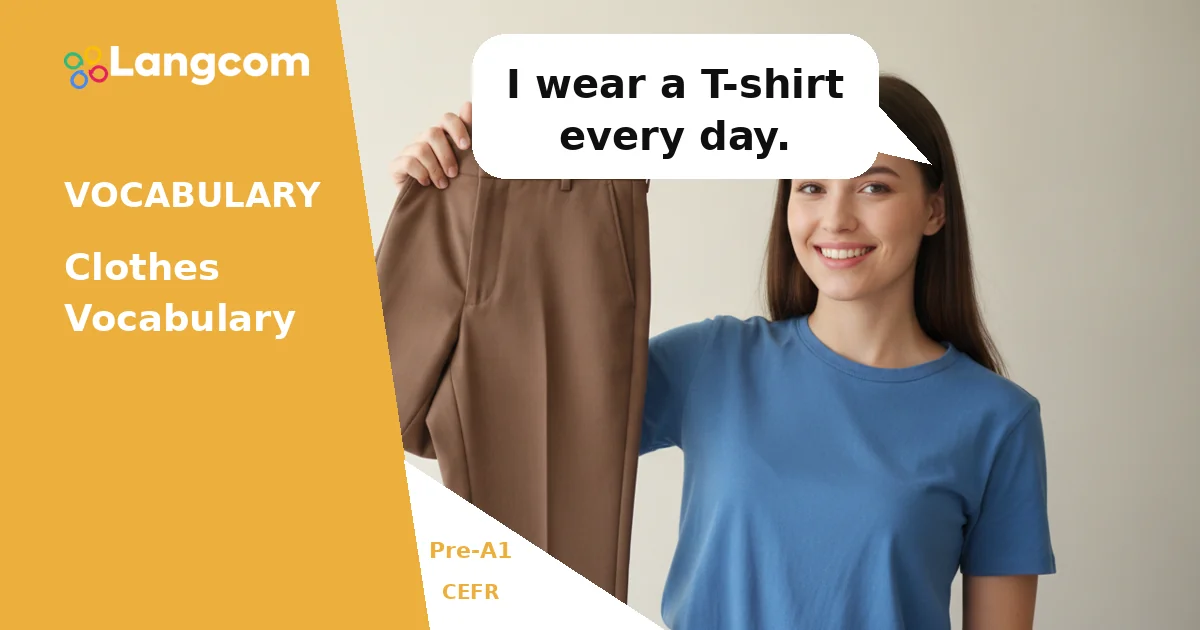
- I wear a T-shirt every day.
- My trousers are black.
- She likes her new skirt.
- I need warm socks.
- Put on your coat, it's cold.
- He wears shorts in summer.
- This jumper is very soft.
- My boots are brown.
- The dress is beautiful.
- Where are my shoes?
- I like to wear jeans.
- He has a funny hat.
Entraînement
💬 Vous avez besoin de conseils personnalisés ?
En tant que centre de préparation agréé par Cambridge, nous pouvons vous aider à choisir la formation et la certification qui vous conviennent. Discutez-en dès aujourd'hui avec nos conseillers.
Discutez avec un conseiller sur WhatsAppErreurs courantes chez les hispanophones
A common mistake for Spanish speakers is using singular forms for clothes that are always plural in English.
- Incorrect : I need a trouser.
- Correct : I need trousers. (Always plural, like 'pants' in Spanish)
The same rule applies to:
- shorts (not 'a short')
- jeans (not 'a jean')
- shoes (not 'a shoe' if you mean a pair)
- socks (not 'a sock' if you mean a pair)
- boots (not 'a boot' if you mean a pair)
Remember to use 'a pair of' if you want to specify one item from a pair, for example, a pair of trousers.
Questions fréquemment posées
What are some very basic clothes words in English?
Some very basic clothes words are T-shirt, dress, trousers, shoes, et hat. These are good words to start with.
How do I ask what someone is wearing?
You can ask: What are you wearing? ou What is she wearing?
Are 'trousers' singular or plural in English?
Trousers are always plural in English. We say My trousers are new, et non My trousers is new.
What is the difference between a 'jumper' and a 'sweater'?
Jumper et sweater mean the same thing. Jumper is more common in British English, and sweater is more common in American English.




0 commentaire