

What is Main Stress in a Sentence?
Every word in English has a stressed syllable. But in a sentence, one word usually stands out more than the rest. This is the word with the main stress.
- Les main stress is the loudest, longest, and highest-pitched sound in a sentence.
- It helps listeners understand the most important part of your message.
- Think of it as shining a spotlight on a specific word.
🎓 Apprenez l'anglais grâce à la méthode mixte
Petits groupes · Tuteur IA disponible 24 h/24, 7 j/7 · Préparation aux examens de Cambridge
Plans provenant de $39 $79 par mois
Why is Main Stress Important for Meaning?
The position of main stress can completely change the meaning of your sentence. It tells your listener what information is new or what you want them to pay attention to.
- To highlight new information: When you introduce something new, you stress that word.
- To show contrast: If you are correcting someone or comparing two things, you stress the words that show the difference.
- To express emotion: Stress can also show surprise, anger, or excitement.
How Do We Use Main Stress for Emphasis?
Most of the time, main stress falls on content words. These are words that carry the main meaning of a sentence.
- Content words include nouns (table, idea), main verbs (run, understand), adjectives (beautiful, difficult), and adverbs (quickly, always).
- Function words (comme a, the, is, on, can) are usually not stressed, unless you want to emphasize them for a special reason.
When you want to emphasize a specific word, you make it stand out. This often happens when you are correcting information or giving a strong opinion.
| Sentence | Meaning with Main Stress |
|---|---|
| I *like* coffee. | I really enjoy it (strong feeling). |
| I like *coffee*. | I like coffee, not tea or juice. |
| He *is* going. | He is definitely going (confirming). |
| He is *going*. | He is leaving now (action in progress). |
Exemples
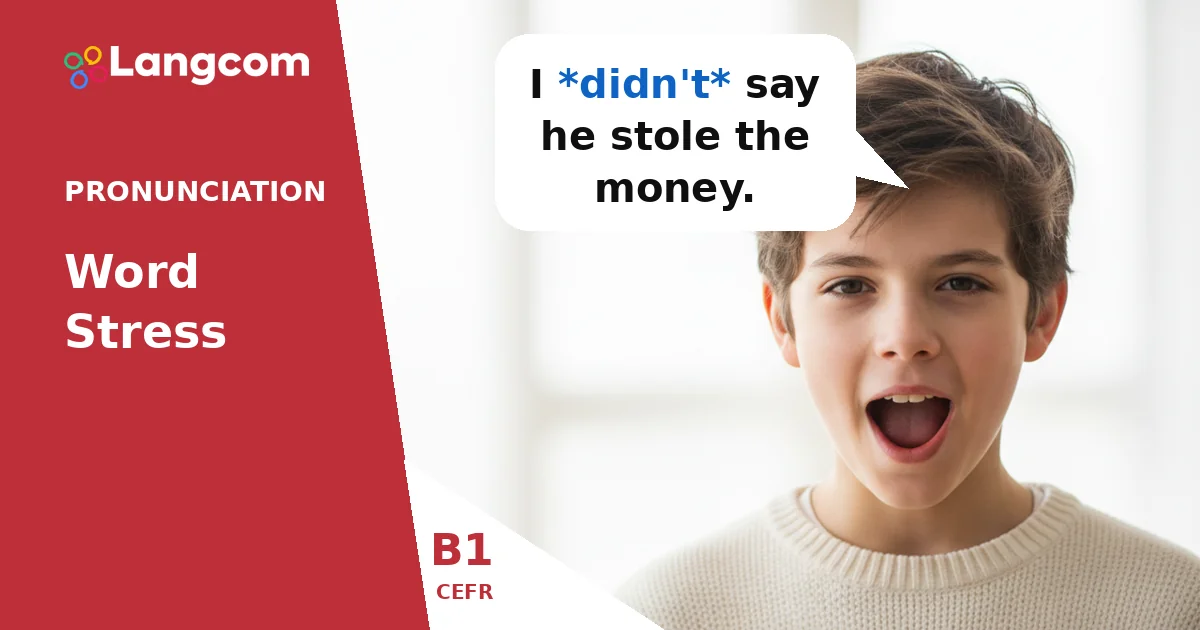
- I *didn't* say he stole the money. (I denied saying it.)
- I didn't say *he* stole the money. (Someone else stole it, not him.)
- I didn't say he *stole* the money. (He didn't steal it; maybe he borrowed it.)
- I didn't say he stole the *money*. (He stole something else, not money.)
- She *wants* to go to the party. (She really desires to go.)
- She wants to go to the *party*. (Not to the concert, but the party.)
Entraînement
✍️ Vous ne savez pas quel est votre niveau ?
Passez notre test de niveau gratuit et recevez des commentaires personnalisés de la part d'examinateurs certifiés par Cambridge.
Passez notre test de niveau GRATUITErreurs courantes chez les hispanophones
Spanish speakers sometimes transfer their native language's stress patterns to English. In Spanish, stress is often more predictable or less flexible in sentences for emphasis.
- Not stressing enough: English speakers use main stress constantly to convey meaning. If you don't stress the important words, your speech can sound flat or unclear.
- Stressing the wrong word: Stressing a function word (comme the ou is) when it's not needed can sound unnatural. For example, saying I want *the* book instead of I want the *book* (if 'book' is the new information).
- Changing meaning unintentionally: As seen in the examples, placing main stress on a different word can completely change what you mean. Be aware of this when speaking.
Questions fréquemment posées
Is main stress the same as word stress?
No, they are related but different. Word stress is about which syllable is stressed within a single word (e.g., pho-TOG-ra-pher). Main stress (ou sentence stress) is about which *word* in a sentence is stressed most to convey meaning or emphasis.
Can any word be stressed in a sentence?
Yes, theoretically any word can receive main stress if you want to emphasize it. However, it is most common for content words to be stressed. Stressing a function word usually indicates strong contrast or correction.
How can I practice main stress?
Listen carefully to native speakers in movies, podcasts, or conversations. Try to identify which words they stress. Then, practice repeating sentences, intentionally placing main stress on different words to see how the meaning changes. Reading aloud and recording yourself can also help.
Does main stress affect my B1 English exam score?
Yes, correct main stress is part of good pronunciation and intonation, which are assessed in speaking exams. Using stress effectively helps you communicate clearly and naturally, contributing to a higher score in criteria like 'Pronunciation' and 'Fluency and Coherence'.




0 commentaire