

Why is Classroom Vocabulary Important for A2 Learners?
Knowing classroom vocabulary helps you every day. It makes learning English easier and more fun.
- You can understand your teacher better.
- You can ask questions about school items.
- You can talk about your studies with friends.
- It helps you prepare for the A2 Key (KET) exam, where you might see these words.
✍️ Vous ne savez pas quel est votre niveau ?
Passez notre test de niveau gratuit et recevez des commentaires personnalisés de la part d'examinateurs certifiés par Cambridge.
Passez notre test de niveau GRATUITWhat are Common Classroom Objects?
Let's look at some important words for things you find in a classroom or use for studying.
- A desk is a type of table where you sit and work, often with drawers. I put my book on my desk.
- A chair is what you sit on. Please sit on your chair.
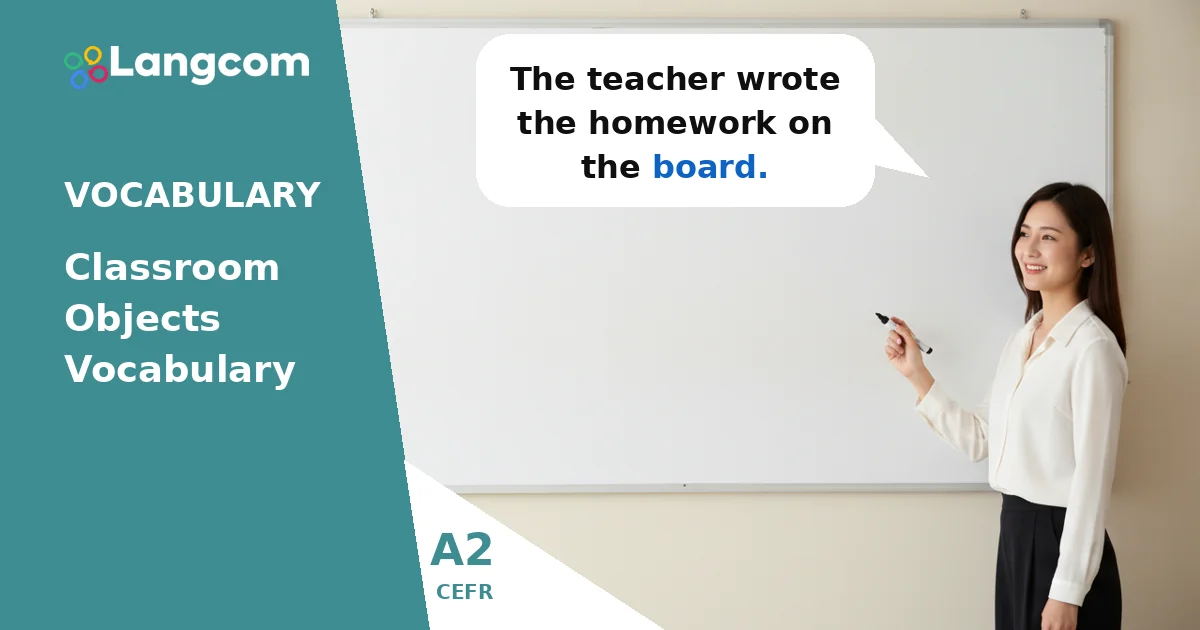
- A board is a large surface on the wall where the teacher writes or shows information. It can be a whiteboard or a blackboard. The teacher wrote on the board.
- A pen is for writing with ink. Can I borrow your pen?
- A pencil is for writing or drawing with lead. You can erase pencil marks. I need a pencil to draw a picture.
- A rubber (British English) is a small piece of material used to remove pencil marks. In American English, it's called an eraser. I made a mistake, so I used my rubber.
- A ruler is a flat, straight tool used for measuring or drawing straight lines. Use a ruler to draw a straight line.
- A notebook is a book with blank pages for writing notes. Please write your answers in your notebook.
- A textbook is a book used for studying a subject, like English or Maths. Open your textbook to page 20.
- A dictionary is a book or electronic resource that gives the meanings of words. If you don't know a word, look it up in a dictionary.
- A pencil case is a small bag or box for holding pens, pencils, and other small stationery items. My pencil case is full of colourful pens.
- A timetable is a list of times when classes happen. Check the timetable for your next class.
| Mot anglais | Meaning / Use |
|---|---|
| board | A large surface for writing or displaying information. |
| desk | A table for working or studying, often with drawers. |
| dictionary | A book or app that gives word meanings. |
| notebook | A book with blank pages for writing notes. |
| pen | A tool for writing with ink. |
| pencil | A tool for writing or drawing with lead. |
| pencil case | A container for pens, pencils, etc. |
| rubber | A tool to remove pencil marks (British English). |
| ruler | A tool for measuring or drawing straight lines. |
| textbook | A book used for studying a subject. |
| timetable | A schedule of classes and activities. |
Exemples
- The teacher wrote the homework on the board.
- Please put your books on your desk.
- I always carry a pen and a pencil in my pencil case.
- My new notebook has 100 pages.
- Use your ruler to measure the line.
- I need a rubber to correct this mistake.
- We use our English textbook every day.
- What time is our next class according to the timetable?
Entraînement
Prêt à obtenir votre certificat ?
Le cours Langcom prépare les étudiants aux examens de Cambridge, IELTS, TOEFL, DELE, SIELE et Michigan.
Commencez avec LangcomErreurs courantes chez les hispanophones
Les hispanophones commettent parfois les erreurs suivantes :
- Desk vs. Table: In Spanish, 'mesa' can mean both. In English, a desk is for working or studying, often with drawers. A table is more general, like for eating or putting things on. I sit at my desk to study. (Correct) I eat dinner at the table. (Correct)
- Rubber vs. Eraser: For the A2 Key (Cambridge) exam, use rubber. I need a rubber. (Correct for KET) I need an eraser. (Correct, but less common in UK English exams)
- Forgetting articles: Remember to use 'a' or 'an' with singular countable nouns. I have a pen. (Correct) I have pen. (Incorrect)
Questions fréquemment posées
What is the difference between a 'notebook' and a 'textbook'?
A notebook is for you to write your own notes and exercises. A textbook is a book with information and exercises from the school or teacher for a specific subject.
Is 'rubber' the same as 'eraser'?
Yes, they are the same item. Rubber is common in British English (used in Cambridge exams), and eraser is common in American English.
How can I practice these words for the A2 Key exam?
For the A2 Key exam, you might need to identify these objects in pictures or use them in simple descriptions. Practice by naming objects in your classroom or home, and try to describe them using simple sentences like It's a pen. It's blue.
What is a 'timetable'?
A timetable is a schedule that shows the times of your classes, breaks, and other school activities for the day or week.

0 commentaire