

How Do You Talk About General Feelings of Illness?
When you don’t feel well, but you don’t have a specific pain, you can use general phrases.
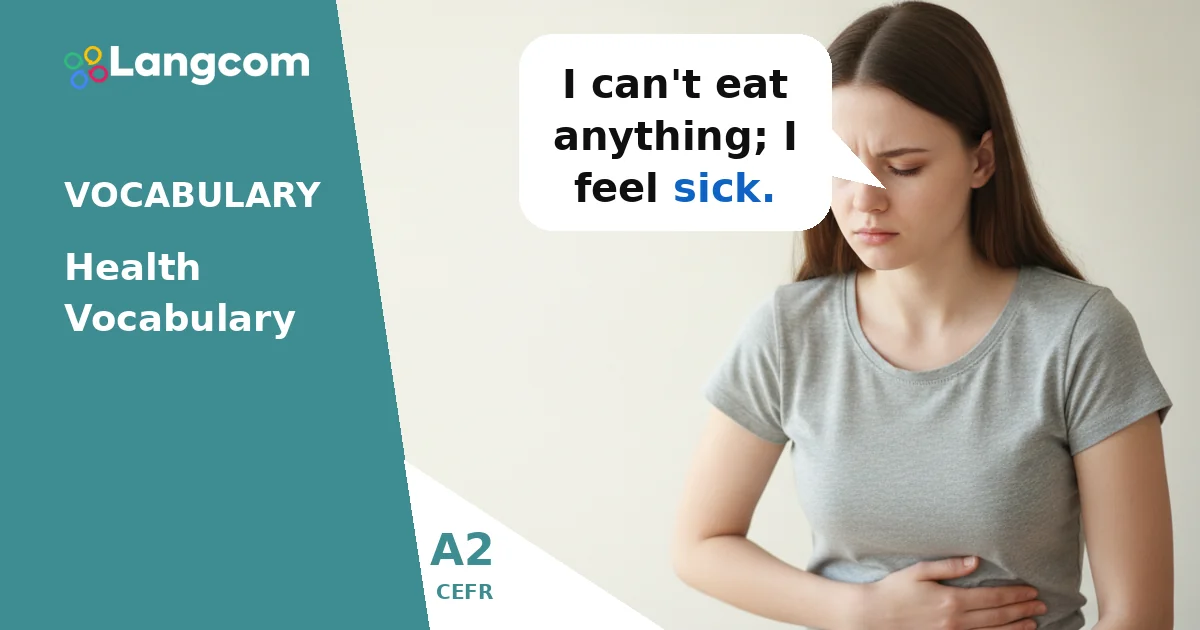
- I feel sick.
This means you feel unwell, often like you might vomit. - I don’t feel well.
This is a general way to say you are ill.
✍️ Vous ne savez pas quel est votre niveau ?
Passez notre test de niveau gratuit et recevez des commentaires personnalisés de la part d'examinateurs certifiés par Cambridge.
Passez notre test de niveau GRATUITHow Do You Describe Pain in Your Body?
When a specific part of your body has pain, you can use the verb hurt or the phrase 've got a/an...ache.
- My arm hurts.
Utilisation hurt when a body part is painful. You can use this for any body part. - My back hurts.
This means you have pain in your back. - I've got toothache.
This means you have pain in a tooth. - I've got a stomachache.
This means you have pain in your stomach.
What About Other Common Illnesses and Injuries?
English has specific words for common health conditions and injuries.
- I've got a cold.
This means you have a common illness with a runny nose, cough, and sometimes a sore throat. - I've got a temperature.
This means your body is hotter than normal, also called a fever. - I've got a broken leg.
This is a serious injury where a bone in your leg is fractured.
Asking About Someone's Health
If you want to ask someone what is wrong, you can use these questions:
- What's the matter?
- What's wrong?
- Are you feeling okay?
| Problem | How to say it |
|---|---|
| General unwell feeling | I feel sick. / I don't feel well. |
| Pain in a body part | My arm hurts. / My back hurts. |
| Pain in a tooth | I've got toothache. |
| Pain in the stomach | I've got a stomachache. |
| Common cold | I've got a cold. |
| High body temperature | I've got a temperature. |
| Broken bone | I've got a broken leg. |
Exemples
- I can't eat anything; I feel sick.
- After playing tennis, my arm hurts.
- I need to see the dentist because I've got toothache.
- I ate too much, and now I've got a stomachache.
- He fell off his bike and now he's got a broken leg.
- She's very warm; I think she's got a temperature.
- I lifted a heavy box, and now my back hurts.
- I'm sneezing a lot today; I think I've got a cold.
Entraînement
Prêt à obtenir votre certificat ?
Le cours Langcom prépare les étudiants aux examens de Cambridge, IELTS, TOEFL, DELE, SIELE et Michigan.
Commencez avec LangcomErreurs courantes chez les hispanophones
Spanish speakers sometimes make mistakes with how to express pain or illness in English:
- Using "have" instead of "have got" or "hurt": In Spanish, you often use "tener" (to have) for pain (e.g., "Tengo dolor de cabeza"). In English, it's more natural to say "I've got a headache" ou "My head hurts." It's incorrect to say "I have pain in my head."
- Confusing "sick" and "ill": Both mean unwell, but "sick" often implies nausea or vomiting, while "ill" is more general. For example, "I feel sick" (nauseous) vs. "I feel ill" (generally unwell).
- Incorrect use of "ache": Remember that "ache" is usually combined with a body part (e.g., toothache, stomachache). You don't say "I have an arm ache." Instead, say "My arm hurts."
Questions fréquemment posées
What is the difference between 'I feel sick' and 'I am sick'?
When you say "I feel sick," it usually means you feel nauseous, like you might vomit. "I am sick" can mean you are generally unwell or ill.
Can I use 'I have' instead of 'I've got' for illnesses?
Yes, you can. "I have a cold" is perfectly correct and means the same as "I've got a cold." "I've got" is very common in informal British English.
How is this vocabulary useful for the A2 Key (KET) exam?
For the A2 Key exam, you might need to describe pictures showing people with health problems, or answer questions about your health and daily life. Knowing phrases like "I've got a cold" ou "My back hurts" will help you communicate clearly in these situations.




0 commentaire