

What Are English Time Expressions?
Time expressions are groups of words that describe when something happens, how often, or for how long. They are essential for clear communication.
Many time expressions are idioms, meaning their overall meaning is not clear from the individual words. For example, ‘kill time’ does not mean to literally kill time.
✍️ Vous ne savez pas quel est votre niveau ?
Passez notre test de niveau gratuit et recevez des commentaires personnalisés de la part d'examinateurs certifiés par Cambridge.
Passez notre test de niveau GRATUITWhy Are Time Expressions Important for B2 English?
At the B2 level, you need to express yourself with greater nuance and accuracy. Time expressions help you do this.
- They make your English sound more natural and less like a direct translation.
- They are common in everyday conversations, news, and literature.
- Knowing them is crucial for understanding and performing well in exams like the B2 First (FCE).
How to Use Common Time Expressions?
Let's look at some important time expressions and how to use them. Pay attention to the prepositions and the context.
- Have a good time: To enjoy yourself.
- Kill time / Pass the time: To do something to make time seem to go by faster, usually when waiting.
- Spend time: To use time doing something or being somewhere.
- Take time off: To stop working for a period.
- Waste time: To use time ineffectively or for no good purpose.
- Tell the time: To be able to read a clock and know what time it is.
- One at a time: Individually, separately, not all together.
- From time to time / At times: Occasionally, sometimes but not often.
- In time: Early enough; before the deadline or a specific moment.
- Time for (something): The appropriate moment for an activity.
- (X) times (Y): Used for multiplication (e.g., ‘ten times three’).
- (X) times as much/many: Used for comparison to show a quantity multiplier.
- A time when: Refers to a specific period or moment in the past or future.
| Expression | Meaning |
|---|---|
| have a good time | To enjoy oneself |
| kill time / pass the time | To do something to make time go by faster, usually when waiting |
| spend time | To use time doing something |
| take time off | To stop working for a period |
| waste time | To use time ineffectively |
| tell the time | To know what time it is by looking at a clock |
| one at a time | Individually, separately |
| from time to time / at times | Occasionally, sometimes |
| in time | Early enough, before a deadline |
| time for (something) | The appropriate moment for an activity |
| X times Y | Used for multiplication (e.g., two times two) |
| X times as much/many | A multiplier for quantity (e.g., twice as much) |
| a time when | A specific period or moment |
Exemples
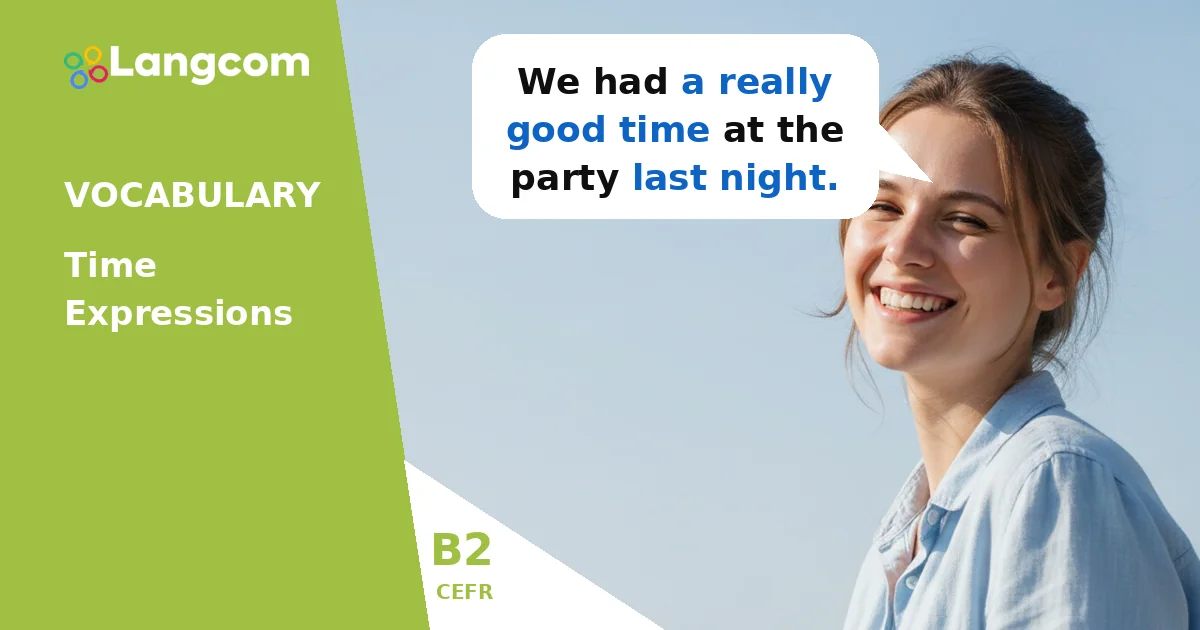
- We had a really good time at the party last night.
- I always bring a book to the doctor's office to kill time while I wait.
- She likes to spend time reading in the park on weekends.
- He decided to take time off work to travel around Europe.
- Don't waste time worrying about things you can't change.
- My little brother is learning to tell the time on an analog clock.
- Please come into the room one at a time.
- From time to time, I enjoy visiting art galleries.
- We arrived at the airport just in time for our flight.
- It's time for breakfast; the eggs are ready!
- Ten times three is thirty.
- The new car costs three times as much as the old one.
- There was a time when I used to play the guitar every day.
Entraînement
Prêt à obtenir votre certificat ?
Le cours Langcom prépare les étudiants aux examens de Cambridge, IELTS, TOEFL, DELE, SIELE et Michigan.
Commencez avec LangcomErreurs courantes chez les hispanophones
Spanish speakers often make specific mistakes with time expressions due to direct translation or confusion between similar phrases.
- In time vs. On time: These are often confused. ‘In time’ means early enough, before a deadline (e.g., We arrived in time for the movie.). ‘On time’ means punctually, at the exact scheduled moment (e.g., The train arrived on time.).
- Literal Translations: Avoid translating expressions directly from Spanish. For example, do not say ‘have a good time’ as ‘tener un buen tiempo’. The correct English is ‘have a good time’.
- Using ‘times’ for frequency: Remember to use ‘from time to time’ ou ‘at times’ for occasional actions, not just ‘times’ alone.
Questions fréquemment posées
What is the difference between 'in time' and 'on time'?
‘In time’ means early enough for something to happen, or before a deadline. For example, ‘We got to the station in time to buy tickets.’ ‘On time’ means punctually, at the exact scheduled moment. For example, ‘The bus always leaves on time.’
How can I remember new time expressions?
The best way is to use them! Try to write your own sentences using each new expression. You can also create flashcards, listen for them in English media, and practice with a language partner or teacher. Focus on understanding the context.
Are time expressions important for the B2 First (FCE) exam?
Yes, absolutely. Time expressions are very common in all parts of the B2 First (FCE) exam, especially in Reading & Use of English, Listening, and Speaking. Using them correctly shows a higher level of fluency and vocabulary range.
Can I translate time expressions directly from my language?
No, this is a common mistake. Many English time expressions are idiomatic, meaning their meaning cannot be guessed from the individual words. Direct translation often leads to incorrect or unnatural-sounding English. Always learn time expressions as complete phrases.




0 commentaire