

What Are Compound Adjectives?
A compound adjective is a single adjective made from two or more words. These words work together to describe a noun.
They are usually connected by a hyphen (–) when they come before the noun. This hyphen shows that the words form one idea.
- a well-known singer (not a well known singer)
- a twenty-minute break (not a twenty minute break)
✍️ Vous ne savez pas quel est votre niveau ?
Passez notre test de niveau gratuit et recevez des commentaires personnalisés de la part d'examinateurs certifiés par Cambridge.
Passez notre test de niveau GRATUITCommon Types of Compound Adjectives
Compound adjectives follow several common patterns. Understanding these patterns helps you recognize and form them correctly.
- Adjective + Past Participle: Describes a state or quality.
- well-known (a well-known author)
- old-fashioned (an old-fashioned dress)
- Adjective + Present Participle: Describes an ongoing action or characteristic.
- good-looking (a good-looking person)
- long-lasting (a long-lasting friendship)
- Noun + Past Participle: Often describes something made or affected by the noun.
- handmade (a handmade gift)
- sun-dried (sun-dried tomatoes)
- Noun + Present Participle: Describes something that performs the action of the noun.
- man-eating (a man-eating tiger)
- record-breaking (a record-breaking achievement)
- Number + Noun (singular): Describes a quantity or duration. Remember the noun is always singular.
- a twenty-minute journey (not twenty-minutes)
- a five-star hotel (not five-stars)
- Adverb + Past Participle: Describes how something is done or its condition.
- fully-booked (a fully-booked restaurant)
- well-dressed (a well-dressed man)
Why Use Compound Adjectives?
Using compound adjectives makes your English more concise and precise. They help you communicate complex ideas efficiently.
- Conciseness: Combine several words into one descriptive unit.
- Instead of: She is a woman who has a very open mind.
- Use: She is an open-minded woman.
- Precision: Add specific details that single adjectives cannot convey alone.
- a blue-eyed cat tells you more than just a blue cat.
- Natural English: They are very common in native speaker language, making your speech and writing sound more fluent and advanced.
How Do Compound Adjectives Describe People and Things?
Compound adjectives are incredibly useful for describing both physical characteristics and personality traits of people, as well as features of objects.
- For People's Appearance:
- She has long, dark hair. → She is a long-haired, dark-haired woman.
- He has blue eyes. → He is a blue-eyed man.
- She uses her left hand. → She is left-handed.
- For People's Character:
- He is often absent in mind. → He is an absent-minded person.
- She has a bad temper. → She is bad-tempered.
- He thinks broadly. → He is broad-minded.
- For Things and Experiences:
- a last-minute decision
- a well-paid job
- a state-of-the-art device
| Pattern | Exemple |
|---|---|
| Adjective + Past Participle | well-known |
| Adjective + Present Participle | good-looking |
| Noun + Past Participle | handmade |
| Noun + Present Participle | man-eating |
| Number + Noun (singular) | a five-star hotel |
| Adverb + Past Participle | fully-booked |
Exemples
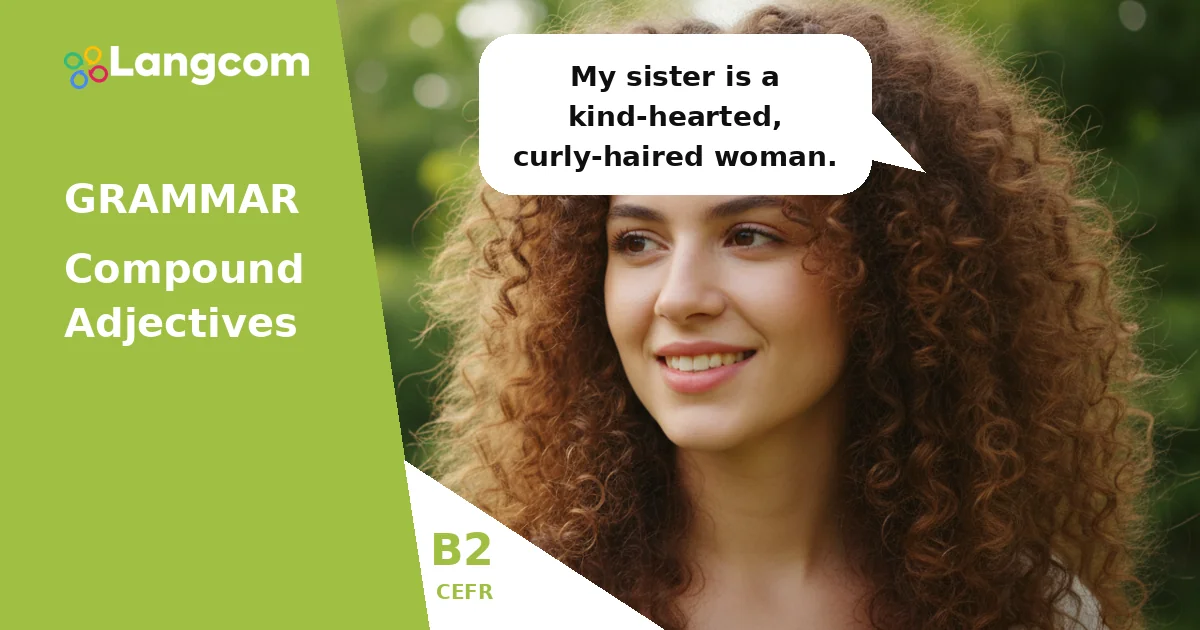
- My sister is a kind-hearted, curly-haired woman.
- They live in a well-decorated, two-story house.
- The company offers a twenty-four-hour customer service line.
- He bought a second-hand car that was still in good condition.
- The decision was a last-minute change to the plan.
- She is a highly-motivated employee who always meets her deadlines.
- We stayed at a five-star hotel during our vacation.
- The new film is a thought-provoking drama.
Entraînement
Prêt à obtenir votre certificat ?
Le cours Langcom prépare les étudiants aux examens de Cambridge, IELTS, TOEFL, DELE, SIELE et Michigan.
Commencez avec LangcomErreurs courantes chez les hispanophones
Spanish speakers sometimes make specific errors with compound adjectives. Be aware of these common pitfalls:
- Missing Hyphens: Remember to use a hyphen when the compound adjective comes *before* the noun.
- Correct : She is a well-known actress.
- Incorrect : She is a well known actress.
- Correct (no hyphen needed): The actress is well known. (Here, "well known" is a predicate adjective, not a compound adjective modifying the noun directly.)
- Plural Nouns in Number + Noun Compounds: In Spanish, you might say "veinte minutos." However, in English compound adjectives, the noun part is always singular.
- Correct : a ten-minute break
- Incorrect : a ten-minutes break
- Correct : a three-day trip
- Incorrect : a three-days trip
- Incorrect Word Order: Compound adjectives always come before the noun they describe.
- Correct : a blue-eyed cat
- Incorrect : a cat blue-eyed
Questions fréquemment posées
What is a compound adjective?
A compound adjective is an adjective made of two or more words, usually joined by a hyphen, that acts as a single descriptor for a noun. For example, long-haired describes someone's hair.
When should I use a hyphen with compound adjectives?
You generally use a hyphen when the compound adjective comes *before* the noun it modifies, as in a well-written essay. If it comes after the noun, like The essay was well written, you usually don't need a hyphen.
Can compound adjectives describe feelings or abstract concepts?
Yes, absolutely! Many compound adjectives describe character traits or abstract qualities, such as open-minded, self-confident, ou thought-provoking.
How are compound adjectives useful for the B2 First exam?
Compound adjectives are excellent for showing a wider range of vocabulary and more sophisticated sentence structures in your B2 First writing tasks, like essays or reviews. They help you describe people, places, and experiences more vividly and concisely, which can earn you higher marks for Lexical Resource.




0 commentaire