
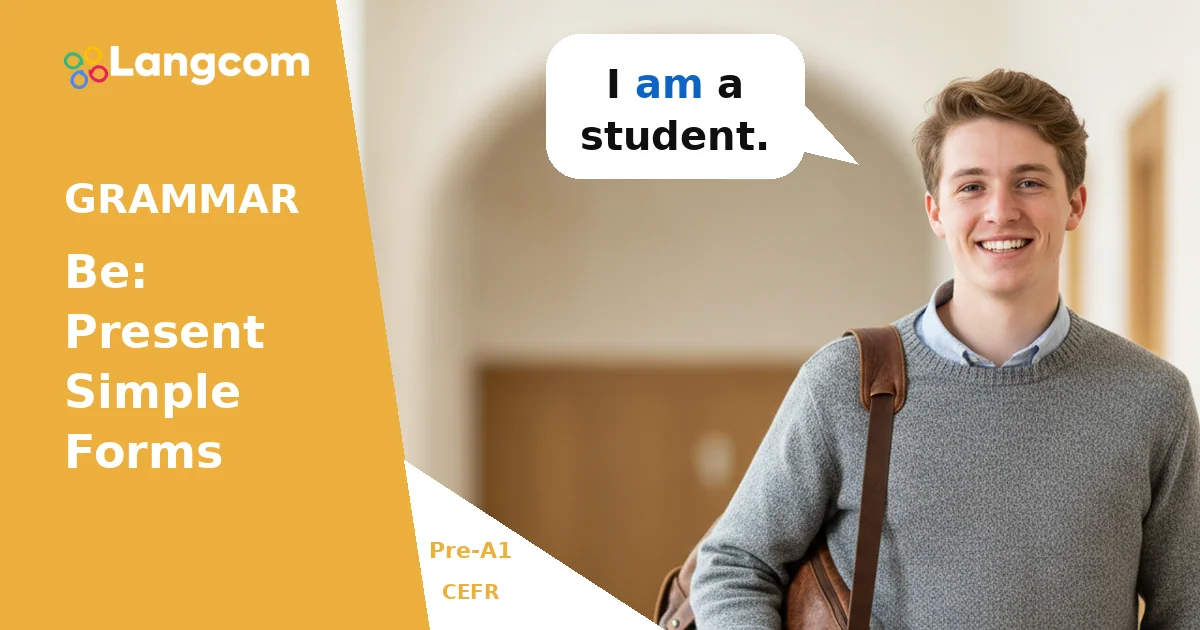

What is the Verb Be?
The verb be is very common in English. It helps you describe things and people. It also tells you where things are.
Think of be like “ser” and “estar” in Spanish. English uses only one verb for both ideas.
🎓 Apprenez l'anglais grâce à la méthode mixte
Petits groupes · Tuteur IA disponible 24 h/24, 7 j/7 · Préparation aux examens de Cambridge
Plans provenant de $39 $79 par mois
How Do We Use Be in Positive Sentences?
The verb be changes its form depending on the subject. There are three forms for the present simple:
- Nous utilisons am with I.
- Exemple : I am happy.
- Nous utilisons is with he, she, it, and singular nouns (one person, one thing).
- Exemple : He is a student.
- Exemple : It is cold.
- Nous utilisons are with you, we, they, and plural nouns (more than one person, more than one thing).
- Exemple : You are kind.
- Exemple : They are friends.
How Do We Use Be in Negative Sentences?
To make a sentence negative, we add not after the verb be.
- With I: am not
- Exemple : I am not sad.
- With he, she, it: is not
- Exemple : She is not from Spain.
- With you, we, they: are not
- Exemple : We are not tired.
What Are Contractions with Be?
In spoken English and informal writing, we often use contractions. Contractions are shorter forms of words.
- For positive sentences:
- I am becomes I'm (par exemple, I'm a student.)
- He is becomes He's (par exemple, He's tall.)
- She is becomes She's (par exemple, She's my sister.)
- It is becomes It's (par exemple, It's sunny.)
- You are becomes You're (par exemple, You're welcome.)
- We are becomes We're (par exemple, We're friends.)
- They are becomes They're (par exemple, They're at home.)
- For negative sentences:
- I am not becomes I'm not (par exemple, I'm not hungry.)
- He is not becomes He isn't ou He's not (par exemple, He isn't here. ou He's not here.)
- She is not becomes She isn't ou She's not
- It is not becomes It isn't ou It's not
- You are not becomes You aren't ou You're not (par exemple, You aren't right. ou You're not right.)
- We are not becomes We aren't ou We're not
- They are not becomes They aren't ou They're not
When Do We Use the Verb Be?
Nous utilisons be for many things. Here are some common uses:
- To talk about identity or names:
- I am Maria.
- He is a doctor.
- To talk about age:
- She is ten years old.
- They are 25.
- To talk about feelings or descriptions:
- We are happy.
- It is a big house.
- To talk about location:
- You are at home.
- The book is on the table.
| Objet | Positive Form | Negative Form | Positive Contraction | Negative Contraction |
|---|---|---|---|---|
| I | am | am not | I'm | I'm not |
| He / She / It | is | is not | He's / She's / It's | isn't / He's not / She's not / It's not |
| You / We / They | are | are not | You're / We're / They're | aren't / You're not / We're not / They're not |
Exemples
- I am a student.
- He is my brother.
- She is happy.
- It is a cat.
- You are tall.
- We are friends.
- They are in the park.
- I am not tired.
- He isn't here.
- They aren't sad.
Entraînement
💬 Vous avez besoin de conseils personnalisés ?
En tant que centre de préparation agréé par Cambridge, nous pouvons vous aider à choisir la formation et la certification qui vous conviennent. Discutez-en dès aujourd'hui avec nos conseillers.
Discutez avec un conseiller sur WhatsAppErreurs courantes chez les hispanophones
Spanish speakers sometimes make these mistakes with be:
- Using have for age: In Spanish, you say "Tengo X años". In English, we use be.
- Faux : I have 10 years.
- À droite : I am 10 years old.
- Forgetting the subject pronoun: In Spanish, you can often omit the subject (e.g., "Es feliz"). In English, you always need a subject.
- Faux : Is happy.
- À droite : He is happy. ou She is happy.
- Confusing ser et estar: Remember, English uses only be for both.
- Spanish: "Soy alto" (ser) and "Estoy cansado" (estar).
- English: I am tall. et I am tired.
Questions fréquemment posées
What are the three present forms of be?
The three present forms are am, is, et are.
How do I make I am negative?
You add not: I am not ou I'm not.
Can I use isn't and is not?
Oui, isn't is a contraction for is not. Both are correct, but isn't is more common in speaking.
When do I use is?
Vous utilisez is with singular subjects like he, she, it, or one person/thing (e.g., The dog is big.).



0 commentaire