

How Do We Ask Yes/No Questions About One Person?
When you want to know a simple ‘yes’ or ‘no’ answer about what someone (he, she) or something (it) does, you start your question with Does.
- First, use Does.
- Then, add the subject: he, she, o it.
- Next, use the main verb in its base form (without -s).
- Finally, add the rest of the sentence.
Look at the pattern:
Does + he/she/it + base verb + …?
[langcom_cta variant=”blended”]
What About Questions with ‘Who’, ‘What’, ‘Where’, ‘When’, ‘Why’, ‘How’?
If you want more specific information, you can use question words like What, Where, When, Why, o How. These words come at the very beginning of the question.
- Start with the question word (What, Where, etc.).
- Then, add does.
- Next, add the subject: he, she, o it.
- After that, use the main verb in its base form.
Look at the pattern:
Question Word + does + he/she/it + base verb + …?
How Do We Give Short Answers?
For ‘yes’ or ‘no’ questions, we often give short answers. These answers are simple and polite.
- For a positive answer, say: Yes, he/she/it does.
- For a negative answer, say: No, he/she/it doesn’t. (doesn’t is short for does not)
Ejemplos
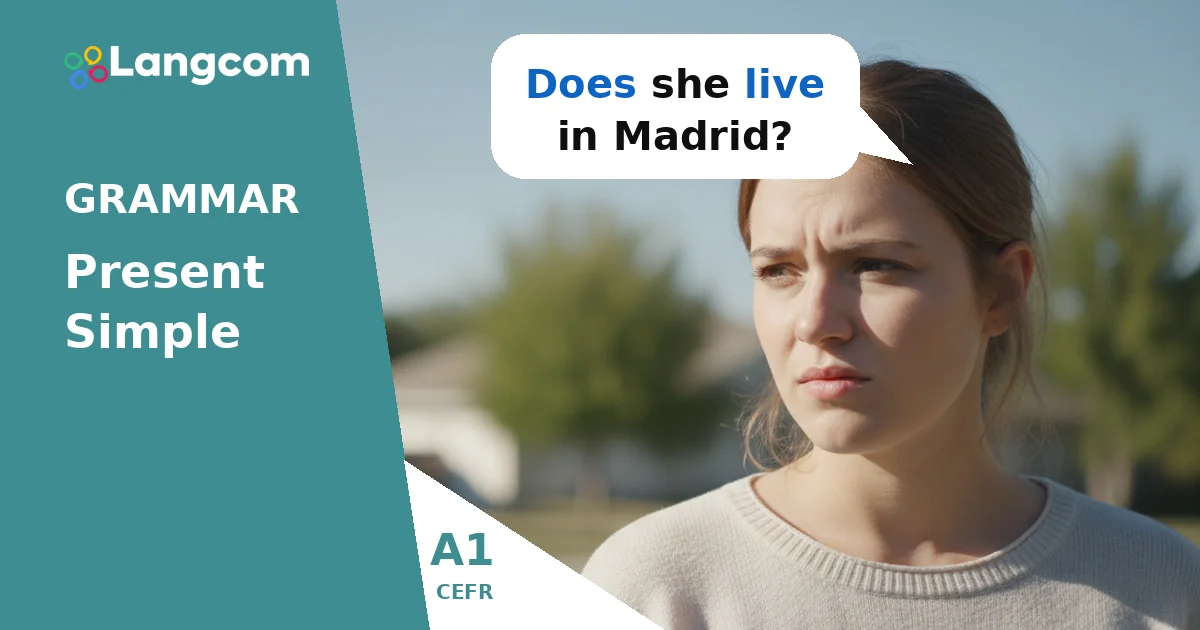
- Does she live in Madrid?
- Yes, she does.
- No, she doesn’t.
- Does he like coffee?
- What time does he wake up?
- Where does she work?
- When does the shop open?
- Why does it rain a lot here?
- How does he travel to work?
Práctica
[langcom_cta variant=”whatsapp”]
Errores habituales de los hispanohablantes
Many Spanish speakers make these common mistakes:
- Añadir -s to the verb: Remember, after does, the main verb is always in its base form. You should say Does she work?, no Does she works?
- Forgetting does: You cannot say He lives here? for a question. You must use Does he live here?
- Uso de do en lugar de does: Para he, she, y it, always use does. So, it’s Does he play football?, no Do he play football?
Preguntas más frecuentes
What is the main rule for ‘he/she/it’ questions in Present Simple?
The main rule is to use the helping verb does before the subject (he, she, o it), and then use the main verb in its base form. For example, Does she speak English?
Why do we use ‘does’ and not ‘do’ for ‘he/she/it’?
In the Present Simple, does is the special form of the verb do that we use only for third-person singular subjects: he, she, y it. For I, you, we, y they, we use do.
Does the main verb change after ‘does’?
No, the main verb never changes after does. It always stays in its base form (the infinitive without ‘to’ and without -s). Por ejemplo, Does he live?, no Does he lives?
Can I use ‘does’ for ‘you’ or ‘we’?
No, you cannot use does para you o we. For these subjects, you must use do. Por ejemplo, Do you like pizza? y Do we have class today?
What are the short answers for ‘he/she/it’ questions?
For positive short answers, you say Yes, he does., Yes, she does., o Yes, it does. For negative short answers, you say No, he doesn’t., No, she doesn’t., o No, it doesn’t.



0 Comentarios