

What are Phrasal Verbs with GET?
Phrasal verbs are combinations of a verb and a preposition or an adverb. Sometimes, they include both. The meaning of a phrasal verb is often different from the meaning of the individual words.
El verbo GET is one of the most versatile verbs in English. When combined with different prepositions or adverbs, it forms many phrasal verbs with distinct meanings. These are essential for B2 learners.
✍️ ¿No sabes en qué nivel estás?
Realiza nuestra prueba de nivel gratuita y recibe comentarios personalizados de examinadores certificados por Cambridge.
Realice nuestra prueba de nivel GRATUITAWhen to use GET AWAY WITH?
The phrasal verb get away with means to do something wrong or illegal and not be punished for it. It implies escaping the consequences of an action.
- We often use it when someone avoids being caught or punished.
- It can also mean to do something successfully, even if it's not the best way.
How to use GET AWAY FROM?
The phrasal verb get away from means to physically escape from a person or place. It focuses on the act of moving away from something or someone.
- This is about physical distance or separation.
- It can also mean to avoid a situation or problem by leaving it.
What does GET DOWN TO mean?
When you get down to something, it means you start doing something seriously and with focus, especially work or a task that requires effort.
- This phrasal verb shows a commitment to begin a task.
- It often implies that you have been delaying the task.
Understanding GET OUT OF (doing something)
A get out of doing something means to avoid a responsibility, duty, or unpleasant task. You find a way to not do it.
- This is about avoiding an obligation.
- It suggests finding an excuse or a trick to escape the task.
How to use GET OVER (something)?
The phrasal verb get over means to recover from an illness, a difficult experience, or an emotional problem. It implies a process of healing or overcoming.
- You use it for physical recovery, like from a cold.
- You also use it for emotional recovery, like from a breakup or a shock.
What does GET INTO (a team/group) mean?
A get into a team, club, or group means to be accepted or selected as a member. It implies successful entry or admission.
- This is common when talking about sports teams, universities, or exclusive clubs.
- It shows that you have met the requirements for entry.
| Phrasal Verb | Significado | Example |
|---|---|---|
| get away with | Avoid punishment or negative consequences for doing something wrong. | He got away with cheating on the exam. |
| get away from | Physically escape from a person or place. | She wanted to get away from the city noise. |
| get down to | Start doing something seriously and with focus. | Let's get down to business. |
| get out of | Avoid a responsibility or unpleasant task. | He tried to get out of doing his chores. |
| get over | Recover from an illness, difficulty, or emotional problem. | It took her months to get over the breakup. |
| get into | Be accepted or selected as a member of a team, group, or institution. | She got into her first-choice university. |
Ejemplos
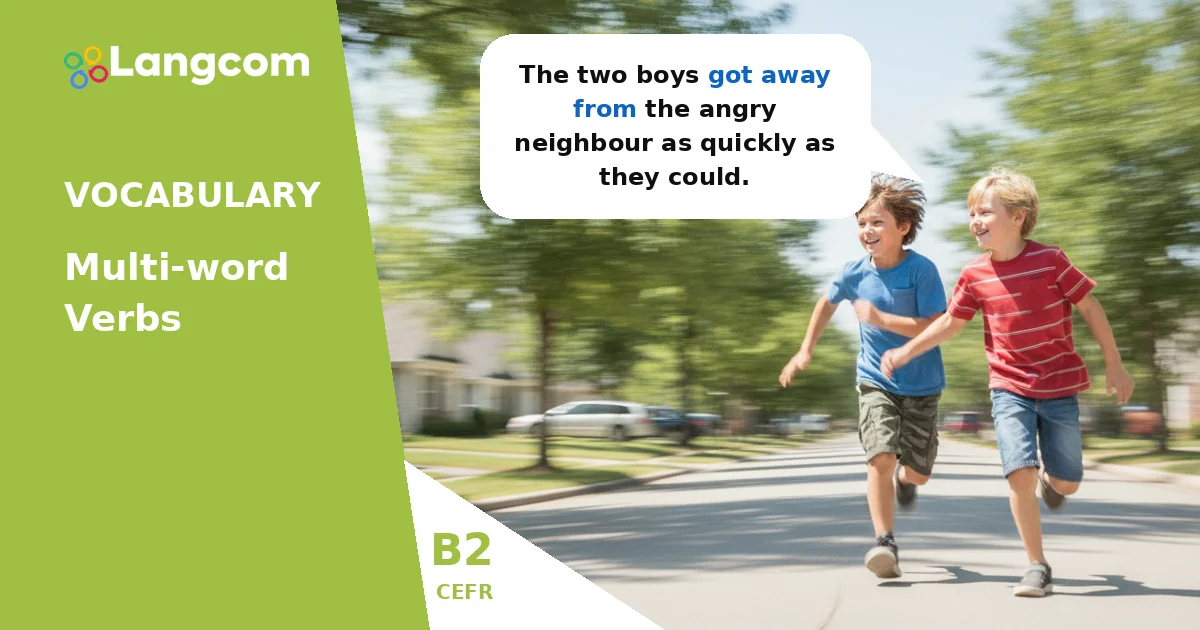
- The two boys got away from the angry neighbour as quickly as they could.
- Suan needs to get down to some work because she has exams soon.
- Tim got out of washing the floor, which put him in a good mood.
- I'm just getting over the flu after being in bed for a week.
- He was delighted when he got into the football team at the weekend.
- You won't get away with not paying taxes.
- She got away with cheating on the test because the teacher didn't see her.
- After the meeting, we need to get down to planning the new project.
- My sister always tries to get out of doing the dishes.
- It took her a long time to get over the shock of losing her job.
- Many students want to get into that prestigious university.
Práctica
¿Estás listo para obtener tu certificado?
El curso Langcom prepara a los alumnos para los exámenes de Cambridge, IELTS, TOEFL, DELE, SIELE y Michigan.
Empieza a utilizar LangcomErrores habituales de los hispanohablantes
Spanish speakers often make specific mistakes with phrasal verbs involving GET:
- Confuso get away with y get away from: While both involve 'escaping', get away from is usually physical (e.g., I got away from the noisy party.), y get away with means avoiding punishment or consequences (e.g., He got away with lying.). Do not say He got away from lying.
- Direct translation for get down to: Sometimes learners might say get down to the work. The correct form is usually get down to work o get down to business, without 'the' if referring to work in general.
- Using a single verb instead of a phrasal verb: For example, saying I recovered the flu en lugar de I got over the flu. While 'recover' is correct, get over is more natural for B2 English in this context.
Preguntas más frecuentes
Why are phrasal verbs with GET so important for B2 level?
Phrasal verbs with GET are very common in everyday English conversations and texts. Mastering them shows a higher level of fluency and helps you understand nuanced meanings, which is crucial for B2 comprehension and production.
Can I use 'recover' instead of 'get over'?
Yes, you can often use 'recover' instead of get over. Por ejemplo, I recovered from the flu is correct. However, get over is a very natural and common phrasal verb that B2 learners should know and use to sound more like a native speaker.
How can I remember all these phrasal verbs?
The best way to remember phrasal verbs is to learn them in context, not just as isolated words. Create your own example sentences, use them in conversations, and review them regularly. Pay attention to how they are used in reading and listening materials.
Are these phrasal verbs useful for the B2 First (FCE) exam?
Absolutely! Phrasal verbs with GET are frequently tested in the B2 First exam, especially in the Use of English paper (Parts 1, 2, 3, and 4) and in the Speaking and Writing sections. Using them correctly can significantly improve your score.
Is there a difference between 'get away with' and 'escape'?
Yes, there is a key difference. Escape usually means to physically leave a place or situation. Get away with specifically means to avoid punishment or negative consequences for something wrong you have done, even if you didn't physically 'escape' a place.




0 Comentarios