

Why Is ‘Get’ So Important in English?
Get is one of the most common and flexible verbs in English. It has many different meanings depending on the words that follow it.
At a C1 level, understanding these specific patterns helps you sound more natural and precise. It allows you to express complex ideas efficiently.
✍️ ¿No sabes en qué nivel estás?
Realiza nuestra prueba de nivel gratuita y recibe comentarios personalizados de examinadores certificados por Cambridge.
Realice nuestra prueba de nivel GRATUITAHow Does 'Get' Show Change or Becoming?
We often use get to talk about a change of state or to mean 'become'. This is a very common and natural way to express transformation.
- Uso get + adjective to describe becoming something:
- I get tired easily these days. (I become tired.)
- It's getting dark outside. (It is becoming dark.)
- She got focused on her studies. (She became focused.)
- Uso get + past participle to describe experiencing a change or an event, often in a passive sense:
- He got promoted last month. (He was promoted.)
- My phone got stolen on the bus. (My phone was stolen.)
- Our ability to concentrate is getting eaten away by technology. (It is being eaten away.)
When Do We Use 'Get' for Causation (Arranging Tasks)?
The causative get means that you arrange for someone else to do a service or task for you. This structure is very similar to causative have.
- The pattern is get + object + past participle.
- It shows that the subject causes the action to be done, but not necessarily by themselves.
- Ejemplos:
- I need to get my hair cut. (I will arrange for a hairdresser to cut my hair.)
- We got the house painted last summer. (We arranged for painters to paint the house.)
- How can I get this report finished by Friday? (How can I arrange for this report to be finished?)
You can often use have in the same way: I need to have my hair cut.
How Does 'Get' Cause Someone to Start an Action?
Utilizamos get + object + verb + -ing to mean that you cause or persuade someone or something to start doing an action.
- This pattern emphasizes the beginning of an action.
- Ejemplos:
- The exciting news got everyone talking. (The news made everyone start talking.)
- Coffee is the only thing that can get me moving in the morning. (Coffee makes me start moving.)
- His story got me thinking about my own experiences. (His story made me start thinking.)
| Patrón | Significado | Ejemplo |
|---|---|---|
| Get + Adjective / Past Participle | To become; to experience a change or event | It's getting cold. He got fired. |
| Get + Object + Past Participle | To arrange for someone else to do something (causative) | I'll get my eyes checked. |
| Get + Object + Verb + -ing | To cause someone/something to start an action | The news got us talking. |
Ejemplos
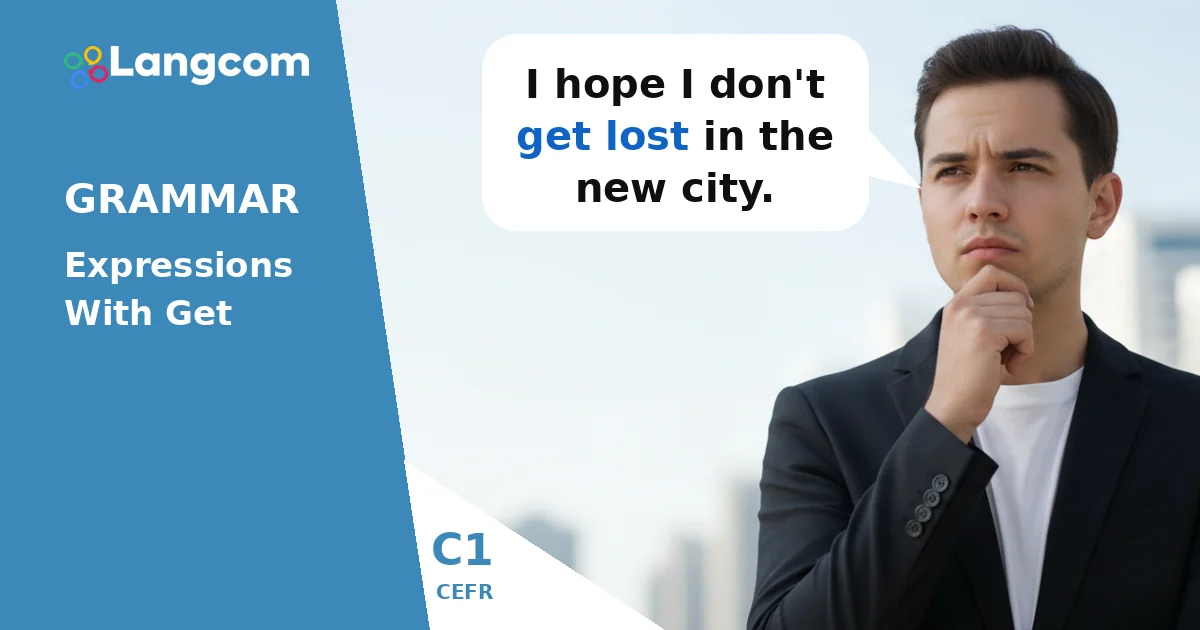
- I hope I don't get lost in the new city.
- We need to get the documents signed before the deadline.
- The loud music got the party started.
- She got her car repaired after the accident.
- It's getting late; we should go home.
- Don't let the small problems get you down.
- Can you get the children ready for school?
Práctica
¿Estás listo para obtener tu certificado?
El curso Langcom prepara a los alumnos para los exámenes de Cambridge, IELTS, TOEFL, DELE, SIELE y Michigan.
Empieza a utilizar LangcomErrores habituales de los hispanohablantes
A los hispanohablantes a veces les cuesta distinguir entre get because its meaning can be similar to 'obtener', 'llegar', or 'ponerse'.
- Confuso get con be in passive voice: Aunque be is standard for passive, get often implies an event or a less formal tone, or something happening to the subject. Don't use be when you mean 'become' or 'experience something happening'.
Wrong: I was tired after the long walk. (Correct, but if you mean 'became tired': I got tired after the long walk.)
Wrong: The window was broken by the ball. (Correct, but if you want to emphasize the event: The window got broken by the ball.) - Uso de make en lugar de get for causing action: Aunque make also causes action, get + object + verb + -ing often implies a more indirect persuasion or a natural consequence.
Menos natural: The joke made me laughing.
More natural: The joke got me laughing. - Incorrect causative structure: Remember the pattern get + object + past participle.
Wrong: I need to get cut my hair.
Correcto: I need to get my hair cut.
Preguntas más frecuentes
What is the main difference between 'get' and 'become'?
Ambos get y become mean to change state. Become is generally more formal and can be used in all contexts. Get is more common in everyday, informal speech and often implies a process or a more sudden change. For example, She became a doctor is formal, while She got sick is informal.
Can I always use 'get' instead of 'have' in causative sentences?
In many causative sentences where you arrange for a service, get y have are interchangeable. For example, I need to get my car washed y I need to have my car washed mean the same. However, have can also be used for experiencing something, often negative, that happens to you (e.g., I had my wallet stolen), where get might be less common or imply a different nuance.
Is 'get' always informal?
Get is very common in informal and everyday English. However, many of its uses, especially in phrasal verbs or specific structures, are perfectly acceptable in formal contexts too. It's more about choosing the right expression for the specific situation and desired tone.

0 Comentarios