

Why Is Pronunciation Important for C1 English?
At C1 level, you use more complex vocabulary. Correct pronunciation helps you communicate clearly and confidently.
It also shows a higher level of fluency and control over the English language.
- Clear Communication: When you pronounce words correctly, people understand you easily.
- Sounding Natural: Good pronunciation makes your English sound more natural, not just grammatically correct.
- CAE Exam Success: In the C1 Advanced (CAE) Speaking test, examiners assess your pronunciation. Accuracy and intonation are key for a good score.
[langcom_cta variant=”placement”]
General Tips for Pronouncing Long Adjectives
Longer words can seem difficult, but some simple strategies can help.
- Break It Down: Divide the word into syllables. This makes it easier to manage.
- Find the Main Stress: English words have one main stressed syllable. This syllable is louder, longer, and higher in pitch. Identifying it is crucial.
- Listen and Imitate: Use online dictionaries with audio or listen to native speakers. Repeat the words exactly as you hear them.
- Pay Attention to Suffixes: Many C1 adjectives have common suffixes. These often follow specific stress patterns.
How to Pronounce Tricky C1 Adjectives
Let’s look at some common C1 adjectives for describing people and focus on their pronunciation challenges.
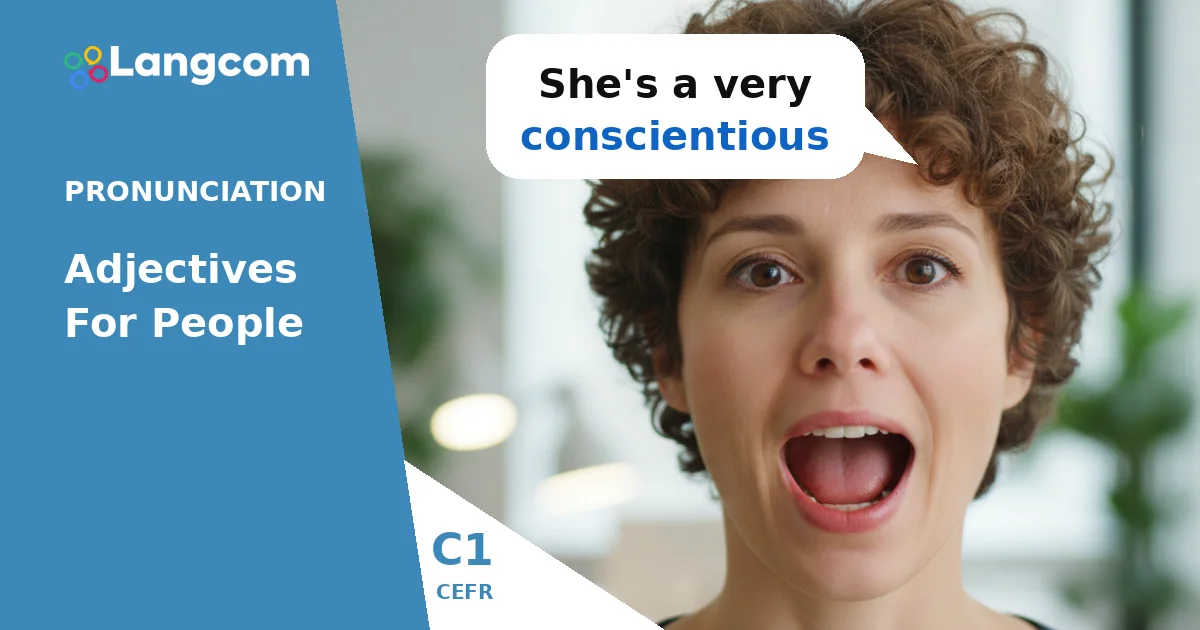
- Conscientious (meaning: careful and hardworking)
The stress is on the third syllable: kon-shee-EN-shus. The -tious ending sounds like ‘shus’. - Knowledgeable (meaning: having a lot of information and understanding)
This word has silent letters: the ‘k’ at the beginning and the ‘d’ in the middle are not pronounced. The stress is on the first syllable: NOL-ij-uh-bul. The -able ending sounds like ‘uh-bul’. - Decisive (meaning: able to make decisions quickly and confidently)
The stress is on the second syllable: dee-SY-siv. The ‘s’ sound is like the ‘s’ in ‘snake’, not ‘z’. - Courageous (meaning: brave)
The stress is on the second syllable: kuh-RAY-jus. The -geous ending sounds like ‘jus’. - Down-to-earth (meaning: practical and realistic)
This is a compound adjective. Pronounce each part clearly, with natural rhythm. The main stresses are on DOWN y ERTH: DOWN-too-ERTH. - Meticulous (meaning: very careful and precise)
The stress is on the second syllable: muh-TIK-yoo-lus. The -ulous ending sounds like ‘yoo-lus’. - Resilient (meaning: able to recover quickly from difficulties)
The stress is on the second syllable: ri-ZIL-yuhnt. The ‘s’ here often sounds like ‘z’.
| Suffix | Typical Stress Pattern | Example Adjective | Pronunciation Guide |
|---|---|---|---|
| -ious | On the syllable *before* the suffix | conscientious | kon-shee-EN-shus |
| -able | On the syllable *before* the suffix | knowledgeable | NOL-ij-uh-bul |
| -sive | On the syllable *before* the suffix | decisive | dee-SY-siv |
| -ous | On the syllable *before* the suffix | courageous | kuh-RAY-jus |
| -ent | Often on the syllable *before* the suffix | resilient | ri-ZIL-yuhnt |
| -ulous | On the syllable *before* the suffix | meticulous | muh-TIK-yoo-lus |
Ejemplos
- She’s a very conscientious student, always completing her assignments on time.
- Our history professor is incredibly knowledgeable about ancient civilizations.
- He’s a decisive leader who isn’t afraid to make tough choices.
- It was a truly courageous act to stand up for what she believed in.
- Despite her fame, she remains a very down-to-earth person.
- The artist was meticulous in every detail of his painting.
- After facing many challenges, she proved to be incredibly resilient.
Práctica
[langcom_cta variant=”exam”]
Errores habituales de los hispanohablantes
Spanish speakers often face specific challenges when pronouncing English adjectives:
- Misplaced Stress: In Spanish, word stress is often on the second-to-last syllable unless an accent mark indicates otherwise. English stress is less predictable and can be on any syllable. For example, incorrectly stressing con-SCIEN-tious en lugar de lo correcto kon-shee-EN-shus.
- Pronouncing Silent Letters: English has many silent letters. Spanish speakers might try to pronounce every letter. For instance, in knowledgeable, the ‘k’ and ‘d’ are silent. Incorrectly saying k-nowledge-able en lugar de NOL-ij-uh-bul is a common error.
- Vowel Sounds: English has more vowel sounds than Spanish. The ‘i’ sound in decisive (like ‘eye’) can be tricky, as can the schwa sound (‘uh’) in unstressed syllables like in knowledgeable.
Preguntas más frecuentes
Why is C1 pronunciation different from B2?
At C1, you encounter more complex, multi-syllable words and need to master subtle nuances in stress and intonation. B2 focuses more on general clarity, while C1 demands greater accuracy and naturalness, especially with less common vocabulary.
How can I practice these sounds effectively?
The best way is to listen to native speakers, record yourself saying the words, and then compare your pronunciation. Focus on the word stress and specific vowel/consonant sounds. Use online dictionaries with audio and repeat phrases like She is very conscientious.
Does pronunciation affect my C1 Advanced (CAE) score?
Yes, absolutely. In the C1 Advanced (CAE) Speaking test, examiners assess your pronunciation based on intelligibility, stress, rhythm, and intonation. Clear and natural pronunciation of C1 vocabulary, like these adjectives, contributes significantly to a higher score in the ‘Pronunciation’ criteria.
Are there general rules for adjective stress in English?
While there are some patterns, especially with certain suffixes (as shown in the table below), English word stress can be quite irregular. It’s often best to learn the stress pattern for each new word you encounter. Listening and imitating are very effective strategies.
[langcom_related]


0 Comentarios