

Why Learn Body Parts in English?
Learning words for body parts helps you talk about yourself and others. It is important for many daily situations.
- You can describe how you look.
- You can talk about how you feel.
- You can understand simple health questions.
- It helps you understand English songs or stories.
🎓 Aprende inglés con el método mixto
Grupos reducidos · Tutor de IA disponible las 24 horas del día, los 7 días de la semana · Preparación para los exámenes de Cambridge
Planes de $39 $79 al mes
What Are the Main Body Parts?
Let’s learn some common words for parts of your body. Look at the list and say the words aloud.
- Head: This is the top part of your body.
- Hair: It grows on your head.
- Face: The front part of your head.
- Eye (plural: eyes): You use these to see.
- Nose: You use this to smell.
- Mouth: You use this to eat and speak.
- Ear (plural: ears): You use these to hear.
- Neck: This connects your head to your body.
- Arm (plural: arms): You have two arms.
- Hand (plural: hands): This is at the end of your arm.
- Finger (plural: fingers): You have five fingers on each hand.
- Leg (plural: legs): You use these to walk.
- Foot (plural: feet): This is at the end of your leg.
- Toe (plural: toes): You have five toes on each foot.
- Stomach: This is in the middle of your body.
- Back: This is the rear part of your body.
How Do We Use Body Part Words?
You can use these words in simple sentences. Here are some examples:
| Body Part | Example Sentence |
|---|---|
| Head | My head is small. |
| Eye | I have brown eyes. |
| Hand | This is my hand. |
| Foot | My foot is big. |
| Leg | I can run with my legs. |
Ejemplos
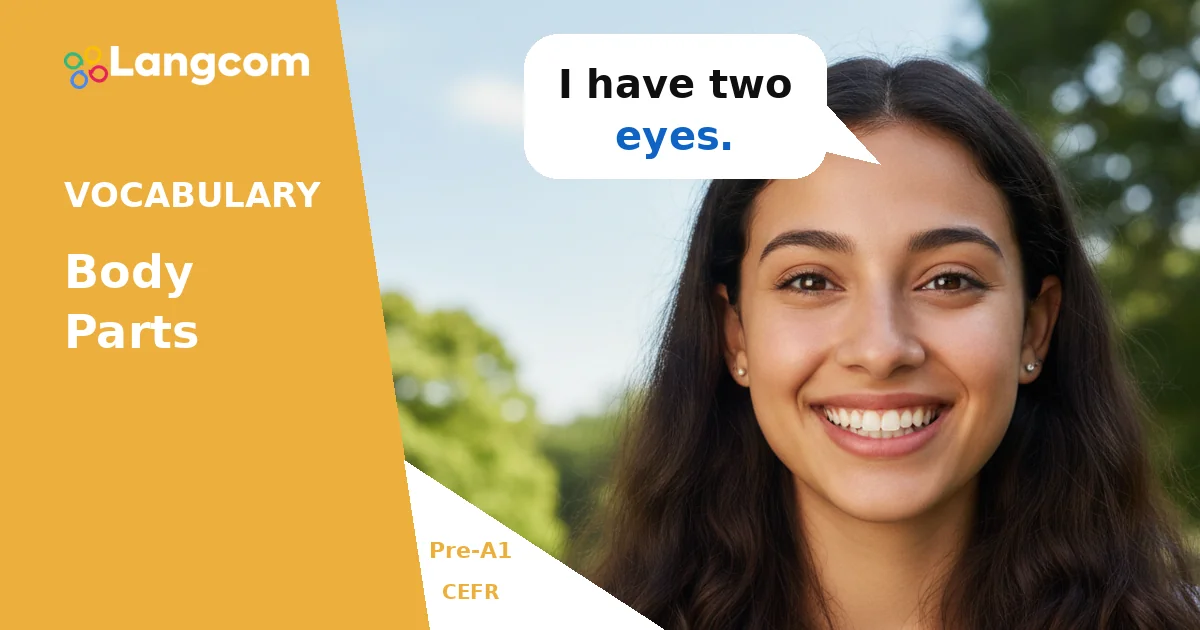
- I have two eyes.
- She has long hair.
- My hand is big.
- He has small feet.
- Touch your nose.
- My leg hurts.
Práctica
💬 ¿Necesitas asesoramiento personalizado?
Como centro autorizado de preparación para los exámenes de Cambridge, podemos orientarte para que elijas el curso y la certificación más adecuados. Habla hoy mismo con nuestros asesores.
Chatea con un asesor por WhatsAppErrores habituales de los hispanohablantes
For Spanish speakers, a common point to remember is the difference between singular and plural forms. In English, many plural forms add an -s, but some words are irregular.
- Correcto: one hand, two hands
- Correcto: one eye, two eyes
- But be careful with: one foot, two feet (not two ‘foots’)
Also, remember to use articles like a o an for singular nouns, or possessive adjectives like my, your.
- Correcto: I have a nose.
- Correcto: This is my arm.
Preguntas más frecuentes
What are the most important body parts to learn first?
Start with the most visible and common parts: head, face, eyes, nose, mouth, hands, y feet. These are useful for basic descriptions.
How can I practice these new words?
You can point to your own body parts and say their English names. Use flashcards with pictures. Try to describe people you see using the new words, like She has blue eyes.
Do I need to learn all body parts at once?
No, it’s better to learn a few words at a time. Practice them until you remember them well, then learn more. This helps you remember them for a long time.




0 Comentarios