

What words describe natural skills and intelligence?
When someone is naturally good at something, or very smart, we use specific adjectives.
- Talented: This means having a natural aptitude or skill for something.
- Brilliant: This describes someone who is extremely intelligent or very good at something. It can also describe an idea or performance.
- Intelligent: This means having a high capacity for understanding, learning, and reasoning.
- Bright: Similar to intelligent, this word often describes children or young people who learn quickly.
🎓 Aprende inglés con el método mixto
Grupos reducidos · Tutor de IA disponible las 24 horas del día, los 7 días de la semana · Preparación para los exámenes de Cambridge
Planes de $39 $79 al mes
How do we talk about being good at something?
We use nouns and phrases to talk about a person's capacity to do something well.
- Ability: This is the power or skill to do something.
- Talent: This is a natural aptitude or skill. It is the noun form of talented.
- Confident: This adjective describes someone who feels sure of their own ability or opinions.
- Good at: This is a common phrase to say you have skill in something. For example, I am good at drawing.
What words describe achieving goals?
When someone works hard and reaches a goal, we have specific vocabulary to describe this.
- Success: This is the accomplishment of an aim or purpose. It is the noun form.
- Successful: This adjective means achieving success.
- Achievement: This is something important that you succeed in doing by your own efforts.
- Determined: This adjective describes someone who has made a firm decision and will not change it. They will continue trying to achieve something even if it is difficult.
- Succeed: This is the verb form, meaning to achieve a desired aim or result.
- Achieve: This verb means to successfully bring about or reach (an objective or desired result) by effort, skill, or courage.
What about mindset and giving up?
Your attitude is very important when trying to achieve something.
- Positive attitude: This means having a good and hopeful way of thinking about things.
- Give up: This phrasal verb means to stop trying to do something.
| Word Type | Palabra | Meaning / Example |
|---|---|---|
| Noun | Ability | The power or skill to do something. Her ability to learn languages is amazing. |
| Noun | Talent | A natural aptitude or skill. He has a talent for drawing. |
| Noun | Success | The accomplishment of an aim or purpose. The project was a great success. |
| Noun | Achievement | Something important you succeed in doing. Winning the award was a big achievement. |
| Noun | Positive attitude | A good and hopeful way of thinking. She always has a positive attitude. |
| Adjective | Talented | Having a natural aptitude or skill. He is a talented artist. |
| Adjective | Brilliant | Extremely intelligent or very good. What a brilliant idea! |
| Adjective | Intelligent | Having a high capacity for understanding. She is a very intelligent person. |
| Adjective | Bright | Intelligent, especially for young people. The bright student quickly understood. |
| Adjective | Successful | Achieving success. He is a successful businessman. |
| Adjective | Confident | Feeling sure of your own ability. She feels confident about the exam. |
| Adjective | Determined | Having made a firm decision; resolute. He is determined to learn English. |
| Verb | Succeed | To achieve a desired aim or result. You will succeed if you work hard. |
| Verb | Achieve | To successfully bring about or reach. We need to achieve our goals. |
| Phrasal Verb | Give up | To stop trying to do something. Never give up on your dreams. |
Ejemplos
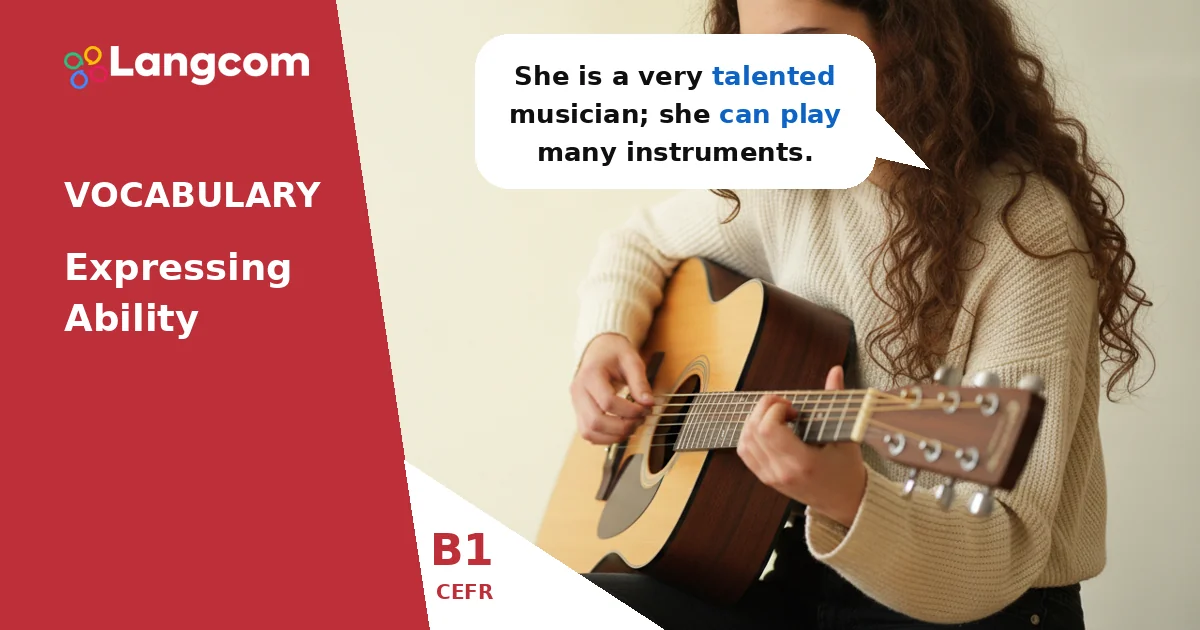
- She is a very talented musician; she can play many instruments.
- That was a brilliant idea! It solved all our problems.
- He is an intelligent student and always gets good grades.
- The young boy is very bright for his age.
- Her ability to speak five languages is impressive.
- He has a natural talent for painting.
- I feel confident about my presentation tomorrow.
- Her new business was a great success.
- Oprah Winfrey is a very successful TV presenter.
- Winning the championship was a huge achievement for the team.
- She is determined to finish her degree this year.
- If you work hard, you will succeed.
- We must achieve our goals by the end of the month.
- It's important to have a positive attitude even when things are difficult.
- Don't give up on your dreams!
Práctica
✍️ ¿No sabes en qué nivel estás?
Realiza nuestra prueba de nivel gratuita y recibe comentarios personalizados de examinadores certificados por Cambridge.
Realice nuestra prueba de nivel GRATUITAErrores habituales de los hispanohablantes
Confusing Nouns and Adjectives
Spanish speakers sometimes confuse the noun form with the adjective form. For example, talent is a noun, but talented is an adjective.
- Incorrecto: She is very talent.
- Correcto: She is very talented. (adjective)
- Correcto: She has a lot of talent. (noun)
The same applies to success (noun) and successful (adjective).
- Incorrecto: His business was very success.
- Correcto: His business was very successful. (adjective)
- Correcto: His business was a great success. (noun)
Using 'Good in' instead of 'Good at'
Remember that when you talk about being skilled in an activity, you use the preposition at.
- Incorrecto: I am good in maths.
- Correcto: I am good at maths.
Preguntas más frecuentes
What is the difference between 'talent' and 'ability'?
Talent usually refers to a natural, inborn skill or aptitude, like a talent for music. Ability is a more general term for the power or skill to do something, which can be natural or learned, like the ability to speak French.
Can I use 'brilliant' for things, not just people?
Sí, brilliant can describe both people and things. For example, you can say She is a brilliant scientist (person) or That was a brilliant idea! (thing).
Is 'bright' only for children?
Aunque bright is often used for children or young people who are intelligent and learn quickly, it can also be used for adults, though intelligent is more common for adults. It can also describe a good future, like a bright future.
What is the opposite of 'give up'?
The opposite of give up is to persevere, continue, o keep going. If you are determined, you will not give up.

0 Comentarios