

What is Ancestry and Heritage?
When we talk about where we come from, we often use the words ancestry y heritage. These terms are closely related but have distinct meanings.
- Ancestry refers to your line of ancestors, the people from whom you are descended. It’s about your family’s historical lineage.
- Un ancestor is a person, typically more remote than a grandparent, from whom one is descended.
- Heritage refers to something inherited from the past, often from family or culture. This can include traditions, values, historical buildings, or even genetic traits.
✍️ ¿No sabes en qué nivel estás?
Realiza nuestra prueba de nivel gratuita y recibe comentarios personalizados de examinadores certificados por Cambridge.
Realice nuestra prueba de nivel GRATUITAUnderstanding Genetics and Family Traits
Our physical and sometimes even behavioral traits are influenced by genetics, which are passed down through generations.
- Genes are the basic physical and functional units of heredity. They are made of DNA and carry information that determines your traits.
- If something is genetic, it relates to genes or genetics. For example, a genetic disorder is caused by changes in genes.
- Hereditary describes characteristics or diseases that are passed from parents to their children through genes.
- El verbo to inherit means to receive money, property, or a title as an heir. In biology, it means to receive a characteristic from your parents through genes.
The Language of Adoption
When a child is raised by parents who are not their biological parents, we use specific vocabulary to describe this situation.
- El verbo to adopt means to legally take another person's child into your own family and raise them as your own.
- Adoption is the noun form, referring to the legal process of adopting a child.
- Un adoptive parent is someone who has adopted a child. An adopted child is a child who has been adopted.
Exploring Ethnicity and Culture
Our background also includes our cultural and ethnic identity, which often connects us to a larger group of people.
- Ethnicity refers to the fact or state of belonging to a social group that has a common national or cultural tradition.
- Ethnic is the adjective form, describing something relating to a population subgroup (defined by common ancestry, culture, or religion). For example, ethnic food or an ethnic group.
Tracing Your Family History: Genealogy
Many people are interested in discovering their family's past, a field of study with its own specific term.
- Genealogy is the study of family history, including the study of who your ancestors were. People who study this are called genealogists.
| Noun | Verbo | Adjetivo | Adverb |
|---|---|---|---|
| ancestor, ancestry | - | ancestral | - |
| heritage | - | hereditary | - |
| gene, genetics, genealogy | - | genetic, genealogical | genetically, genealogically |
| adoption | adopt | adoptive, adopted | - |
| ethnicity | - | ethnic | ethnically |
| inheritance | inherit | inheritable | - |
Ejemplos
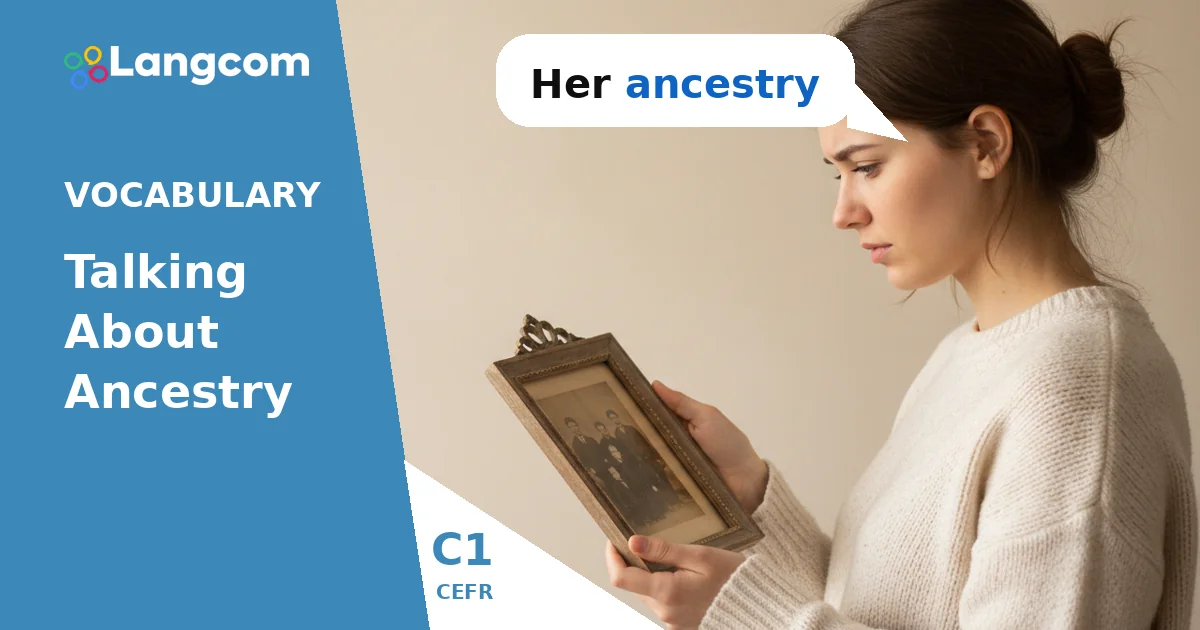
- Her ancestry can be traced back to Viking settlers in Scandinavia.
- My great-grandmother was a strong woman, and I hope I inherit some of her resilience.
- The family's heritage includes a beautiful old house and a tradition of storytelling.
- They decided to adopt a child from a different country.
- Sickle cell anemia is a hereditary disease common in certain populations.
- He took a DNA test to learn more about his ethnic background.
- Through genealogy, she discovered a distant relative who was a famous artist.
- The genetic makeup of each person is unique.
Práctica
¿Estás listo para obtener tu certificado?
El curso Langcom prepara a los alumnos para los exámenes de Cambridge, IELTS, TOEFL, DELE, SIELE y Michigan.
Empieza a utilizar LangcomErrores habituales de los hispanohablantes
Spanish speakers sometimes confuse similar-sounding words or the different forms of words when discussing ancestry and related topics:
- Hereditary vs. Heritage: Hereditary (adjective) describes something passed down through genes (e.g., a hereditary disease). Heritage (noun) refers to traditions, culture, or property passed down (e.g., cultural heritage). You cannot say *'my hereditary is rich'*. You should say 'my heritage is rich'.
- Ethnic vs. Ethnicity: Ethnic is an adjective (e.g., ethnic food, ethnic group). Ethnicity is a noun (e.g., What is your ethnicity?). Do not say *'I have a diverse ethnic'* when you mean 'I have a diverse ethnicity'.
- Uso de Adopt: Remember adopt is a verb. The child is adopted (past participle used as an adjective), and the parents are adoptive parents. Avoid saying *'my adopt parents'*; the correct form is 'my adoptive parents'.
Preguntas más frecuentes
What is the difference between 'ancestry' and 'genealogy'?
Ancestry refers to your line of ancestors, the people you are descended from. Genealogy is the study of that family history. So, ancestry is the subject, and genealogy is the process of researching it.
Can 'heritage' refer to genetic traits?
Sí, heritage can broadly include genetic traits, especially when discussing what is passed down through generations. However, hereditary is the more specific adjective for traits passed through genes.
How can I use this vocabulary in a C1 English exam?
This vocabulary is excellent for C1 writing tasks like essays or reports on social issues, personal identity, or historical topics. You can also use it in speaking tasks to discuss family background, cultural diversity, or ethical considerations related to adoption o genetic testing, demonstrating a wide range of sophisticated vocabulary.
Is 'ethnic' always used to describe people?
No, ethnic can describe things related to a particular cultural group, such as ethnic food, ethnic music, o ethnic clothing. It's not limited to describing people directly.



0 Comentarios