

What are Adjectives for Appearance?
Adjectives are words that describe nouns. Nouns are people, places, or things. Adjectives for appearance describe how a person looks.
For example, if you see a person, you can describe their age, their size, or if they are pretty or not.
🎓 Aprende inglés con el método mixto
Grupos reducidos · Tutor de IA disponible las 24 horas del día, los 7 días de la semana · Preparación para los exámenes de Cambridge
Planes de $39 $79 al mes
How to Use Adjectives in English
In English, adjectives usually go in two places:
- Before a noun: a tall man, a young girl.
- After the verb ‘to be’ (am, is, are): He is tall. She is young.
Adjectives for Age
We use these words to talk about how many years someone has lived.
- Young: Not old. A child or a teenager is often young.
- Old: Not young. A grandmother or grandfather is often old.
Examples:
- My brother is young.
- My grandmother is old.
Adjectives for Size and Body Shape
These words describe how big or small a person is, or their body type.
- Tall: Has a great height.
- Short: Does not have a great height.
- Thin: Not fat. Has a small body.
- Fat: Not thin. Has a large body.
Examples:
- The basketball player is tall.
- The baby is short.
- She is thin.
- He is fat.
Adjectives for General Looks
These words describe if someone is pleasant to look at.
- Good-looking: Attractive or beautiful.
- Ugly: Not good-looking.
Examples:
- My friend is very good-looking.
- That monster is ugly.
| Adjective | Opposite |
|---|---|
| young | old |
| tall | short |
| thin | fat |
| good-looking | ugly |
Ejemplos
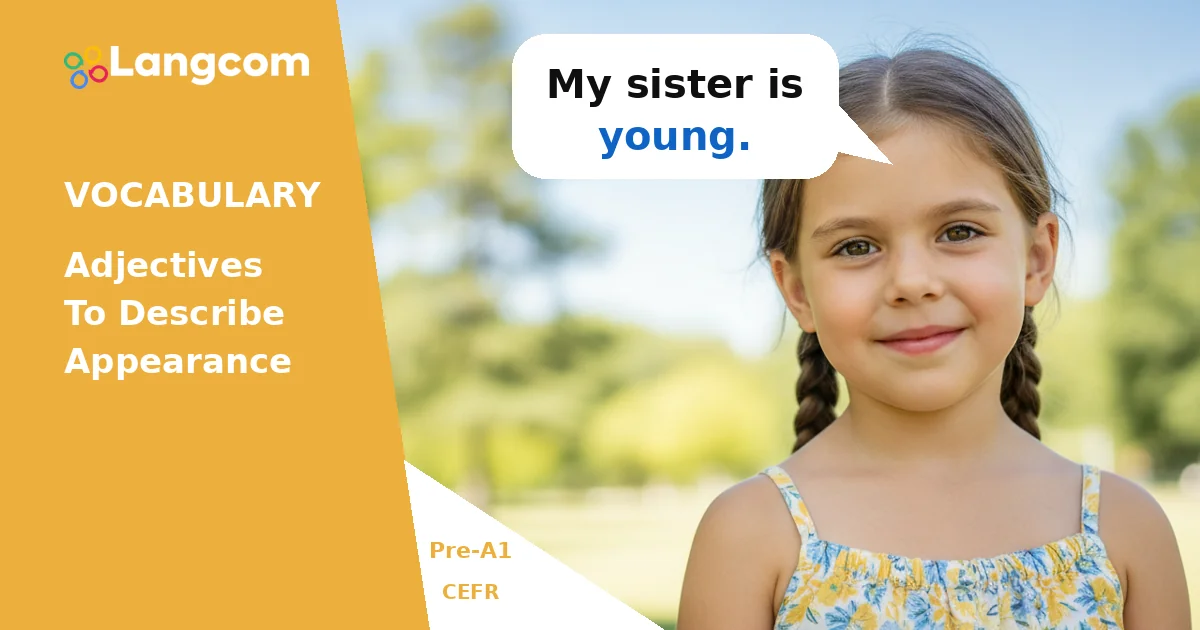
- My sister is young.
- My grandfather is old.
- The man is tall.
- The boy is short.
- She is a thin woman.
- He is a fat man.
- That actor is good-looking.
- The witch in the story is ugly.
Práctica
💬 ¿Necesitas asesoramiento personalizado?
Como centro autorizado de preparación para los exámenes de Cambridge, podemos orientarte para que elijas el curso y la certificación más adecuados. Habla hoy mismo con nuestros asesores.
Chatea con un asesor por WhatsAppErrores habituales de los hispanohablantes
A common mistake for Spanish speakers is the order of adjectives. In Spanish, adjectives often come after the noun. In English, they usually come before the noun or after the verb ‘to be’.
- Incorrecto: a man tall (like ‘un hombre alto’)
- Correcto: a tall man
- Correcto: The man is tall.
Preguntas más frecuentes
What is an adjective?
An adjective is a word that describes a noun (a person, place, or thing). For example, tall describes a person.
Where do adjectives go in an English sentence?
Adjectives usually go before a noun (e.g., a young girl) or after the verb ‘to be’ (e.g., She is young).
Can I use ‘beautiful’ for a man?
It’s more common to use good-looking o handsome for a man. Beautiful is usually for women or things.



0 Comentarios