

What Are Modal Verbs for Possibility and Probability?
Modal verbs help us talk about how certain we are about something. They show different levels of possibility, from very likely to very unlikely.
The main modal verbs for expressing possibility about specific events are may, might, y could.
- Utilizamos may (not), might (not), o could (but not could not for possibility) when we think something is possible, but we are not sure.
- For example: The train may be delayed due to the bad weather. o She might not come to the party tonight.
✍️ ¿No sabes en qué nivel estás?
Realiza nuestra prueba de nivel gratuita y recibe comentarios personalizados de examinadores certificados por Cambridge.
Realice nuestra prueba de nivel GRATUITAHow Do We Express Different Degrees of Possibility?
You can make your statements about possibility stronger or weaker by adding specific adverbs or using different phrases.
Strong Possibility
- Uso may well, might well, o could easily to show a strong possibility.
- Ejemplo: If you don't study, you could easily fail the exam.
- Ejemplo: The new policy may well lead to more job opportunities.
Remote Possibility
- To show a very small or remote possibility, use may possibly, might conceivably, o just might.
- Ejemplo: I just might have time to help you tomorrow, but it's unlikely.
- Ejemplo: My boss might conceivably agree to the proposal, but I wouldn't count on it.
When Do We Use 'Can' for Possibility?
The modal verb can is also used for possibility, but in a different way than may, might, o could.
- Utilizamos can to talk about general possibilities or things that are sometimes true. It refers to what is generally possible, not a specific event.
- Ejemplo: It can get very cold in winter here. (This means it's a general characteristic of winter in this place.)
- Compare this to: It might get cold tonight. (This refers to a specific possibility for tonight.)
- También utilizamos can't to express certainty that something is impossible.
- Ejemplo: That can't be true!
What Other Phrases Express Possibility and Probability?
Beyond modal verbs, there are many useful phrases to express different levels of possibility and probability.
For Possibility
- Uso It's (just/quite/very/entirely) possible that + clause.
- Ejemplo: It's entirely possible that we will finish the project ahead of schedule.
- Uso There's (a/some/a slight/every/a good/strong/real) possibility/chance that + clause o of + -ing verb.
- Ejemplo: There's a good chance that she'll get the promotion.
- Ejemplo: There's a slight possibility of rain later.
For Probability
- Uso is likely/unlikely to + infinitive o It's likely/unlikely that + clause.
- Ejemplo: He is unlikely to accept the offer.
- Ejemplo: It's likely that the meeting will be postponed.
- You can intensify these with highly o very: It's highly unlikely that they will agree.
How Do We Express Certainty and Impossibility?
When you are very sure about something, or sure that something is not true, you use different modals.
For Certainty (Deduction)
- Uso must when you are almost certain something is true based on evidence.
- Ejemplo: She's been working all day; she must be exhausted.
- Uso can't o couldn't when you are certain something is impossible.
- Ejemplo: He can't be serious!
- Ejemplo: That couldn't be true.
| Degree | Modal Verbs / Phrases | Ejemplo |
|---|---|---|
| General Possibility | can | Accidents can happen. |
| Remote Possibility | might conceivably, just might, It's just possible that | She just might agree. |
| Possibility | may, might, could, It's possible that | He may be late. |
| Strong Possibility | may well, might well, could easily, There's a good chance that | They may well win. |
| High Probability | is likely to, It's highly probable that | She's likely to succeed. |
| Certainty (Deduction) | must | You must be tired. |
| Certainty (Impossibility) | can't, couldn't | That can't be right. |
Ejemplos
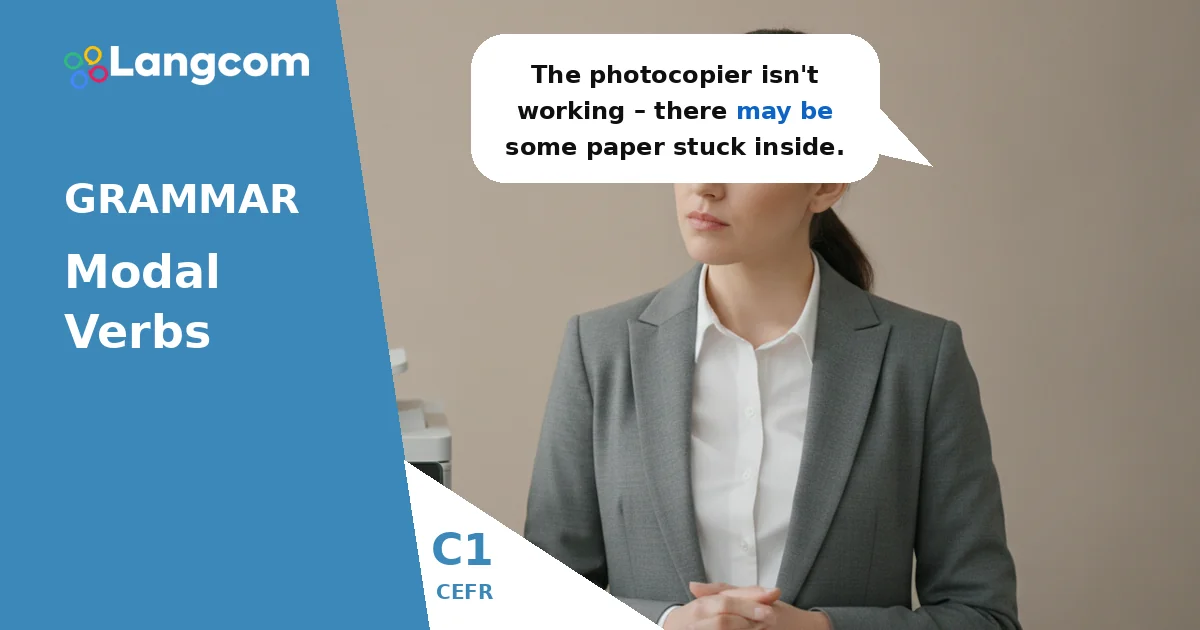
- The photocopier isn't working – there may be some paper stuck inside.
- It can rain heavily in this region in autumn.
- But it might rain this evening.
- Children can be very irritating.
- But you may find my children annoying when they make a lot of noise.
- The weather may well improve by the weekend.
- I'd better write it down; otherwise, I could easily forget.
- My boss could conceivably change her mind and decide to give me a pay increase.
- I just might have time to finish that report this week.
- It's just possible that we'll finish the project by March.
- There's every possibility that the business will expand next year.
- If you've had no joy applying for positions this way, it may well be more productive to start hunting for less visible vacancies instead.
- If you're answering ads for junior jobs in media, applying blind is highly unlikely to reap rewards.
- In the long run you might easily conclude that the most treasured aspect of your university experience wasn't your academic education or any careers advice, but rather the friends you made.
Práctica
¿Estás listo para obtener tu certificado?
El curso Langcom prepara a los alumnos para los exámenes de Cambridge, IELTS, TOEFL, DELE, SIELE y Michigan.
Empieza a utilizar LangcomErrores habituales de los hispanohablantes
Spanish speakers often make specific mistakes when expressing possibility and certainty in English, mainly due to direct translation from 'poder'.
- Confuso can y may/might: In Spanish, 'poder' can mean both general ability/possibility and specific possibility. In English, can is for general possibility or ability, while may/might/could are for specific possibilities.
- Incorrecto: It can rain tomorrow. (Unless you mean it's generally possible for it to rain, not a specific forecast.)
- Correcto: It might rain tomorrow. (For a specific event.)
- Uso de could not for possibility: Could not usually means impossibility or past inability, not simply 'not possible'.
- Incorrecto: She could not be at home now. (If you mean 'it's possible she's not at home.')
- Correcto: She may not be at home now. o She might not be at home now.
- Correct (for impossibility): She couldn't be at home; I just saw her at the office.
- Uso excesivo maybe: Aunque maybe is correct, C1 learners should use a wider range of expressions like perhaps, it's possible that, or modal verbs with adverbs to sound more natural and sophisticated.
Preguntas más frecuentes
What is the main difference between 'may' and 'might' for possibility?
Ambos may y might express possibility, and often they are interchangeable. However, might can sometimes suggest a slightly lower or more remote possibility than may. Por ejemplo, It may rain suggests a reasonable chance, while It might rain could imply a slightly less certain chance.
Can I use 'couldn't' to express possibility?
No, couldn't is typically used to express certainty that something is impossible or to talk about a past inability. To express that something is possibly not true, use may not o might not. Por ejemplo, He couldn't be the thief means 'it's impossible he's the thief', whereas He may not be the thief means 'it's possible he's not the thief'.
How can I make my predictions sound more certain in English?
To make predictions sound more certain, you can use phrases like will definitely, is bound to, is sure to, o must (for deductions based on strong evidence). For example, instead of It might be difficult, you could say It's bound to be difficult if you are very certain.
How are these modals tested in the C1 Advanced (CAE) exam?
In the C1 Advanced (CAE) exam, expressing possibility, probability, and certainty is often tested in the Use of English section, particularly in Part 4 (Key Word Transformations) where you might need to rephrase sentences using different modals or probability phrases. It's also crucial for your Writing and Speaking papers to demonstrate a sophisticated range of expressions for nuanced communication.



0 Comentarios